Wednesday of the Ninth Week in Ordinary Time


“Then sad at heart, I groaned and wept aloud. With sobs I began to pray: ...” (Tobit 3:1.)

Origen of Alexandria (part 2 of Pope Benedict’s reflections on Origen) comments on this verse from the First Reading proclaimed at Mass today:

“Regarding the second kind of prayer, see Daniel: “And Azarias standing up prayed in this manner and opening his mouth in the midst of the fire he said.” And Tobias: “And I began to pray with tears, saying, You are just, O Lord, and all your works are just and all your ways mercy and truth. And your judgments are true and just forever.” And since the passage in Daniel has been obelized on the ground that it is not found in the Hebrew text, and those of the circumcision reject the book of Tobias as not being canonical, I shall quote the words of Anna from the first book of Kings: “And she prayed the Lord, shedding many tears. And she made a vow, saying, O Lord of hosts, if you will look down on the affliction of your servant,” and so on. And in Habakkuk: “A prayer of Habakkuk the prophet with song. O Lord, I have heard your voice and was afraid. O Lord, I reflected on your works and was astonished. In the midst of two animals you will be known; in the approach of the years you will be recognized.” The example just given illustrates very well the definition of prayer inasmuch as he who offers it unites it with praise of God. And again, in the book of Jonah: “Jonah prayed to the Lord his God out of the belly of the fish. And he said, I cried out of my affliction to the Lord my God, and he heard me. Out of the belly of hell you heard the screams of my voice. And you have thrown me into the deep in the heart of the sea, and a flood has surrounded me.” (On Prayer, 14.)


Collect
O God,
Whose providence never fails in its design,
keep from us, we humbly beseech You,
all that might harm us
and grant all that works for our good.
Through our Lord Jesus Christ, Your Son,
Who lives and reigns with You
in the unity of the Holy Spirit,
God, for ever and ever. Amen.


Glory to the Father
and to the Son
and to the Holy Spirit:
as it was in the beginning,
is now, and will be forever. Amen




True doctrine dispels arrogance


Bishop of Rome and Great Western Father of the Church

An excerpt from his Moral Reflections on Job, Book 23-24.

Wednesday of the Ninth Week in Ordinary Time

Listen, Job, to what I say and ponder all my words. The teaching of the arrogant has this characteristic: they do not know how to introduce their teaching humbly and they cannot convey correctly to others the things they understand correctly themselves. With their words they betray what they teach; they give the impression that they live on lofty heights from which they look down disdainfully on those whom they are teaching; they regard the latter as inferiors, to whom they do not deign to listen as they talk; indeed they scarcely deign to talk to them at all—they simply lay down the law.

To teachers of this kind the Lord through the prophet says rightly: But you will rule them with severity and with power. There is no doubt that such as are prone not to correct their subjects with quiet reasoning, but to compel them to change by rough and domineering methods, rule with severity and power.

On the contrary true doctrine all the more effectively shuns the voice of arrogance through reflection, in which it pursues the arrogant teacher himself with the arrows of its words. It ensures that the pride which it attacks in the hearts of those listening to the sacred words will not in fact be preached by arrogant conduct. For true doctrine tries both to teach by words and to demonstrate by living example—humility, which is the mother and mistress of virtues. Its goal is to express humility among the disciples of truth more by deeds than by words.

Accordingly, when addressing the Thessalonians, Paul is oblivious of his own eminent dignity as an apostle; he actually says: We became as little children in your midst. Similarly, the apostle Peter enjoins: Be always prepared to satisfy everybody who asks a reason for the hope which is in you, and by adding the words, with a good conscience, speak gently and respectfully, Peter draws attention to the manner in which sacred doctrine should be taught.

When he tells his disciples: These things command and teach with all power, Paul really recommends the credibility that goes hand in hand with good behavior rather than the domineering exercise of power. When one practices first and preaches afterwards, one is really teaching with power. Doctrine loses credibility, if conscience tethers the tongue. Paul, therefore, in the saying quoted above, does not refer to the power of lofty rhetoric but to the confidence elicited by good deeds. Of the Lord, too, it is said: He taught with authority unlike the Scribes and the Pharisees. He alone in a unique and sovereign way spoke from the power of his goodness because no evil weakness led him into sin. For he had from the power of his own divine nature what he gave to us through the sinlessness of his human nature.


Glory to the Father
and to the Son
and to the Holy Spirit:
as it was in the beginning,
is now, and will be forever. Amen


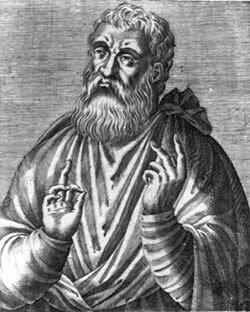
Saint Justin of Rome, Martyr


“They came and said to him, “Teacher, we know that you are a truthful man and that you are not concerned with anyone’s opinion. You do not regard a person’s status but teach the way of God in accordance with the truth. Is it lawful to pay the census tax to Caesar or not? Should we pay or should we not pay?” (Mark 12:14.)

Saint Justin of Rome comments on this verse from the Gospel proclaimed at Mass today:

“So we worship God only, but in temporal matters we gladly serve you, recognizing you as emperors and rulers, and praying that along with your imperial power you may also be found to have a sound mind. Suppose you pay no attention to our prayers and our frank statements about everything. That will not injure us, since we believe, and are convinced without doubt, that everyone will finally experience the restraint of divine judgment in relation to their voluntary actions. Each will be required to give account for the responsibilities which he has been given by God” (First Apology, 17.)


Collect
O God, Who through the folly of the Cross
wondrously taught Saint Justin the Martyr
the surpassing knowledge of Jesus Christ,
grant us, through his intercession,
that, having rejected deception and error,
we may become steadfast in the faith.
Through our Lord Jesus Christ, Your Son,
Who lives and reigns with You in the
unity of the Holy Spirit,
God, for ever and ever.


Glory to the Father
and to the Son
and to the Holy Spirit:
as it was in the beginning,
is now, and will be forever. Amen


Top


I have accepted the true doctrines of the Christians


Martyr and Apologist

An excerpt from his First Apology in the Defense of Christians

Memorial: Saint Justin of Rome, Martyr

The saints were seized and brought before the prefect of Rome, whose name was Rusticus. As they stood before the judgement seat, Rusticus the prefect said to Justin: “Above all, have faith in the gods and obey the emperors.” Justin said: “We cannot be accused or condemned for obeying the commands of our Savior, Jesus Christ.”

Rusticus said: “What system of teaching do you profess?” Justin said: “I have tried to learn about every system, but I have accepted the true doctrines of the Christians, though these are not approved by those who are held fast by error.”

The prefect Rusticus said: “Are those doctrines approved by you, wretch that you are?” Justin said: “Yes, for I follow them with their correct teaching.”

The prefect Rusticus said: “What sort of teaching is that?” Justin said: “Worship the God of the Christians. We hold him to be from the beginning the one creator and maker of the whole creation, of things seen and things unseen. We worship also the Lord Jesus Christ, the Son of God. He was foretold by the prophets as the future herald of salvation for the human race and the teacher of distinguished disciples. For myself, since I am a human being, I consider that what I say is insignificant in comparison with his infinite godhead. I acknowledge the existence of a prophetic power, for the one I have just spoken of as the Son of God was the subject of prophecy. I know that the prophets were inspired from above when they spoke of his coming among men.”

Rusticus said: “You are a Christian, then?” Justin said: “Yes, I am a Christian.”

The prefect said to Justin: “You are called a learned man and think that you know what is true teaching. Listen: if you were scourged and beheaded, are you convinced that you would go up to heaven?” Justin said: “I hope that I shall enter God’s house if I suffer that way. For I know that God’s favor is stored up until the end of the whole world for all who have lived good lives.”

The prefect Rusticus said: “Do you have an idea that you will go up to heaven to receive some suitable rewards?” Justin said: “It is not an idea that I have; it is something I know well and hold to be most certain.”

The prefect Rusticus said: “Now let us come to the point at issue, which is necessary and urgent. Gather round then and with one accord offer sacrifice to the gods.” Justin said: “No one who is right thinking stoops from true worship to false worship.”

The prefect Rusticus said: “If you do not do as you are commanded you will be tortured without mercy.” Justin said: “We hope to suffer torment for the sake of our Lord Jesus Christ, and so be saved. For this will bring us salvation and confidence as we stand before the more terrible and universal judgment-seat of our Lord and Savior.”

In the same way the other martyrs also said: “Do what you will. We are Christians; we do not offer sacrifice to idols.”

The prefect Rusticus pronounced sentence, saying: “Let those who have refused to sacrifice to the gods and to obey the command of the emperor be scourged and led away to suffer capital punishment according to the ruling of the laws.” Glorifying God, the holy martyrs went out to the accustomed place. They were beheaded, and so fulfilled their witness of martyrdom in confessing their faith in their Savior.


Glory to the Father
and to the Son
and to the Holy Spirit:
as it was in the beginning,
is now, and will be forever. Amen


Feast of the Visitation of the Blessed Virgin Mary


“The LORD has removed the judgment against you, he has turned away your enemies; The King of Israel, the LORD, is in your midst, you have no further misfortune to fear.” (Zephaniah 3:15.)

Saint Cyril of Jerusalem comments on this verse from the First Reading proclaimed at Mass today:

“Take heart, O Jerusalem, the Lord will take away your iniquities. The Lord will wash away the filth of his sons and daughters by the spirit of judgment and the spirit of burning. He will pour upon you clean water, and you shall be cleansed from all your sins. Choiring angels shall encircle you, chanting, “Who is it that comes up all white and leaning upon her beloved?” For the soul that was formerly a slave has now accounted its Lord as its kinsman, and he, acknowledging its sincere purpose, will answer, “Ah, you are beautiful, my beloved, ah, you are beautiful — your teeth are like a flock of ewes to be shorn” — a sincere confession is a spiritual shearing. And further: “all of them big with twins,” signifying the twofold grace, either that perfected by water and the Spirit or that announced in the Old and in the New Testament. God grant that all of you, your course of fasting finished, mindful of the teaching, fruitful in good works, standing blameless before the spiritual bridegroom, may obtain the remission of your sins from God, in Christ Jesus our Lord, to whom be the glory forever and ever.” (Catechetical Lecture, 3.)


Collect
Almighty, ever-living God,
Who, while the Blessed Virgin Mary
was carrying Your Son in her womb,
inspired her to visit Elizabeth,
grant us, we pray, that,
faithful to the promptings of the Spirit,
we may magnify Your greatness
with the Virgin Mary at all times.
Through our Lord Jesus Christ, Your Son,
Who lives and reigns with You
in the unity of the Holy Spirit,
God, for ever and ever.


Glory to the Father
and to the Son
and to the Holy Spirit:
as it was in the beginning,
is now, and will be forever. Amen


Top


Mary proclaims the greatness of the Lord working in her


Priest and Doctor of the Church

An excerpt from a Homily, Book 1

Feast of the Visitation of the Blessed Virgin Mary

My soul proclaims the greatness of the Lord, and my spirit rejoices in God my savior. With these words Mary first acknowledges the special gifts she has been given. Then she recalls God’s universal favors, bestowed unceasingly on the human race.

When a man devotes all his thoughts to the praise and service of the Lord, he proclaims God’s greatness. His observance of God’s commands, moreover, shows that he has God’s power and greatness always at heart. His spirit rejoices in God his savior and delights in the mere recollection of his creator who gives him hope for eternal salvation.

These words are often for all God’s creations, but especially for the Mother of God. She alone was chosen, and she burned with spiritual love for the son she so joyously conceived. Above all other saints, she alone could truly rejoice in Jesus, her savior, for she knew that he who was the source of eternal salvation would be born in time in her body, in one person both her own son and her Lord.

For the Almighty has done great things for me, and holy is his name. Mary attributes nothing to her own merits. She refers all her greatness to the gift of the one whose essence is power and whose nature is greatness, for he fills with greatness and strength the small and the weak who believe in him.

She did well to add: and holy is his name, to warn those who heard, and indeed all who would receive his words, that they must believe and call upon his name. For they too could share in everlasting holiness and true salvation according to the words of the prophet: and it will come to pass, that everyone who calls on the name of the Lord will be saved. This is the name she spoke of earlier: and my spirit rejoices in God my savior.

Therefore it is an excellent and fruitful custom of holy Church that we should sing Mary’s hymn at the time of evening prayer. By meditating upon the incarnation, our devotion is kindled, and by remembering the example of God’s Mother, we are encouraged to lead a life of virtue. Such virtues are best achieved in the evening. We are weary after the day’s work and worn out by our distractions. The time for rest is near, and our minds are ready for contemplation.


Glory to the Father
and to the Son
and to the Holy Spirit:
as it was in the beginning,
is now, and will be forever. Amen


Light, radiance and grace are in the Trinity and from the Trinity


Bishop and Great Eastern Father of the Church

An excerpt from First Letter to Serapion

The Solemnity of the Most Holy Trinity

It will not be out of place to consider the ancient tradition, teaching and faith of the Catholic Church, which was revealed by the Lord, proclaimed by the apostles and guarded by the fathers. For upon this faith the Church is built, and if anyone were to lapse from it, he would no longer be a Christian either in fact or in name.

We acknowledge the Trinity, holy and perfect, to consist of the Father, the Son and the Holy Spirit. In this Trinity there is no intrusion of any alien element or of anything from outside, nor is the Trinity a blend of creative and created being. It is a wholly creative and energizing reality, self-consistent and undivided in its active power, for the Father makes all things through the Word and in the Holy Spirit, and in this way the unity of the holy Trinity is preserved. Accordingly, in the Church, one God is preached, one God who is above all things and through all things and in all things. God is above all things as Father, for he is principle and source; he is through all things through the Word; and he is in all things in the Holy Spirit.

Writing to the Corinthians about spiritual matters, Paul traces all reality back to one God, the Father, saying: Now there are varieties of gifts, but the same Spirit; and varieties of service, but the same Lord; and there are varieties of working, but it is the same God who inspires them all in everyone.

Even the gifts that the Spirit dispenses to individuals are given by the Father through the Word. For all that belongs to the Father belongs also to the Son, and so the graces given by the Son in the Spirit are true gifts of the Father. Similarly, when the Spirit dwells in us, the Word who bestows the Spirit is in us too, and the Father is present in the Word. This is the meaning of the text: My Father and I will come to him and make our home with him. For where the light is, there also is the radiance; and where the radiance is, there too are its power and its resplendent grace.

This is also Paul’s teaching in his second letter to the Corinthians: The grace of our Lord Jesus Christ and the love of God and the fellowship of the Holy Spirit be with you all. For grace and the gift of the Trinity are given by the Father through the Son in the Holy Spirit. Just as grace is given from the Father through the Son, so there could be no communication of the gift to us except in the Holy Spirit. But when we share in the Spirit, we possess the love of the Father, the grace of the Son and the fellowship of the Spirit himself.


Glory to the Father
and to the Son
and to the Holy Spirit:
as it was in the beginning,
is now, and will be forever. Amen


Saturday of the Eighth Week in Ordinary Time


“... and said to him, “By what authority are you doing these things? Or who gave you this authority to do them?”” (Mark , 11:28.)

Saint Augustine of Hippo comments on this verse from the Gospel proclaimed at Mass today:

“Fearing a stoning, but fearing more an admission of the truth, they answered the truth with a lie, reminiscent of the Scripture: “injustice has lied within herself.”1 For they said, “We know not.” And because they had shut themselves up against him, by asserting that they did not know what they knew, the Lord did not open up to them because they did not knock. For it has been said, “Knock and it will be opened to you.”2 But they not only had not knocked that it might be opened, but by their denial they barricaded the door itself against themselves. And the Lord said to them, “Neither do I tell you by what authority I do these things.”” (Tractate on John, , 2.)


Collect
Grant us, O Lord, we pray,
that the course of our world
may be directed by Your peaceful rule
and that Your Church may rejoice,
untroubled in her devotion.
Through our Lord Jesus Christ, Your Son,
Who lives and reigns with You
in the unity of the Holy Spirit,
God, for ever and ever. Amen.


Glory to the Father
and to the Son
and to the Holy Spirit:
as it was in the beginning,
is now, and will be forever. Amen


Job was a type of Christ


(Bishop)

An excerpt from Sermon 15

Saturday of the Eighth Week in Ordinary Time

Is Job a type of Christ? If I am right, he is, and the comparison will reveal the truth of my claim. But while Job was called a just man by God, God himself is the fountain of justice from whom all the saints drink. See what Scripture says: The sun of justice will arise for you. Job was called truthful, but the Lord is, as he says in the Gospel, the way, the truth and the life. And while Job was rich, the Lord is far richer, for the earth is the Lord’s and everything in it; the world and all who dwell in it. All rich men are his servants, and the whole world and all of nature as well.

But we may compare Job and Christ in many ways. As Job was tempted by the devil three times, so too Christ was tempted three times. The Lord set aside his riches out of love for us and chose poverty so that we might become rich, while Job lost all that he possessed. A violent wind killed Job’s sons, while the sons of God, the prophets, were killed by the fury of the Pharisees. Job became ulcerated and disfigured, while the Lord, by becoming man, took on the defilement of the sins committed by all mankind. The wife of Job tempted him to sin, much as the synagogue tried to force the Lord to yield to corrupt leadership. Thus he was insulted by the priests, the servants of his altar, as Job was insulted by his friends. And as Job sat on a dunghill of worms, so all the evil of the world is really a dunghill which became the Lord’s dwelling place, while men that abound in every sort of crime and base desire are really worms.

The restoration of health and riches to Job prefigures the resurrection, which gives health and eternal life to those who believe in Christ. Regaining lordship over all the world, Christ says: All things have been given to me by my Father. And just as Job fathered other sons, so too did Christ, for the apostles, the sons of the Lord, succeeded the prophets.

Job died happily and in peace, but there is no death for the Lord. He is praised for ever, just as he was before time began, and as he always will be as time continues and moves into eternity.


Glory to the Father
and to the Son
and to the Holy Spirit:
as it was in the beginning,
is now, and will be forever. Amen


Friday of the Eighth Week in Ordinary Time


“Seeing from a distance a fig tree in leaf, he went over to see if he could find anything on it. When he reached it he found nothing but leaves; it was not the time for figs.” (Mark , 11:13.)

Saint Augustine of Hippo comments on this verse from the Gospel proclaimed at Mass today:

“Some who witnessed Christ’s miracles did not understand what they meant, and how they spoke to those who knew they had special meaning. They wondered only at the miracles themselves. Others both marvelled at the miracles, and attained some preliminary understanding of them. For this we must come to the school of Christ himself. Those fixed only upon the plain sense of Scripture tend to focus merely upon miracle for miracles’ sake. Hence they may prematurely conclude that Jesus himself was ignorant of the time of the year, something any ordinary farmer could discern. For it was not yet the season for the tree to bear fruit. Nevertheless, since he was hungry, he looked for fruit on the tree. Does this imply that Christ knew less than what every peasant could easily discern? Surely not. Wouldn’t you expect the maker of the fig tree to know what the ordinary orchard worker would know in a snap? So when he was hungry he looked for fruit on the tree, but he seemed to be looking for something more from this tree. He noted that the tree had no fruit, but was full of leaves. It was at that point that he cursed it, and it withered away. So what terrible thing had the poor tree done simply in not bearing fruit? Could the tree reasonably be faulted for its fruitlessness? No. But human beings who by their own free will decide not to bear fruit—that is a different matter. Those found wanting in accountability in this case are those who had the benefit of the law, which was meant to bear fruit, but they had no fruit to show for it. They had a full growth of leaves (the law), yet they bore no fruit (works of mercy).” (Sermons on New Testamnet Lessions, 48.)


Collect
Grant us, O Lord, we pray,
that the course of our world
may be directed by Your peaceful rule
and that Your Church may rejoice,
untroubled in her devotion.
Through our Lord Jesus Christ, Your Son,
Who lives and reigns with You
in the unity of the Holy Spirit,
God, for ever and ever. Amen.


Glory to the Father
and to the Son
and to the Holy Spirit:
as it was in the beginning,
is now, and will be forever. Amen


The Interior Witness


Bishop of Rome and Great Western Father of the Church

An excerpt from his Moral Reflections on Job, Book 10.

Friday of the Eighth Week in Ordinary Time

Whoever is mocked by his friend, as I am, shall call upon God, and he shall hear him. A weak-minded person is frequently diverted toward pursuing exterior happiness when the breath of popular favor accompanies his good actions. So he gives up his own personal choices, preferring to remain at the mercy of whatever he hears from others. Thus, he rejoices not so much to become but to be called blessed. Eager for praise, he gives up what he had begun to be; and so he is severed from God by the very means by which he appeared to be commendable in God.

But sometimes a soul firmly strives for righteousness and yet is beset by men’s ridicule. He does what is admirable but he gets only mockery. He might have gone out of himself because of man’s praise; he returns to himself when repelled buy their abuse. Finding no resting-place without, he cleaves more intensely to God within. All his hope is fixed on his Creator, and amid all the ridicule and abuse he invokes his interior witness alone. One who is afflicted in this way grows closer to God the more he turns away from human popularity. He straightway pours himself out in prayer, and, pressured from without, he is refined with a more perfect purity to penetrate what is within.

In this context, the words apply: Whoever is mocked by his friend, as I am, shall call upon God, and he shall hear him. For while the wicked reproach the just, they show them whom they should look to as the witness of their actions. Thus afflicted, the soul strengthens itself by prayer; it is united within to one who listens from on high precisely because it is cut off externally from the praise of men. Again, we should note how appropriately the words, are inserted, as I am. There are some people who are both oppressed by human mockery and are yet deprived of God's favorable hearing. For when the mockery is done to a man’s own sin, it obviously does not produce the merit that is due to virtue.

The simplicity of the just man is laughed to scorn. It is the wisdom of this world to conceal the heart with stratagems, to veil one’s thoughts with words to make what is false appear true and what is true appear false. On the other hand it is the wisdom of the just never to pretend anything for show, always to use words to express one’s thoughts, to love the truth as it is and to avoid what is false, to do what is right without reward and to be more willing to put up with evil than to perpetrate it, not to seek revenge for wrong, and to consider as gain any insult for truth’s sake. But this guilelessness is laughed to scorn, for the virtue of innocence is held as foolishness by the wise of this world. Anything that is done out of innocence, they doubtless consider to be stupidity, and whatever truth approves of, in practice is called folly by their worldly wisdom.

Glory to the Father
and to the Son
and to the Holy Spirit:
as it was in the beginning,
is now, and will be forever. Amen


Memorial of Saint Philip Neri, Priest


“... Jesus said to them, “You do not know what you are asking....” (Mark 10:38.)

In commenting on these verses from today’s Gospel proclamation, Saint John Chrysostom writes:

“They were expecting him to enter into [the kingdom], but not to go to the cross and death. Even though they had heard it ten thousand times, they could not clearly understand. Since they had not gotten a clear and certain knowledge of his teachings, they thought that he was going to this visible kingdom and would rule in Jerusalem. So the sons of Zebedee caught up with him on the road. They thought they had found the opportune moment. They put their request to him. They had broken away from the throng of the disciples and, just as if the whole situation had turned out exactly as they wanted, they asked about the privilege of the first seats and about being first among the others.9 They asked for this because they assumed that everything was finished and the whole business was over and done with. They made their request because they thought that now was the time for crowns and rewards.

Do you see? They did not understand what they were asking for when they were talking to him about crowns and rewards and the privilege of the first seats and honors even before the contest had begun. Christ was communicating with them on two levels when he said: “You do not know what you are asking for.”14 One was that they were talking about an earthly kingdom and he had said nothing about this. There had been no announcement or promise about a visible kingdom on earth. The other was that, when they sought at this time the privilege of the first seats and the honors of heaven, when they wished to be seen as more illustrious and splendid than the others, they were not asking for these things at the right time. The timing was precisely wrong. For this was not the right time for crowns or prizes. It was the time for struggles, contests, toils, sweat, wrestling rings and battles.” (On the Incomprehensible Nature of God, 8.)


Collect
O God,
Who never cease to bestow the glory
of holiness on the faithful servants
You raise up for Yourself,
graciously grant that the Holy Spirit
may kindle in us that fire
with which He wonderfully filled
the heart of saint Philip Neri.
Through our Lord Jesus Christ, your Son,
Who lives and reigns with You
in the unity of the Holy Spirit,
God, for ever and ever. Amen.


Glory to the Father
and to the Son
and to the Holy Spirit:
as it was in the beginning,
is now, and will be forever. Amen


Rejoice in the Lord always


Bishop and Great Western Father of the Church

An excerpt from his Sermon 171

Memorial of Saint Philip Neri, Priest

The Apostle tells us to rejoice, but in the Lord, not in the world. Whoever wishes to be a friend of this world, says Scripture, will be reckoned an enemy of God. As a man cannot serve two masters, so one cannot rejoice both in the world and in the Lord.

Let joy in the Lord prevail, then, until joy in the world is no more. Let joy in the Lord go on increasing; let joy in the world go on decreasing until it is no more. This is said, not because we are not to rejoice while we are in this world, but in order that, even while we are still in this world, we may already rejoice in the Lord.

You may object: I am in the world; if I rejoice I certainly rejoice where I am. What is this? Do you mean that because you are in the world you are not in the Lord? Listen again to the Apostle, speaking now to the Athenians: in the Acts of the Apostles he says this is of God and the Lord our creator: In him we live and move and have our being. If he is everywhere, where is he not? Surely this was what he was exhorting us to realize. The Lord is near, do not be anxious about anything.

This is a great truth, that he ascended above all the heavens, yet is near to those on earth. Who is this stranger and neighbor if not the one who became our neighbor out of compassion?

The man lying on the road, left half-dead by robbers, the man treated with contempt by the priest and the levite who passed by, the man approached by the passing Samaritan to take care of him and help him, that man is the whole human race. When the immortal one, the holy one, was far removed from us because we were mortal and sinners, he came down to us, so that he, the stranger, might become our neighbor.

He did not treat us as our sins deserved. For we are now sons of God. How do we show this? The only Son of God died for us, so that he might not remain alone. He who died as the only Son did not want to remain as the only Son. For the only Son of God made many sons of God. He bought brothers for himself by his blood; he made them welcome by being rejected; he ransomed them by being sold; he honored them by being dishonored; he gave them life by being put to death.

So, brethren, rejoice in the Lord, not in the world. That is, rejoice in the truth, not in wickedness; rejoice in the hope of eternity, not in the fading flower of vanity. That is the way to rejoice. Wherever you are on earth, however long you remain on earth, the Lord is near, do not be anxious about anything.

Glory to the Father
and to the Son
and to the Holy Spirit:
as it was in the beginning,
is now, and will be forever. Amen


Tuesday of the Eighth Week in Ordinary Time


“Jesus said, “Amen, I say to you, there is no one who has given up house or brothers or sisters or mother or father or children or lands for my sake and for the sake of the gospel ...” (Mark 10:29.)


Saint Clement of Alexandria offers the following insight on this verse from today’s Gosepl Proclamation:

“Do not let this passage trouble you. Put it side by side with the still harder saying Jesus delivered in another place in the words, “Whoever hates not father, and mother, and children, and his own life besides, cannot be my disciple.” Note that the God of peace, who exhorts us to love our enemies, does not arbitrarily require us literally to hate or abandon those dearest to us. But if we are to love our enemies, it must be in accordance with right reason that, by analogy we should also love our nearest relatives. But insofar as one’s father, or son, or brother, becomes for you a hindrance to faith or an impediment to godly life, one should then not collude with that temptation. Attend to the spiritual, rather than the fleshly, meaning of the command. (Salvation of the Rich Man, 22.)


Collect
Grant us, O Lord, we pray,
that the course of our world
may be directed by Your peaceful rule and
that Your Church may rejoice,
untroubled in her devotion.
Through our Lord Jesus Christ, Your Son
Who lives and reigns with You
in the unity of the Holy Spirit,
God, for ever and ever.


Glory to the Father
and to the Son
and to the Holy Spirit:
as it was in the beginning,
is now, and will be forever. Amen


Whoever I may be, Lord, I lie exposed to your scrutiny


Bishop and Great Western Father of the Church

An excerpt from a The Confessions, 

Tuesday of the Eighth Week in Ordinary Time

Lord, you know me. Let me know you. Let me come to know you even as I am known. You are the strength of my soul; enter it and make it a place suitable for your dwelling, a possession without spot or blemish. This is my hope and the reason I speak. In this hope I rejoice, when I rejoice rightly. As for the other things of this life, the less they deserve tears, the more likely will they be lamented; and the more they deserve tears, the less likely will men sorrow for them. For behold, you have loved the truth, because the one who does what is true enters into the light. I wish to do this truth before you alone by praising you, and before a multitude of witnesses by writing of you.

O Lord, the depths of a man’s conscience lie exposed before your eyes. Could anything remain hidden in me, even though I did not want to confess it to you? In that case I would only be hiding you from myself, not myself from you. But now my sighs are sufficient evidence that I am displeased with myself; that you are my light and the source of my joy; that you are loved and desired. I am thoroughly ashamed of myself; I have renounced myself and chosen you, recognizing that I can please neither you nor myself unless you enable me to do so.

Whoever I may be, Lord, I lie exposed to your scrutiny. I have already told of the profit I gain when I confess to you. And I do not make my confession with bodily words, bodily speech, but with the words of my soul and the cry of my mind which you hear and understand. When I am wicked, my confession to you is an expression of displeasure with myself. But when I do good, it consists in not attributing this goodness to myself. For you, O Lord, bless the just man, but first you justify the wicked. And so I make my confession before you in silence, and yet not in silence. My voice is silent but my heart cries out.

You, O Lord, are my judge. For though no one knows a man’s innermost self except the man’s own spirit within him, yet there is something in a man which even his own spirit does not know. But you know all of him, for you have made him. As for me, I despise myself in your sight, knowing that I am but dust and ashes; yet I know something of you that I do not know of myself.

True, we see now indistinctly as in a mirror, but not yet face to face. Therefore, so long as I am in exile from you, I am more present to myself than to you. Yet I do know that you cannot be overcome, while I am uncertain which temptations I can resist and which I cannot. Nevertheless, I have hope, because you are faithful and do not allow us to be tempted beyond our endurance, but along with the temptation you give us the means to withstand it.

I will confess, therefore, what I know of myself, and also what I do not know. The knowledge that I have of myself, I possess because you have enlightened me; while the knowledge of myself that I do not yet possess will not be mine until my darkness shall be made as the noonday sun before your face.


Glory to the Father
and to the Son
and to the Holy Spirit:
as it was in the beginning,
is now, and will be forever. Amen


Memorial of the Blessed Virgin Mary, Mother of the Church


“All these devoted themselves with one accord to prayer, together with some women, and Mary the mother of Jesus, and his brothers...” (Acts 1:14.)

Arator comments on this verse from the First Reading proclaimed during today’s Mass:

“They sought by a swift path, with which it was possible to go a mile on their sabbath, the well-known walls where Mary, the gateway of God, the virgin mother of her Creator, formed by her own son, was sitting at a religious gathering. The second virgin put to flight the woes of Eve’s crime; there is no harm done to the sex; she restored what the first took away. Let grief not raise up complaints or vex mourning hearts with groaning over the old law; these very forms of wickedness and crime rather cause delight at this bargain, and a better lot comes to the redeemed world from the fall. The person, not the nature [of a woman], caused ruin; in those days [of Eve] a pregnant woman [brought forth] peril. In these [of Mary] one grew great to bring forth God, the one begetting mortal things and the other bearing divine—she through whom the Mediator came forth into the world and carried actual flesh to the heavens.” (On the Acts of the Apostles, 1.)


Collect
O God, Father of mercies,
Whose Only Begotten Son,
as He hung upon the Cross,
chose the Blessed Virgin Mary, His Mother,
to be our Mother also,
grant, we pray, that with her loving help
your Church may be more fruitful day by day
and, exulting in the holiness of her children,
may draw to her embrace
all the families of the peoples.
Through our Lord Jesus Christ, Your Son
Who lives and reigns with You
in the unity of the Holy Spirit,
God, for ever and ever. Amen.


Glory to the Father
and to the Son
and to the Holy Spirit:
as it was in the beginning,
is now, and will be forever. Amen


Mary’s motherhood in the order of grace


Second Vatican Council

An excerpt from Lumen Gentium, 61-62.

Memorial of the Blessed Virgin Mary, Mother of the Church

The Blessed Virgin was predestined to be the Mother of God in the eternal plan for the incarnation of God’s Word. By decree of God’s providence she was, here on earth, the loving mother of the divine Redeemer, the noblest of all his companions, and the humble servant of the Lord. In conceiving Christ, in bearing him, in nursing him, in presenting him to the Father in the temple, in sharing her Son’s passion as he was dying on the cross, by her obedience, her faith, her hope and burning love, she cooperated, in a way that was quite unique, in the work of the Savior in restoring supernatural life to souls. She is therefore a mother to us in the order of grace.

This motherhood of Mary in the order of grace — from the consent which she gave in faith at the annunciation, and which she continued to give unhesitatingly at the foot of the cross — lasts without interruption until all the elect enter into eternal fulfillment. When she was taken up into heaven, she did not lay aside this saving role but she continues by her intercession for all to gain for us the gifts of eternal salvation.

In her maternal love she cares for the brothers and sisters of her Son as they journey on earth in the midst of dangers and hardships, until they are brought safely home to the happiness of heaven.

The Blessed Virgin is thus invoked in the Church under the titles of Advocate, Auxiliatrix, Adjutrix and Mediatrix. These titles must not, however, be understood as in any way detracting from, or adding to, the dignity and effectiveness of Christ, the one Mediator.

No creature can ever be classed as an equal with the incarnate Word, the Redeemer. But just as the priesthood of Christ is shared in various ways by his ministers and his faithful people, and as the goodness of God, one though it is, is, in different ways, really shared with creatures, so also the unique meditation of Christ does not exclude but brings about a variety of shared cooperation, deriving from the one unique source.

The Church does not hesitate to acknowledge this kind of subordinate role in the person of Mary. The Church has continuous experience of its effects, and commends it to the hearts of the faithful, so that as they lean on her motherly protection they may be brought into closer union with the Mediator, our Savior.


Glory to the Father
and to the Son
and to the Holy Spirit:
as it was in the beginning,
is now, and will be forever. Amen


Pentecost Sunday
(At the Mass during the Day)


“I have much more to tell you, but you cannot bear it now...” (John 16:12)

Saint Augustine of Hippo comments on this verse from the Gospel proclaimed during today’s Mass:

“Now, however, you are perhaps wishing to know what those things were that the apostles were then unable to bear. But which of us would venture to assert his own present capacity for what they lacked in ability to receive? And this is why you are neither to expect me to tell you things that perhaps I could not comprehend myself were they told me by another; nor would you be able to bear them even if I were talented enough to let you hear of things that are above your comprehension. It may be, indeed, that some among you are fit enough already to comprehend things that are still beyond the grasp of others. But what they were that he himself thus omitted to tell, it would be rash to have even the wish to presume to say. Therefore, one may say that Christian people, even when desiring to hear, ought not to be told what those things are of which the Lord said here. If the apostles were still unable, much more so are you. For surely if we had read any such thing in the books confirmed by canonical authority, which were written after our Lord’s ascension, it would not have been enough to have read such a statement, had we not also read in the same place that this was actually one of those things that the Lord was then unwilling to tell his disciples because they were unable to bear them.” (Tractates on the Gospel of John, 96.)


Collect
O God,
Who by the mystery of today’s great feast
sanctify Your whole Church
in every people and nation,
pour out, we pray,
the gifts of the Holy Spirit
across the face of the earth and,
with the divine grace that was at work
when the Gospel was first proclaimed,
fill now once more the hearts of believers.
Through our Lord Jesus Christ, your Son,
who lives and reigns with You
in the unity of the Holy Spirit,
God, for ever and ever


Glory to the Father
and to the Son
and to the Holy Spirit:
as it was in the beginning,
is now, and will be forever. Amen


Top


The sending of the Holy Spirit


Bishop, Father of the Church and Martyr

An excerpt from his Against Heresies, Book 1

Pentecost Sunday

When the Lord told his disciples to go and teach all nations and baptize them in the name of the Father and of the Son and of the Holy Spirit, he conferred on them the power of giving men new life in God.

He had promised through the prophets that in these last days he would pour out his Spirit on his servants and handmaids, and that they would prophesy. So when the Son of God became the Son of Man, the Spirit also descended upon him, becoming accustomed in this way to dwelling with the human race, to living in men and to inhabiting God’s creation. The Spirit accomplished the Father’s will in men who had grown old in sin, and gave them new life in Christ. Luke says that the Spirit came down on the disciples at Pentecost, after the Lord’s ascension, with power to open the gates of life to all nations and to make known to them the new covenant. So it was that men of every language joined in singing one song of praise to God, and scattered tribes, restored to unity by the Spirit, were offered to the Father as the first-fruits of all the nations.

This was why the Lord had promised to send the Advocate: he was to prepare us as an offering to God. Like dry flour, which cannot become one lump of dough, one loaf of bread, without moisture, we who are many could not become one in Christ Jesus without the water that comes down from heaven. And like parched ground, which yields no harvest unless it receives moisture, we who were once like a waterless tree could never have lived and borne fruit without this abundant rainfall from above. Through the baptism that liberates us from change and decay we have become one in body; through the Spirit we have become one in soul.

The Spirit of wisdom and understanding, the Spirit of counsel and strength, the Spirit of knowledge and the fear of God came down upon the Lord, and the Lord in turn gave this Spirit to his Church, sending the Advocate from heaven into all the world into which, according to his own words, the devil too had been cast down like lightning.

If we are not to be scorched and made unfruitful, we need the dew of God. Since we have our accuser, we need an advocate as well. And so the Lord in his pity for man, who had fallen into the hands of brigands, having himself bound up his wounds and left for his care two coins bearing the royal image, entrusted him to the Holy Spirit. Now, through the Spirit, the image and inscription of the Father and the Son have been given to us, and it is our duty to use the coin committed to our charge and make it yield a rich profit for the Lord.


Glory to the Father
and to the Son
and to the Holy Spirit:
as it was in the beginning,
is now, and will be forever. Amen


Saturday after the Seventh Sunday of Easter


“... and with complete assurance and without hindrance he proclaimed the kingdom of God and taught about the Lord Jesus Christ.” (Acts of the Apostles 28:31)

In commenting on this verse from today’s First Reading, Eusebius of Caesarea writes:

“And Luke, who wrote the Acts of the Apostles, brought his history to a close at this point, after stating that Paul spent two whole years at Rome as a prisoner at large and preached the word of God without restraint. Thus after he had made his defense it is said that the apostle was sent again upon the ministry of preaching and that upon coming to the same city a second time he suffered martyrdom. In this imprisonment [Paul] wrote his Second Epistle to Timothy, in which he mentions his first defense and his impending death. But hear his testimony on these matters.

“At my first answer,” he says, “no one stood with me, but all forsook me: I pray God that it may not be laid to their charge. Notwithstanding the Lord stood with me and strengthened me, that by me the preaching might be fully known and that all the Gentiles might hear; and I was delivered out of the mouth of the lion.” He plainly indicates in these words that on the former occasion, in order that the preaching might be fulfilled by him, he was rescued from the mouth of the lion, referring, in this expression, to Nero, as is probable on account of the latter’s cruelty. He did not therefore afterward add the similar statement, “He will rescue me from the mouth of the lion”; for he saw in the Spirit that his end would not be long delayed. Wherefore he adds to the words “and he delivered me from the mouth of the lion” this sentence, “The Lord shall deliver me from every evil work and will preserve me to his heavenly kingdom,” indicating his speedy martyrdom; which he also foretells still more clearly in the same epistle, when he writes, “For I am now ready to be offered, and the time of my departure is at hand.”

In his Second Epistle to Timothy, moreover, he indicates that Luke was with him when he wrote that at his first defense not even Luke was there. So it is probable that Luke wrote the Acts of the Apostles at that time, continuing his history down to the period when he was with Paul. But these things have been adduced by us to show that Paul’s martyrdom did not take place at the time of that Roman sojourn that Luke records. It is probable indeed that as Nero was more disposed to mildness in the beginning, Paul’s defense of his doctrine was more easily received; but that when he [Nero] had advanced to the commission of lawless deeds of daring, he made the apostles as well as others the subjects of his attacks.” (Ecclesiastical History, 2)


Collect
Grant, we pray, almighty God,
that we, who have celebrated
the paschal festivities,
may by Your gift hold fast to them
in the way that we live our lives.
Through our Lord Jesus Christ, Your Son,
Who lives and reigns with You
in the unity of the Holy Spirit,
God, for ever and ever. Amen.


Glory to the Father
and to the Son
and to the Holy Spirit:
as it was in the beginning,
is now, and will be forever. Amen


The Church in its unity speaks in the language of every nation


Anonymous Ancient Christian Author

An excerpt from a Sixth Century Homily

Saturday after the Seventh Sunday of Easter

The disciples spoke in the language of every nation. At Pentecost God chose this means to indicate the presence of the Holy Spirit: whoever had received the Spirit spoke in every kind of tongue. We must realize, dear brothers, that this is the same Holy Spirit by whom love is poured out in our hearts. It was love that was to bring the Church of God together all over the world. And as individual men who received the Holy Spirit in those days could speak in all kinds of tongues, so today the Church, united by the Holy Spirit, speaks in the language of every people.

Therefore if somebody should say to one of us, “You have received the Holy Spirit, why do you not speak in tongues?” his reply should be, “I do indeed speak in the tongues of all men, because I belong to the body of Christ, that is, the Church, and she speaks all languages. What else did the presence of the Holy Spirit indicate at Pentecost, except that God’s Church was to speak in the language of every people?”

This was the way in which the Lord’s promise was fulfilled: No one puts new wine into old wineskins. New wine is put into fresh skins, and so both are preserved. So when the disciples were heard speaking in all kinds of languages, some people were not far wrong in saying: They have been drinking too much new wine. The truth is that the disciples had now become fresh wineskins, renewed and made holy by grace. The new wine of the Holy Spirit filled them, so that their fervor brimmed over and they spoke in manifold tongues. By this spectacular miracle they became a sign of the Catholic Church, which embraces the language of every nation.

Keep this feast, then, as members of the one body of Christ. It will be no empty festival for you if you really live what you are celebrating. For you are the members of that Church which the Lord acknowledges as his own, being himself acknowledged by her, that same Church which he fills with the Holy Spirit as she spreads throughout the world. He is like a bridegroom who never loses sight of his own bride; no one could ever deceive him by substituting some other woman.

To you men of all nations, then, who make up the Church of Christ, you, the members of Christ, you, the body of Christ, you, the bride of Christ, to all of you the Apostle addresses these words: Bear with one another in love; do all you can to preserve the unity of the Spirit in the bond of peace. Notice that when Paul urges us to bear with one another, he bases his argument on love, and when he speaks of our hope of unity, he emphasizes the bond of peace. This Church is the house of God. It is his delight to dwell here. Take care, then, that he never has the sorrow of seeing it undermined by schism and collapsing in ruins.


Glory to the Father
and to the Son
and to the Holy Spirit:
as it was in the beginning,
is now, and will be forever. Amen


Thursday after the Seventh Sunday of Easter


“The following night the Lord stood by him and said, “Take courage. For just as you have borne witness to my cause in Jerusalem, so you must also bear witness in Rome.” (Acts 23:11.)

Origen of Alexandria (part 2 of Pope Benedict’s reflections on Origen) comments on this verse from the Reading proclaimed at Mass today.:

“Scripture says, “Fear not to go down into Egypt,” which means, When you come against “the principalities and powers and rulers of the darkness of this world” — those figuratively called Egypt — do not fear or recoil. If you wish to know why you should not fear, listen to my promise: “There, I will make of you a great nation, and I shall go down into Egypt with you, and I shall call you back from there in the end.” He is, therefore, not afraid to go down into Egypt. He fears neither the combats of this world nor the trials of demonic adversaries. Hear, then, what the apostle Paul says: “More than those others have I labored, yet not I, but the grace of God with me.” Even in Jerusalem, when a plot had been set in motion against him and he toiled in combat for the word and the preaching of the Lord, beside him the Lord stood and said these same things that are said to Israel: “Fear not, Paul, for just as you have been my witness in Jerusalem, so you must also be my witness in Rome.” (Homiles on Genesis, 15.)


Collect
May Your Spirit, O Lord, we pray,
imbue us powerfully with spiritual gifts,
that He may give us a mind pleasing to You
and graciously conform us to Your will.
Through our Lord Jesus Christ, Your Son,
Who lives and reigns with You in the
unity of the Holy Spirit,
God, for ever and ever.


Glory to the Father
and to the Son
and to the Holy Spirit:
as it was in the beginning,
is now, and will be forever. Amen


Top