The law of the Lord is manifold


(Bishop of Rome and Great Western Father of the Church)

An excerpt from Moral Reflections on Job, Book 10.

ORDINARY TIME, Week 8: Thursday

How must we interpret this law of God? How, if not by love? The love that stamps the precepts of right-living on the mind and bids us put them into practice. Listen to Truth speaking of this law: This is my commandment, that you love one another. Listen to Paul: The whole law, he declares, is summed up in love; and again: Help one another in your troubles, and you will fulfill the law of Christ. The law of Christ—does anything other than love more fittingly describe it? Truly we are keeping this law when, out of love, we go to the help of a brother in trouble.

But we are told that this law is manifold. Why? Because love’s lively concern for others is reflected in all the virtues. It begins with two commands, but it soon embraces many more. Paul gives a good summary of its various aspects. Love is patient, he says, and kind; it is never jealous or conceited; its conduct is blameless; it is not ambitious, not selfish, not quick to take offense; it harbors no evil thoughts, does not gloat over other people’s sins, but is gladdened by an upright life.

The man ruled by this love shows his patience by bearing wrongs with equanimity; his kindness by generously repaying good for evil. Jealousy is foreign to him. It is impossible to envy worldly success when he has no worldly desires. He is not conceited. The prizes he covets lie within; outward blessings do not elate him. His conduct is blameless, for he cannot do wrong in devoting himself entirely to love of God and his neighbor. He is not ambitious. The welfare of his own soul is what he cares about. Apart from that he seeks nothing. He is not selfish. Unable to keep anything he has in this world, he is as indifferent to it as if it were another’s. Indeed, in his eyes nothing is his own but what will be so always. He is not quick to take offense. Even under provocation, thought of revenge never crosses his mind. The reward he seeks hereafter will be greater in proportion to his endurance. He harbors no evil thoughts. Hatred is utterly rooted out of a heart whose only love is goodness. Thoughts that defile a man can find no entry. He does not gloat over other people’s sins. No; an enemy’s fall affords him no delight, for loving all men, he longs for their salvation.

On the other hand, he is gladdened by an upright life. Since he loves others as himself, he takes as much pleasure in whatever good he sees in them as if the progress were his own. That is why this law of God is manifold.


Glory to the Father
and to the Son
and to the Holy Spirit:
as it was in the beginning,
is now, and will be forever. Amen


ORDINARY TIME


— The Lord’s Day —


MOST HOLY TRINITY


Pondering the
Father’s victorious Word: Jesus


εὐαγγελίζω (euaggelizo)
“to announce the Good News of victory in battle”

“Jesus said to his disciples:
“I have much more to tell you, but you cannot bear it now.
But when he comes, the Spirit of truth,
he will guide you to all truth.
He will not speak on his own,
but he will speak what he hears,
and will declare to you the things that are coming.
He will glorify me,
because he will take from what is mine and declare it to you.
Everything that the Father has is mine;
for this reason I told you that he will take from what is mine
and declare it to you.”


θεωρέω (theoreo)
(“to perceive, discover, ponder a deeper meaning”)

What happens when you hear the phrase, ‘the Mystery of the Most Holy Trinity’? Is there a particular word that captures your mind? Many of the undergraduate students that I have in class often get hung up on the word mystery. Many have heard from childhood that the Most Holy Trinity is a mystery and therefore one will never completely understand the reality. The more practical students in the class then say, “so we won’t be studying this and it certainly won’t be on the test! Correct?” “Not so fast,” I caution because the Divine Community of love and life, the singular Divine Unity of three distinct, divine Persons is the very grounding of all reality, all life and all love.

Andrei Rublev's icon of the Holy Trinity in Tretyakov Gallery, Moscow
Part of the ‘problem’ lies, not in the word mystery itself, but how the word is grasped in Western culture. Mystery was used in the Eastern world to describe a particular way of living. In the Hellenistic world of antiquity, one was ‘initiated into the mysteries.’ Once one’s life began ‘in the mysteries,’ one’s life was different. Mystery in this original Greek context was not primarily focused on the unknowable, but on living what was known of the particular reality that now captivated one’s life. In other words, mystery was a word used to describe a very active and particular way of living life. Sure there were aspects of this living that were unknown, unclear and uncertain. The person living the mysteries knew however that deeper insights and the occasional resolution of the unknown, unclear and uncertain came only by living deeply that which is known.

Consider though how mystery is popularly understood in the West. Mystery is practically synonymous first and foremost with ‘unknowable’ or ‘can't be figured out.’ Further complications arise when these (and others) descriptions of mystery hit the pragmatic and utilitarian approach of Western culture: ‘why bother,’ why waste time trying to figure out the unfirgurable,’ etc. I'll simply take ‘it’ on faith and believe, even though I may have absolutely no idea of what I am saying.

Along with ‘taking the Holy Trinity on faith,’ Christians often try to engage theological algebra: how can 3 be 1, how can 1 be 3? We attempt an explanation with Saint Patrick's shamrock (1 leaf with 3 petals), or water (ice, liquid, steam) or a candle (wax, wick, flame). Early Christianity had its struggles with articulating an acceptable expression of the Incomprehensible. In fourth-century Constantinople, Saint Gregory of Nyssa quipped, “The whole city is full of it, the squares, the marketplaces, the crossroads, the alleyways; rag dealers, money-changers, food-sellers, they are all busy arguing. If you ask someone to give you change, he philosophizes about the Begotten and the Unbegotten; if you inquire about the price of a loaf, you are told by way of reply that the Father is greater and the Son inferior; if you ask, “Is my bath ready?” the attendant answers that the Son was made out of nothing.”

Far from an abstract, heading teaching, the Mystery of the Most Holy Trinity is an invitation to live life in a particular way, a way that always leads to an intensification of live and love. Saint Gregory of Nyssa in the Life of Moses summed it up this way: “May life thunder loud and pure in the proclamation of the Most Holy Trinity and may life imitate the fruit of the pomegranate!”


PREFACE

It is truly right and just, our duty and our salvations,
always and everywhere to give You thanks,
Lord, holy Father, almighty and eternal God.

For with Your Only Begotten Son and the Holy Spirit
You are One God, One Lord:
not in the unity of a single person,
but in a Trinity of one substance.

For what You have revealed to us of Your glory
we believe equally of Your Son
and of the Holy Spirit,
so that, in confessing of the true and eternal Godhead,
You might be adored in what is proper to each Person,
their unity in substance, and their equality in majesty.

For this is praised by Angels and Archangels,
Cherubim, too, and Seraphim,
who never cease to cry out each day,
as with one voice they acclaim:


ORDINARY TIME


Week 7: Saturday


“... he should know that whoever brings back a sinner from the error of his way will save his soul from death and will cover a multitude of sins.” (James 5:20.)

In commenting on these verses from today’s First Reading, Saint John Chrysostom writes:

“And how do you go about converting someone? It is like the seeds sown by farmers. They are sown once, but they do not survive forever unless they are carefully nurtured. And unless the tillers of the soil protect the seeds, they will be exposed to the birds and to every seedeating creature. We are just like this, unless we protect what has been sown in us by constant care, for the devil will snatch it away and our own lethargy will destroy it. The sun dries it up, the rain drowns it, and weeds choke it, so that it is not enough for the sower to pass by once only. Rather he must tend it often, driving away the birds of the air, pulling up the weeds and filling up the rocky places with much soil. He must prevent, block off and eject any form of destruction. Where soil is concerned, everything depends on the farmer, for without him it remains lifeless, ready only to suffer harm. It is not like that with spiritual soil however. For in spiritual matters it is not all up to the teachers; at least half the effort must come from the pupils. It is up to us the teachers to sow the seed but up to you the pupils to do the rest.” (Catena)


Collect
Grant, we pray, almighty God,
that, always pondering spiritual things,
we may carry out in both word and deed
that which is pleasing to you.
Through our Lord Jesus Christ, your Son,
Who lives and reigns with You
in the unity of the Holy Spirit,
one God, for ever and ever. Amen.


Glory to the Father
and to the Son
and to the Holy Spirit:
as it was in the beginning,
is now, and will be forever. Amen


Approach the Lord and receive His Light


(Bishop)

An excerpt from Commentary on Ecclesiastes

Ordinary Time, Week 7: Saturday

In the words of Ecclesiastes: Light itself is delightful, and it is a great boon for the eye to have sight of the sun. Devoid of light, the world would be without beauty and life would be lifeless. That was why Moses, who saw God, said in anticipation: And God saw the light and said that it was good. To reflect on the true and eternal light is even more fitting for us. This light is Christ who enlightens every man who comes into the world, the savior and redeemer of the world. He is the one who became man and sank to the very depths of the human condition. As David said: Sing to God a hymn to his name, make a highway for him who rises to the west. His name is the Lord, rejoice before him!

This light he called delightful and foretold that it would be good to see the sun of glory. In the days of his incarnation, he said: I am the light of the world. He who follows me will not walk in darkness but will possess the light of life. On another occasion he said: This is the judgment: the light has come into the world.

Sunlight, then, is a symbol. What we see with our eyes foretells the coming of the Sun of Justice. He was a most delightful light for those who were worthy to be instructed by him personally. He was also a radiance to those who saw him with their bodily eyes when he lived on earth as a man among men. It was not just any man they saw, for he was true God. He made the blind see, the lame walk, and the deaf hear. He cleansed the lepers, and by a simple command he raised the dead back to life.

Now it is our supreme delight to behold him and contemplate his divine splendor with the eyes of our spirit. When we participate in and associate with that beauty, we are enlightened and adorned and this is our delight. We take delight in being saturated with the sweetness of the Spirit, in being clothed in holiness, in achieving wisdom. Finally we are filled with a joy that comes from God and endures through all the days of our earthly life. In the wise words of Ecclesiastes: A man may live for many years, but he will experience happiness throughout his days. For all who gaze upon the Sun of Justice, he is their supreme delight. David spoke of them: Let them be joyful before God and be jubilant with joy. Indeed he even said: Rejoice in the Lord, you who are just, for praise befits those who are upright.

Glory to the Father
and to the Son
and to the Holy Spirit:
as it was in the beginning,
is now, and will be forever. Amen


ORDINARY TIME


Week 7: Tuesday


“You ask but do not receive, because you ask wrongly, to spend it on your passions. ” (James 4:3.)

In commenting on these verses from today’s First Reading, Didymus the Blind writes:

“The Savior said: “Ask and you will receive. Everyone who asks will receive.” How can it be then that some people pray but do not get what they ask for? To this it must be answered that if someone comes to prayer in the right way, omitting none of the prerequisites for intercession, he will receive everything he asks for. But if someone appears to be going beyond the permissible bounds laid down for intercession, he will appear to be asking for something in the wrong way and therefore will not obtain it. (Commentary on James.)


Collect
Grant, we pray, almighty God,
that, always pondering spiritual things,
we may carry out in both word and deed
that which is pleasing to you.
Through our Lord Jesus Christ, your Son,
Who lives and reigns with You
in the unity of the Holy Spirit,
one God, for ever and ever. Amen.


Glory to the Father
and to the Son
and to the Holy Spirit:
as it was in the beginning,
is now, and will be forever. Amen


There is a time to be born,
and a time to die


(Bishop and Father of the Church)

An excerpt from Homily on Ecclesiastes, Homily 6

Ordinary Time, Week 7: Tuesday


There is a time to be born and a time to die. The fact that there is a natural link between birth and death is expressed very clearly in this text of Scripture. Death invariably follows birth and everyone who is born comes at last to the grave.

There is a time to be born and a time to die. God grant that mine may be a timely birth and a timely death! Of course no one imagines that the Speaker regards as acts of virtue our natural birth and death, in neither of which our own will plays any part. A woman does not give birth because she chooses to do so; neither does anyone die as a result of his own decision. Obviously, there is neither virtue nor vice in anything that lies beyond our control. So we must consider what is meant by a timely birth and a timely death.

It seems to me that the birth referred to here is our salvation, as is suggested by the prophet Isaiah. This reaches its full term and is not stillborn when, having been conceived by the fear of God, the soul’s own birth pangs bring it to the light of day. We are in a sense our own parents, and we give birth to ourselves by our own free choice of what is good. Such a choice becomes possible for us when we have received God into ourselves and have become children of God, children of the Most High. On the other hand, if what the Apostle calls the form of Christ has not been produced in us, we abort ourselves. The man of God must reach maturity.

Now if the meaning of a timely birth is clear, so also is the meaning of a timely death. For Saint Paul every moment was a time to die, as he proclaims in his letters: I swear by the pride I take in you that I face death every day. Elsewhere he says: For your sake we are put to death daily and we felt like men condemned to death. How Paul died daily is perfectly obvious. He never gave himself up to a sinful life but kept his body under constant control. He carried death with him, Christ’s death, wherever he went. He was always being crucified with Christ. It was not his own life he lived; it was Christ who lived in him. This surely was a timely death—a death whose end was true life.

I put to death and I shall give life, God says, teaching us that death to sin and life in the Spirit is his gift, and promising that whatever he puts to death he will restore to life again.


Glory to the Father
and to the Son
and to the Holy Spirit:
as it was in the beginning,
is now, and will be forever. Amen


ORDINARY TIME


Week 7: Monday


“And the fruit of righteousness is sown in peace for those who cultivate peace.” (James 3:18.)

Saint Bede the Venerable comments on this verse from today’s First Reading:

“Everything we do in this life contains within it the seed of future reward. Paul says the same thing when he writes: “Whatever a man sows, that will he also reap.”11 Therefore it is rightly said that the fruit of righteousness is sown in peace by those who make peace. For the fruit of righteousness is eternal life, which is the reward for good works, so that those who desire peace and implement it sow the earth with the best seed there is, and by their daily actions gain an increase which entitles them to inherit the fruits of life in heaven. The reprobate also reap what they sow, because they will also receive their just reward at the judgment. But that reward will not be the fruits of eternal life, but corruption, because they will reap the eternal punishment due to the corruption in which they passed their lives on earth.” (Concerning the Epistle of Saint James)


Collect
Grant, we pray, almighty God,
that, always pondering spiritual things,
we may carry out in both word and deed
that which is pleasing to you.
Through our Lord Jesus Christ, your Son,
Who lives and reigns with You
in the unity of the Holy Spirit,
one God, for ever and ever. Amen.


Glory to the Father
and to the Son
and to the Holy Spirit:
as it was in the beginning,
is now, and will be forever. Amen


Blessing Prayer for our Moms


Loving God,
as a mother gives life and nourishment
to her children,
so you watch over your Church.
Bless these women,
that they may be strengthened
as Christian mothers.
Let the example of their faith
and love shine forth.

Grant that we, their sons and daughters,
may honor them always
with a spirit of profound respect.

Grant this through Christ our Lord.


EASTER SEASON


— The Lord’s Day —


Easter, the Seventh Sunday


Pondering the
Father’s victorious Word:
Jesus


εὐαγγελίζω (euaggelizo)
“to announce the Good News of victory in battle”

Lifting up his eyes to heaven, Jesus prayed saying:
“Holy Father, I pray not only for them,
but also for those who will believe in me through their word,
so that they may all be one,
as you, Father, are in me and I in you,
that they also may be in us,
that the world may believe that you sent me.
And I have given them the glory you gave me,
so that they may be one, as we are one,
I in them and you in me,
that they may be brought to perfection as one,
(ἵνα ὦσιν τετελειωμένοι εἰς ἕν, hina osin teteleiomenoi eis en)
that the world may know that you sent me,
and that you loved them even as you loved me.
Father, they are your gift to me.
I wish that where I am they also may be with me,
that they may see my glory that you gave me,
because you loved me before the foundation of the world.
Righteous Father, the world also does not know you,
but I know you, and they know that you sent me.
I made known to them your name and I will make it known,
that the love with which you loved me
may be in them and I in them.”


θεωρέω (theoreo)
(“to perceive, discover, ponder a deeper meaning”)

‘The Week of Easter’ – the 7 Sundays of Easter – always draw to a close on the Seventh Easter with an excerpt from some part of Jesus’ ‘High Priestly Prayer.’ Each of these Easter Sundays has marked a particular aspect of the new creation of Jesus’ resurrection and the transforming power that Jesus, Who is Resurrection and Life, has unleashed in the universe to make all things new in His Father. As God the Creator rested on the seventh day of Creation, the One Who makes all things new rests on Easter 7 by defining the action of that rest: oneness with His Father. But as far as Jesus is concerned, nothing is ever about Him. As the One Who came to serve and not be served, His life is about drawing us as His disciples into the marvelous life He shares with His Father in the love of the Holy Spirit.

While one may get ‘caught up’ in the “I in You, You in me” sayings throughout the prayer, it is vital to recall what is looming on the horizon: the Cross. At the conclusion of the prayer, Jesus will go out across the Kidron valley to a garden and be arrested. He knew what was coming and yet entered deeply into prayer with His Father for us!


Of the petitions woven through the entire Prayer, similar to that of the Lord’s Prayer found in Matthew 6, Jesus prays, “that they may be brought to perfection as one.” The Greek word τετελειωμένοι (teteleiomenoi) is translated here as “perfection.” The word is well worth examining this Sunday as ‘ideas of perfection’ often get us humans into quite a bit of trouble in the quest for the ever elusive ‘perfection.’ τελειόω (teleioo) is a Greek verb that means ‘to complete in a broad manner.’ In early Greek, τελειόω (teleioo) conveyed a sense ‘to accomplish’ or ‘to finish.’ This use of τελειόω (teleioo) often had a particular task in view that was clearly identified and one engaged in a series of steps or actions to bring a desired ‘end’ to the task. Gradually another ‘sense’ of τελειόω (teleioo) evolved epsecially when applied to human life, notably growth in the ‘life of virtue.’ “Accomplish” and “finish,” associated more often with specific tasks, became ‘being complete for living’ when dealing with aspects of human life.

So how is τελειόω (teleioo) to be understood in the context of Jesus’ prayer in John 17? Minimally, “perfection” is NOT attaining or obtaining something or some level and calling it quits. Minimally, “perfection” is NOT establishing a particular goal, setting a series of outcomes and then objectively assessing it through a properly devised rubric and congratulating oneself on meeting the goal or goals. Minimally, Christian “perfection” IS being given all necessary gifts to live radically the oneness of the Father. This flows directly from what Jesus did and said: “I have given them the glory you gave Me.” The question here is not ‘what’ is glory; rather ‘Who’? Saint Gregory of Nyssa’s words from his Homilies on the Song of Songs are worth pondering:

“In giving “all power” to his disciples by his blessing, in his prayer here to the Father he grants many other favors to those who are holy. And he adds this, which is the crown of all blessings, that in all the diversity of life’s decisions they should never be divided greatly in their choice of the good. And so he prays that all “may be one,” united in a single good so that linked “in the bond of peace,” as the apostle says, through “the unity of the [Holy] Spirit,” all might become “one body and one spirit,” through the “one hope” to which they have all been called. But it would be better here if we would quote the actual words of the Gospel. “That they all may be one,” he says, “as you, Father, are in me, and I in you; that they also may be one in us.” Now the bond of this unity is glory, and no one who would consider seriously the Lord’s words would deny that this glory is the Holy Spirit. For he says, “The glory that you have given me, I have given to them.” He gave his disciples this glory when he said to them, “Receive the Holy Spirit.” And he himself received this glory when he put on human nature, though he had indeed always possessed it since before the beginning of the world. And now that his human nature has been glorified by the Spirit, this participation in the glory of the Spirit is communicated to all who are united with him, beginning with his disciples.”


EASTER SEASON


Week 7: Sunday


“Behold, I am coming soon. I bring with me the recompense I will give to each according to his deeds.” (Revelation 22:12.)

In commenting on these verses from today’s First Reading, Saint Clement of Rome writes:

“What, then, brothers, ought we to do? Should we grow slack in doing good and give up love? May the Lord never permit this to happen at any rate to us! Rather, should we be energetic in doing “every good deed” with earnestness and eagerness. The good laborer accepts the bread he has earned with his head held high; the lazy and negligent workman cannot look his employer in the face. We must, then, be eager to do good; for everything comes from him. For he warns us, “See, the Lord is coming. He is bringing his reward with him, to pay each one according to his work.” He bids us, therefore, to believe on him with all our heart and not to be slack or negligent in “every good deed.” He should be the basis of our boasting and assurance. We should be subject to his will. We should note how the whole throng of his angels stand ready to serve his will. For the Scripture says, “Ten thousand times ten thousand stood by him, and thousands of thousands ministered to him and cried out: Holy, holy, holy is the Lord of Hosts: all creation is full of his glory.” We too, then, should gather together for worship in concord and mutual trust and earnestly beseech him as it were with one mouth, that we may share in his great and glorious promises. For he says, “Eye has not seen and ear has not heard and human heart has not conceived what he has prepared for those who patiently wait for him.” (I Clement, 33.)


Collect
Graciously hear our supplications, O Lord,
so that we,
who believe that the Savior of the human race
is with You in Your glory,
may experience, as He promised,
until the end of the world,
His abiding presence among us.
Who lives and reigns with You
in the unity of the Holy Spirit,
one God, for ever and ever. Amen.


Glory to the Father
and to the Son
and to the Holy Spirit:
as it was in the beginning,
is now, and will be forever. Amen


And so our Redeemer’s visible presence
has passed into the sacraments


(Bishop of Rome and Father of the Church)

An excerpt from Sermon 2 on the Ascension

Easter Week 6: Saturday

At Easter, beloved brethren, it was the Lord’s resurrection which was the cause of our joy; our present rejoicing is on account of his ascension into heaven. With all due solemnity we are commemorating that day on which our poor human nature was carried up, in Christ, above all the hosts of heaven, above all the ranks of angels, beyond the highest heavenly powers to the very throne of God the Father. It is upon this ordered structure of divine acts that we have been firmly established, so that the grace of God may show itself still more marvelous when, in spite of the withdrawal from men’s sight of everything that is rightly felt to command their reverence, faith does not fail, hope is not shaken, charity does not grow cold.

For such is the power of great minds, such is the light of truly believing souls, that they put unhesitating faith in what is not seen with the bodily eye; they fix their desires on what is beyond sight. Such fidelity could never be born in our hearts, nor could anyone be justified by faith, if our salvation lay only in what was visible.

And so our Redeemer’s visible presence has passed into the sacraments. Our faith is nobler and stronger because sight has been replaced by a doctrine whose authority is accepted by believing hearts, enlightened from on high. This faith was increased by the Lord’s ascension and strengthened by the gift of the Spirit; it would remain unshaken by fetters and imprisonment, exile and hunger, fire and ravening beasts, and the most refined tortures ever devised by brutal persecutors. Throughout the world women no less than men, tender girls as well as boys, have given their life’s blood in the struggle for this faith. It is a faith that has driven out devils, healed the sick and raised the dead.

Even the blessed apostles, though they had been strengthened by so many miracles and instructed by so much teaching, took fright at the cruel suffering of the Lord’s passion and could not accept his resurrection without hesitation. Yet they made such progress through his ascension that they now found joy in what had terrified them before. They were able to fix their minds on Christ’s divinity as he sat at the right hand of his Father, since what was presented to their bodily eyes no longer hindered them from turning all their attention to the realization that he had not left his Father when he came down to earth, nor had he abandoned his disciples when he ascended into heaven.

The truth is that the Son of Man was revealed as Son of God in a more perfect and transcendent way once he had entered into his Father’s glory; he now began to be indescribably more present in his divinity to those from whom he was further removed in his humanity. A more mature faith enabled their minds to stretch upward to the Son in his equality with the Father; it no longer needed contact with Christ’s tangible body, in which as man he is inferior to the Father. For while his glorified body retained the same nature, the faith of those who believed in him was now summoned to heights where, as the Father’s equal, the only-begotten Son is reached not by physical handling but by spiritual discernment.

Glory to the Father
and to the Son
and to the Holy Spirit:
as it was in the beginning,
is now, and will be forever. Amen


SOLEMNITY


Ascension of the Lord


“For Christ did not enter into a sanctuary made by hands, a copy of the true one, but heaven itself, that he might now appear before God on our behalf.” (Hebrews 9:24.)

Origen of Alexandria (part 2 of Pope Benedict’s reflections on Origen) comments on this verse from the Reading proclaimed at Mass today:

“If the ancient custom of sacrifices is clear to you, let us see what these things also contain according to the mystical understanding. You heard that there were two sanctuaries: one, as it were, visible and open to the priests; the other, as it were, invisible and inaccessible. With the exception of the high priest alone, the others were outside. I think this first sanctuary can be understood as this church in which we are now placed in the flesh, in which the priests minister “at the altar of the whole burnt offerings” with that fire kindled about which Jesus said, “I came to cast fire upon the earth, and would that it were already kindled.” And I do not want you to marvel that this sanctuary is open only to the priests. For all who have been anointed with the chrism of the sacred anointing have become priests, just as Peter says to all the church, “But you are a chosen race, a royal priesthood, a holy nation.” Therefore you are a priestly race, and because of this you approach the sanctuary. Therefore the priesthood is exercised in this way in the first sanctuary and the offerings are offered. And from this sanctuary the high priest, dressed in the sanctified garments, proceeds and enters into the interior of the veil just as we already pointed out above in citing the words of Paul, “Christ has entered not into a sanctuary made with hands but into heaven itself, now to appear in the presence of God on our behalf.” Therefore, the place of heaven and the throne itself of God are designated by the figure and the image of the interior sanctuary.” (Homilies on Leviticus, /i>9.)


Collect
Gladden us with holy joys, almighty God,
and make us rejoice with devout thanksgiving,
for the Ascension of Christ your Son
is our exaltation,
and, where the Head has gone before in glory,
the Body is called to follow in hope.
Through our Lord Jesus Christ, your Son,
who lives and reigns with you in the
unity of the Holy Spirit,
one God, for ever and ever.


Glory to the Father
and to the Son
and to the Holy Spirit:
as it was in the beginning,
is now, and will be forever. Amen


Top


MEMORIAL


Saint Athanasius of Alexandria


“One of them, a woman named Lydia, a dealer in purple cloth, from the city of Thyatira, a worshiper of God, listened, and the Lord opened her heart to pay attention to what Paul was saying.” (Acts 16:14.)

In commenting on these verses from today’s First Reading, Saint John Chrysostom writes:

“Therefore we need God, who can open the heart. (God, however, opens hearts that are willing. For there are also hearts that are crippled, incapable of seeing.) “To give heed to what was said by Paul.” The opening, then, was God’s work, the “give heed,” hers. Therefore it was both God’s doing and Paul’s. “And when she was baptized,” it says, “she sought us, saying, ‘If you have judged me.’” Look, as soon as she is baptized, she receives the apostles with an entreaty more earnest than Abraham’s. And she mentions no other proof but that by which she was saved. She did not say, “if you have judged me a great woman” or “if you have judged me a devout woman.” What does she say? “If you have judged me to be faithful to the Lord” - if faithful to the Lord, all the more so to you, unless you dispute it. And she did not say “stay with me” but “come to my house and stay,” thus showing the great eagerness with which she was doing this. Truly a faithful woman!” (Homilies on the Acts of the Apostles, 35.)


Collect
Almighty, ever-living God,
Who raised up the Bishop Saint Athanasius
as an outstanding champion
of Your Son’s divinity,
mercifully grant, that,
rejoicing in his teaching and protection,
we may never cease to grow
in knowledge and love of you.
Through our Lord Jesus Christ, your Son,
Who lives and reigns with You
in the unity of the Holy Spirit,
one God, for ever and ever. Amen.


Glory to the Father
and to the Son
and to the Holy Spirit:
as it was in the beginning,
is now, and will be forever. Amen


EASTER SEASON


Week 6: Sunday


“Some who had come down from Judea were instructing the brothers, “Unless you are circumcised according to the Mosaic practice, you cannot be saved.”” (Acts 15:1.)

Origen of Alexandria (part 2 of Pope Benedict’s reflections on Origen) comments on this verse from the Reading proclaimed at Mass today.:

“Observe what he alleges as a proof of his statement: “Christians at first were few in number and held the same opinions, but when they grew to be a great multitude, they were divided and separated, each wishing to have his own individual party. This was their object from the beginning.” That Christians at first were few in number, in comparison with the multitudes who subsequently became Christian, is no doubt true.

He also says that “all the Christians were of one mind,” not noticing, even in this particular, that from the beginning there were differences of opinion among believers regarding the meaning of the books held to be divine. At all events, while the apostles were still preaching and eyewitnesses of Jesus were still teaching his doctrine, there was no small discussion among the converts from Judaism regarding Gentile believers and whether they ought to observe Jewish customs or reject the burden of clean and unclean meats as not being obligatory on those who had abandoned their ancestral Gentile customs and had become believers in Jesus.” (Against Celsus, 3.)


Collect
Grant, almighty God,
that we may celebrate
with heartfelt devotion these days of joy,
which we keep in honor of the risen Lord,
and that what we relive in remembrance
we may always hold to in what we do.
Through our Lord Jesus Christ, your Son,
who lives and reigns with you in the
unity of the Holy Spirit,
one God, for ever and ever.


Glory to the Father
and to the Son
and to the Holy Spirit:
as it was in the beginning,
is now, and will be forever. Amen


Top


EASTER SEASON


Week 4: Thursday


“From this man’s descendants God, according to his promise, has brought to Israel a savior, Jesus.” (Acts 13:23.)

In commenting on these verses from today’s First Reading, Saint John Chrysostom writes:

“Notice how [Paul] weaves his discourse from things present and from the prophets. Thus he says, “from [this man’s] seed according to the promise,” and then adduces John again, saying, “By condemning they fulfilled all that was written.” Both the apostles as witnesses of the resurrection, and David bearing witness. For neither do the Old Testament proofs seem so cogent when taken by themselves, nor the later testimonies apart from the former. Therefore it is through both that he makes his discourse trustworthy.” (Homilies on the Acts of the Apostles, 29.)


Collect
O God, who restore human nature
to yet greater dignity than at its beginnings,
look upon the amazing mystery
of your loving kindness,
and in those you have chosen to make new
through the wonder of rebirth
may you preserve the gifts
of your enduring grace and blessing
Through our Lord Jesus Christ, your Son,
Who lives and reigns with You
in the unity of the Holy Spirit,
one God, for ever and ever. Amen.


Glory to the Father
and to the Son
and to the Holy Spirit:
as it was in the beginning,
is now, and will be forever. Amen


EASTER SEASON


Week 4: Tuesday


“Then he went to Tarsus to look for Saul ...” (Acts 11:25.)

Origen of Alexandria (part 2 of Pope Benedict’s reflections on Origen) comments on this verse from the Reading proclaimed at Mass today.:

“Now it is good to read through the history what Jeremiah suffered among the people, in reference to whom he said, “I said: No more shall I speak or name the name of the Lord,” and again elsewhere, “I have unceasingly been an object of derision.” But whatever he also suffered at the hand of the reigning king of Israel has been written in his prophecy. But that those from among the people came frequently to stone even Moses has also been written, and the stones of that place were not his homeland, but those following him were, that is, the people, by whom he too was dishonored. And Isaiah is reported to have been cut up by the people. Now, if someone does not accept this report because it is found in the apocryphal Isaiah, let him believe in what is written in the letter to the Hebrews: “They were stoned, cut up, put to the test.” The “cut up” is referred to Isaiah, just as the verse “they were murdered by the sword” applies to Zechariah, who was murdered “between the temple and the altar,” as the Savior taught bearing witness, I believe, to a writing not contained in the shared and publicly accepted books but to one that is probably apocryphal. But they were dishonored by the Jews and went about “in sheepskins, in goatskins, impoverished, suffering tribulation” and the following. For “all who desire to live uprightly in Christ Jesus will suffer persecution.” Now it is probably because he learned that a prophet cannot have honor “in his homeland,” that Paul, having proclaimed the word in many other places, did not preach in Tarsus.” (Commentary on the Matthew, 10.)


Collect
Grant, we pray, almighty God,
that, celebrating the mysteries
of the Lord’s Resurrection,
we may merit
to receive the joy of our redemption.
Through our Lord Jesus Christ, your Son,
who lives and reigns with you in the
unity of the Holy Spirit,
one God, for ever and ever.


Glory to the Father
and to the Son
and to the Holy Spirit:
as it was in the beginning,
is now, and will be forever. Amen


Top


EASTER SEASON


Week 4: Sunday


“I said to him, “My lord, you are the one who knows.” He said to me, “These are the ones who have survived the time of great distress; they have washed their robes and made them white in the blood of the Lamb.” (Revelation 7:14.)

Caesarius of Arles comments on this verse from the Second Reading proclaimed at Mass today:

“These are not, as some think, only martyrs, but rather the whole people in the church. For it does not say that they washed their robes in their own blood but in the blood of the Lamb, that is, in the grace of God through Jesus Christ, our Lord. As it is written, “And the blood of his Son has cleansed us.” (Exposition on the Apocalypse, 7)


Reflection on Sunday’s Gospel


Collect
Almighty ever-living God,
lead us to a share in the joys of heaven,
so that the humble flock may reach
where the brave Shepherd has gone before.,
Who lives and reigns with You
in the unity of the Holy Spirit,
one God, for ever and ever.


Glory to the Father
and to the Son
and to the Holy Spirit:
as it was in the beginning,
is now, and will be forever. Amen


Top


EASTER SEASON


Week 3: Friday


"He fell to the ground and heard a voice saying to him, “Saul, Saul, why are you persecuting me?” (Acts 9:4.)

Saint Augustine of Hippo comments on this verse from the First Reading proclaimed during today’s Mass:

“How can we show that he is there and that he is also here? Let Paul answer for us, who was previously Saul. First of all, the Lord’s own voice from heaven shows this: “Saul, Saul, why are you persecuting me?” Had Paul climbed up to heaven then? Had Paul even thrown a stone at heaven? It was Christians he was persecuting, them he was tying up, them he was dragging off to be put to death, them he was everywhere hunting out of their hiding places and never sparing when he found them. To him the Lord said, “Saul, Saul.” Where is he crying out from? Heaven. So he’s up above. “Why are you persecuting me?” So he’s down below.” (Sermon 122)


Collect
Grant, we pray, almighty God,
that we, who have come to know
the grace of the Lord’s Resurrection,
may, through the love of the Spirit,
ourselves rise to newness of life.
Through our Lord Jesus Christ, your Son,
who lives and reigns with you in the
unity of the Holy Spirit,
one God, for ever and ever.


Glory to the Father
and to the Son
and to the Holy Spirit:
as it was in the beginning,
is now, and will be forever. Amen


Top


MEMORIAL


Saint Stanislaus


“Now Stephen, filled with grace and power, was working great wonders and signs among the people...” (Acts 6:8.)

In commenting on these verses from today’s First Reading, Saint John Chrysostom writes:

“See how even among the seven there was one who was preeminent and who won the first prize. For although the ordination was common to all seven, he drew upon himself greater grace. And notice how he worked no [signs and wonders] before this, but only when he became publicly known. This was to show that the gift of preaching alone is not sufficient and that there is also need of the ordination. Thus was the assistance of the Spirit gained. For if they were full of the Spirit, clearly it came from the bath of baptism.” (Homilies On the Acts of the Apostles, 15.)


Collect
O God, for whose honor the Bishop Saint Stanislaus
fell beneath the swords of his persecutors,
grant, we pray,
that we may persevere
strong in faith even until death.
Through our Lord Jesus Christ, Your Son
Who lives and reigns with You
in the unity of the Holy Spirit,
one God, for ever and ever. Amen.


Glory to the Father
and to the Son
and to the Holy Spirit:
as it was in the beginning,
is now, and will be forever. Amen
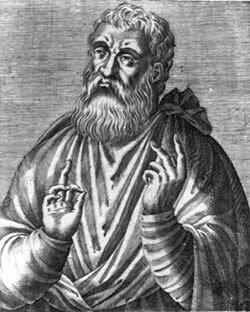


The celebration of the eucharist


(Martyr and Apologist)

An excerpt from a First Apology in the Defense of Christians

Easter Week 3: Sunday

No one may share the eucharist with us unless he believes that what we teach is true, unless he is washed in the regenerating waters of baptism for the remission of his sins, and unless he lives in accordance with the principles given us by Christ.

We do not consume the eucharistic bread and wine as if it were ordinary food and drink, for we have been taught that as Jesus Christ our Savior became a man of flesh and blood by the power of the Word of God, so also the food that our flesh and blood assimilates for its nourishment becomes the flesh and blood of the incarnate Jesus by the power of his own words contained in the prayer of thanksgiving.

The apostles, in their recollections, which are called gospels, handed down to us what Jesus commanded them to do. They tell us that he took bread, gave thanks and said: Do this in memory of me. This is my body. In the same way he took the cup, he gave thanks and said: This is my blood. The Lord gave this command to them alone. Ever since then we have constantly reminded one another of these things. The rich among us help the poor and we are always united. For all that we receive we praise the Creator of the universe through his Son Jesus Christ and through the Holy Spirit.

On Sunday we have a common assembly of all our members, whether they live in the city or the outlying districts. The recollections of the apostles or the writings of the prophets are read, as long as there is time. When the reader has finished, the president of the assembly speaks to us; he urges everyone to imitate the examples of virtue we have heard in the readings. Then we all stand up together and pray.

On the conclusion of our prayer, bread and wine and water are brought forward. The president offers prayers and gives thanks to the best of his ability, and the people give assent by saying, “Amen.” The eucharist is distributed, everyone present communicates, and the deacons take it to those who are absent.

The wealthy, if they wish, may make a contribution, and they themselves decide the amount. The collection is placed in the custody of the president, who uses it to help the orphans and widows and all who for any reason are in distress, whether because they are sick, in prison, or away from home. In a word, he takes care of all who are in need.

We hold our common assembly on Sunday because it is the first day of the week, the day on which God put darkness and chaos to flight and created the world, and because on that same day our savior Jesus Christ rose from the dead. For he was crucified on Friday and on Sunday he appeared to his apostles and disciples and taught them the things that we have passed on for your consideration.


Reflection on Sunday’s Gospel.


Glory to the Father
and to the Son
and to the Holy Spirit:
as it was in the beginning,
is now, and will be forever. Amen


EASTER OCTAVE


— The Lord’s Day —


Easter, the Second Sunday


Pondering Jesus’ victorious Word


εὐαγγελίζω (euaggelizo)
“to announce the Good News of victory in battle”

“I, John, your brother, who share with you
the distress, the kingdom,
and the endurance we have in Jesus,
found myself on the island called Patmos
because I proclaimed God’s word
and gave testimony to Jesus.
I was caught up in spirit on the Lord’s day
and heard behind me a voice
as loud as a trumpet, which said,
“Write on a scroll what you see.”
Then I turned to see whose voice
it was that spoke to me,
and when I turned, I saw seven gold lampstands
and in the midst of the lampstands
one like a son of man,
wearing an ankle-length robe,
with a gold sash around his chest.

When I caught sight of him, I fell down
at his feet as though dead.
He touched me with his right hand and said,
“Do not be afraid.
I am the first and the last, the one who lives.
Once I was dead,
but now I am alive forever and ever.
I hold the keys to death and the netherworld.
Write down, therefore, what you have seen,
and what is happening,
and what will happen afterwards.”


θεωρέω (theoreo)
(“to perceive, discover, ponder a deeper meaning”)

In this present Cycle of Sunday Scriptures, we will listen each Sunday of Easter to a lesson from the Acts of the Apostles, the Book of Revelation and the Gospel according to Saint John. The ‘Sunday’ Word of God will form us as the proclamation of God’s Word ‘travels’ to the world stage of Rome in the Acts of the Apostles while offering hope in the midst of persecution (Book of Revelation) as Jesus, the new day of Creation, makes all things new in our midst (Gospel according to Saint John). The Acts of the Apostles and Gospel according to Saint John are also proclaimed, for the most part, during daily Mass in the Easter Season and the Book of Revelation is the principle source of Scripture for the Office of Readings in this Liturgical season. With such consistency in the proclamation of God’s Word, I think it helpful to explore 1 of these Books more thoroughly through the lens of the Sunday celebration. Hence over the course of these Easter Sundays, we will examine the Lord’s message to us from the Book of Revelation as it presents, among many insights, hope for the faithful whose connection to the Person Jesus undergoes a variety of tests, struggles and persecutions.


The apocalyptic Text proclaimed this Sunday is a shortened introduction to the Book of Revelation. We meet John on “the Lord’s Day” on the “island called Patmos,” a place where dissidents were banished to live out their days in silence. The introduction also draws us into one of Revelation’s more fascinating elements: visions. Throughout the Sacred Text the many visions are vivid and often troubling, capturing the imagination with all sorts of questions that ponder connections between the text and events of the biblical era as well as our own. While preachers and a host of people throughout the centuries have used (abused?) Revelation’s imagery for a variety of reasons, it is important to situate everything in the Text within a holistic context. Problems arise with any part of Scripture that is divorced from its context and Revelation is no different. ‘Keeping everything together’ is essential for a proper grasp of the salvific meaning of this apocalyptic Text.

In the vision before us this Sunday, John speaks of “seven gold lampstands,” a reference to 7 specific Churches that will be addressed individually. In both ancient and contemporary scholarship, many have asked, ‘why these Churches?’ Apringius of Beja, for example, writes in the sixth century: “We have already said that he addressed one church which exists during the time of the whole world, that is, from that time when he spoke to the consummation of the world. Since he now mentions the names of these churches specifically, let us see what meanings they have. . . . There is a mighty mystery in the names which we will examine and discuss to the extent that God allows. Ephesus means “my will” or “my plan.” Pergamum means “to him who divides their horns.” This refers either to the insolence of the powers of the air, or to the arrogance of the heretics. He writes to Thyatira, that is “enlightened.” This signifies that, after the expulsion of heretical pride and after the defeat of temptations from the powers of the air, the holy church is deserving of the light of righteousness. Sardis means the “beginning of beauty.” The church is seized by the sun of righteousness and is illumined by the light of truth, so that she might have the beginning of beauty, the Lord Jesus Christ, and might always shine in perpetual light. Philadelphia means “preserving devotion to the Lord.” After possessing the sun of righteousness, after the illumination of holiness, after the comeliness of holy beauty, the church rightly is devoted to the Lord and preserves herself by an inviolable observation of devotion. Laodicea means either “a tribe beloved of the Lord,” or, as some would have it, “a birth is expected.” Both are meaningful, for she who has merited the beauty of faith and the sun of righteousness and knows that through faith the Lord cleaves to her, might also be a tribe whom the Lord loves, who is both loved by the Lord and preserved by the Lord. (Tractate on the Apocalypse).” While one may debate the basis upon which Apringius ‘defines’ the meaning of each Church, a vast majority contend that the 7 gold lampstands is a way of speaking of the universal Church whose presence in the world is expressed through local communities.

That being said, the introductory vision is vital for a proper view of the visions, for in the midst of the 7 lampstands is the Person Jesus. His centrality in the Church and indeed in the midst of all reality is a consistent and significant message of the Apocalypse. His presence as the Risen Savior is the light against which the lives of the Churches and believers will be measured. As the Word unfolds on these Easter Sundays, the challenge will be to permit the light of Easter to shine in such a way that our ecclesial and individual lives are grounded in the security and peace that Jesus alone brings and gives to a waiting world.


EASTER OCTAVE


Easter, the Second Sunday


“Then I turned to see whose voice it was that spoke to me, and when I turned, I saw seven gold lampstands...” (Revelation 1:12.)

In commenting on these verses from today’s Second Reading, Saint Irenaeus of Lyons writes:

“Neither Moses nor Elijah nor Ezekiel, who all had many celestial visions, saw God. Rather, what they did see were likenesses of the splendor of the Lord and prophecies of things to come. It is evident that the Father is indeed invisible, of whom also the Lord said, “No man has seen God at any time.” But his Word, as he himself willed it, and for the benefit of those who beheld, did show the Father’s brightness and explained his purposes, as also the Lord said, “The only begotten God, which is in the bosom of the Father, he has declared [him].” John also, the Lord’s disciple, when seeing the priestly and glorious advent of his kingdom, says in the Apocalypse: “I turned to see the voice that spoke with me. And, being turned, I saw seven golden candlesticks, and in their midst One like the Son of man, clothed with a garment reaching to the feet, and wrapped around the chest with a golden girdle. His head and his hair were white, as white as wool, and as snow. His eyes were like a flame of fire. His feet were like fine brass, as if they were forged in a furnace. His voice [was] like the sound of waters. He had in his right hand seven stars. Out of his mouth came a sharp twoedged sword. He looked like the sun shining at full strength.” For in these words he sets forth something of the glory [which he has received] from his Father, as the head. He sets forth something of the priestly office, as in the case of the long garment reaching to the feet. And this was the reason why Moses vested the high priest after this fashion. Something also alludes to the end [of all things], as [where he speaks of] the fine brass being forged in the fire, which denotes the power of faith, and constant prayer, because of the consuming fire which is to come at the end of time.” (Against Heresies, 4.)


Reflection on this Sunday’s Scriptures.


Collect
God of everlasting mercy,
Who in the very recurrence
of the paschal feast
kindle the faith of the people
You have made Your own,
increase, we pray,
the grace You have bestowed,
that all may grasp and rightly understand
in what font they have been washed,
by Whose Spirit they have been reborn,
by Whose Blood they have been redeemed.
Through our Lord Jesus Christ, Your Son
Who lives and reigns with You
in the unity of the Holy Spirit,
one God, for ever and ever. Amen.


Glory to the Father
and to the Son
and to the Holy Spirit:
as it was in the beginning,
is now, and will be forever. Amen