The Sacred Paschal Triduum
Holy Saturday

“Therefore, a sabbath rest still remains for the people of God.” (Hebrews 4:9)

Saint John Chrysostom comments on this verse from today’s Liturgy of the Hours, Office of Readings:

“He says that there are “three” rests: one, that of the sabbath, in which God rested from works; the second, that of Palestine, in which, when the Jews had entered, they would be at rest from their hardships and labors; the third, that which is rest indeed, the kingdom of heaven, where those who obtain it do indeed rest from their labors and troubles. Of these three then he makes mention here. And why did he mention the three, when he is speaking only of the one? That he might show that the prophet is speaking concerning this one. For he did not speak, he says, concerning the first. For how could he, when that had taken place long before? Nor yet again concerning the second, that in Palestine. For how could he? For he says, “They shall not enter into my rest.” It remains, therefore, that it is this third.” (On the Epistle to the Hebrews, 6)


Collect
All-powerful and ever-living God,
Your only Son went down among the dead
and rose again in glory.
In Your goodness
raise up your faithful people,
buried with him in baptism,
to be one with Him
in the everlasting life of heaven,
where He lives and reigns with You and the Holy Spirit,
one God, for ever and ever.


Glory to You Father, Son and Holy Spirit:
as it was in the beginning is now
and will be forever. Amen!


The Sacred Paschal Triduum
Friday of the Passion of the Lord

“He grew up like a sapling before him, like a shoot from the parched earth; He had no majestic bearing to catch our eye, no beauty to draw us to him.” (Isaiah 53:2)

Saint Irenaeus of Lyons comments on this verse from today’s Isaian proclamation (The Fourth Suffering Servant Song):

“I have shown from the Scriptures that no one of the children of Adam is as to everything, and absolutely, called God, or named Lord. But that he is himself in his own right, beyond all people who ever lived, God, and Lord, and King eternal and the incarnate Word, proclaimed by all the prophets, the apostles and the Spirit himself, may be seen by all who have attained to even a small portion of the truth. Now, the Scriptures would not have testified these things of him if, like others, he had been a mere man. But that he had, beyond all others, in himself that preeminent birth that is from the most high Father and also experienced that preeminent generation that is from the Virgin, the divine Scriptures do in both respects testify of him: also, that he was a man without comeliness and liable to suffering; that he sat on the foal of a donkey; that he was despised among the people and humbled himself even to death; and that he is the holy Lord, the wonderful, the counselor, the beautiful in appearance and the mighty God, coming on the clouds as the judge of all people — all these things did the Scripture prophesy of him. ” (Adversus haereses, 3)


Collect
O God,
who by the Passion of Christ your Son, our Lord,
abolished the death inherited from ancient sin
by every succeeding generation,
grant that just as, being conformed to him,
we have borne by the law of nature
the image of the man of earth,
so by the sanctification of grace
we may bear the image of the Man of heaven.
Through Christ our Lord.

Glory to the Father
and to the Son
and to the Holy Spirit:
as it was in the beginning,
is now, and will be forever. Amen


The power of Christ’s blood


Today’s Second Reading from the
Office of Readings (Liturgy of the Hours)
Good Friday

An excerpt from: Catecheses
Saint John Chrysostom
(bishop and Father of the Church)

If we wish to understand the power of Christ’s blood, we should go back to the ancient account of its prefiguration in Egypt. Sacrifice a lamb without blemish, commanded Moses, and sprinkle its blood on your doors. If we were to ask him what he meant, and how the blood of an irrational beast could possibly save men endowed with reason, his answer would be that the saving power lies not in the blood itself, but in the fact that it is a sign of the Lord’s blood. In those days, when the destroying angel saw the blood on the doors he did not dare to enter, so how much less will the devil approach now when he sees, not that figurative blood on the doors, but the true blood on the lips of believers, the doors of the temple of Christ.

If you desire further proof of the power of this blood, remember where it came from, how it ran down from the cross, flowing from the Master’s side. The gospel records that when Christ was dead, but still hung on the cross, a soldier came and pierced his side with a lance and immediately there poured out water and blood. Now the water was a symbol of baptism and the blood, of the holy eucharist. The soldier pierced the Lord’s side, he breached the wall of the sacred temple, and I have found the treasure and made it my own. So also with the lamb: the Jews sacrificed the victim and I have been saved by it.

There flowed from his side water and blood. Beloved, do not pass over this mystery without thought; it has yet another hidden meaning, which I will explain to you. I said that water and blood symbolized baptism and the holy eucharist. From these two sacraments the Church is born: from baptism, the cleansing water that gives rebirth and renewal through the Holy Spirit, and from the holy eucharist. Since the symbols of baptism and the eucharist flowed from his side, it was from his side that Christ fashioned the Church, as he had fashioned Eve from the side of Adam. Moses gives a hint of this when he tells the story of the first man and makes him exclaim: Bone from my bones and flesh from my flesh! As God then took a rib from Adam’s side to fashion a woman, so Christ has given us blood and water from his side to fashion the Church. God took the rib when Adam was in a deep sleep, and in the same way Christ gave us the blood and the water after his own death.

Do you understand, then, how Christ has united his bride to himself and what food he gives us all to eat? By one and the same food we are both brought into being and nourished. As a woman nourishes her child with her own blood and milk, so does Christ unceasingly nourish with his own blood those to whom he himself has given life.

Glory to the Father
and to the Son
and to the Holy Spirit:
as it was in the beginning,
is now, and will be forever. Amen


The Sacred Paschal Triduum
Thursday of the Lord's Supper
At the Evening Mass

“They will consume its meat that same night, eating it roasted with unleavened bread and bitter herbs.” (Exodus 11:8)

Origen of Alexandria (part 2 of Pope Benedict’s reflections on Origen) comments on this verse from the First Reading proclaimed at Mass this evening:

“Christians eat the flesh of the lamb every day, that is, they consume daily the flesh of the Word. “For Christ our pasch is sacrificed.” And because the law of the pasch is such that it is eaten in the evening, for this reason the Lord suffered in the evening of the world, that you may always eat of the flesh of the Word, because you are always in the evening until the morning comes. And if in this evening you shall be anxious and “in weeping and fasting” and shall lead your life in every labor of justice, you shall be able to say, “In the evening weeping shall have place and in the morning gladness.” For you shall rejoice in the morning, that is, in the world to come, if in this world you have gathered “the fruit of justice” in weeping and labor.” (Homilies on Genesis, 10)


Collect
O God,
Who have called us to participate
in this most sacred Supper,
in which your Only Begotten Son,
when about to hand himself over to death,
entrusted to the Church a sacrifice new for all eternity,
the banquet of his love,
grant, we pray,
that we may draw from so great a mystery,
the fullness of charity and of life.
Through our Lord Jesus Christ, Your Son,
Who lives and reigns with You
in the unity of the Holy Spirit,
one God, for ever and ever. Amen.


Glory to the Father
and to the Son
and to the Holy Spirit:
as it was in the beginning,
is now, and will be forever. Amen


The Chrism Mass

“The spirit of the Lord GOD is upon me, because the LORD has anointed me; He has sent me to bring good news to the afflicted, to bind up the brokenhearted, To proclaim liberty to the captives, release to the prisoners...” (Isaiah 61:1)

Saint Ambrose of Milan offers the following insight on this verse from today’s First Reading:

We have shown by the clear evidence of the Scripture that the apostles and prophets were appointed, the latter to prophesy, the former to preach the gospel, by the Holy Spirit in the same way as by the Father and the Son. Now we add what all will rightly wonder at and not be able to doubt, that the Spirit was on Christ; and that as he sent the Spirit, so the Spirit sent the Son of God. For the Son of God says, “The Spirit of the Lord is on me, because he has appointed me, he has sent me to preach the gospel.” And having read this from the book of Isaiah, he says in the Gospel, “Today has this Scripture been fulfilled in your ears,” that he might point out that it was said of himself.” (On the Holy Spirit, 3)


Collect
O God,
Who anointed Your Only Begotten Son
with the Holy Spirit
and made Him Christ and Lord,
graciously grant
that, being made sharers in His consecration,
we may bear witness
to Your Redemption in the world.
Through our Lord Jesus Christ, your Son,
Who lives and reigns with You
in the unity of the Holy Spirit,
one God, for ever and ever. Amen.


Glory to the Father
and to the Son
and to the Holy Spirit:
as it was in the beginning,
is now, and will be forever. Amen


The Lamb that was slain
has delivered us from death and given us life

Today’s Second Reading from the
Office of Readings (Liturgy of the Hours)
Holy Thursday

An excerpt from: An Easter Homily
Saint Melito of Sardis
(bishop)

There was much proclaimed by the prophets about the mystery of the Passover: that mystery is Christ, and to him be glory for ever and ever. Amen.

For the sake of suffering humanity he came down from heaven to earth, clothed himself in that humanity in the Virgin’s womb, and was born a man. Having then a body capable of suffering, he took the pain of fallen man upon himself; he triumphed over the diseases of soul and body that were its cause, and by his Spirit, which was incapable of dying, he dealt man’s destroyer, death, a fatal blow.

He was led forth like a lamb; he was slaughtered like a sheep. He ransomed us from our servitude to the world, freed us from our slavery to the devil, as he had freed Israel from the hand of Pharaoh. He sealed our souls with his own Spirit, and the members of our body with his own blood.

He is the One who covered death with shame and cast the devil into mourning as Moses cast Pharaoh into mourning. He is the One who smote sin and robbed iniquity of offspring, as Moses robbed the Egyptians of their offspring. He is the One who brought us out of slavery into freedom, out of darkness into light, out of death into life, out of tyranny into an eternal kingdom; who made us a new priesthood, a people chosen to be his own for ever. He is the Passover that is our salvation.

It is he who endured every kind of suffering in all those who foreshadowed him. In Abel he was slain, in Isaac bound, in Jacob exiled, in Joseph sold, in Moses exposed to die. He was sacrificed in the Passover lamb, persecuted in David, dishonored in the prophets.

It is he who was made man of the Virgin, he who was hung on the tree; it was he who was buried in the earth, raised from the dead, and taken up to the heights of heaven. He is the mute lamb, the slain lamb, the lamb born of Mary, the fair ewe. He was seized from the flock, dragged off to be slaughtered, sacrificed in the evening, and buried at night. On the tree no bone of his was broken; in the earth his body knew no decay. He is the One who rose from the dead, and who raised man from the depths of the tomb.

Glory to the Father
and to the Son
and to the Holy Spirit:
as it was in the beginning,
is now, and will be forever. Amen


Holy Week: Wednesday

“The Lord GOD is my help, therefore I am not disgraced; Therefore I have set my face like flint, knowing that I shall not be put to shame.” (Isaiah 50:7)

Saint Cyril of Alexandria reflects on this verse from today’s First Reading, writes:

“And the Father was Christ’s helper. For he did not allow or concede that his own Son should be completely shamed or overwhelmed. For they were punished, those who sought to take their punishment out on me as those who dare to fight with God. For though being with us, he was the only-begotten Word of God. He put on an identical human likeness, by which reason alone he was believed to be of a nature with us. For every human being is subject to faults and sins, and no one alive is completely blameless. He alone in becoming man retained the divine dignity. And being Word and God, his flesh was able to shoo away destruction. Thus, the Son became a man who was fit to be accepted by the Father. For all that human beings have is Godgiven. For the one God and Father, through him, undid the power of death through his resurrection from the dead. He was the servant of God, who while being human was yet truly the Son of God and the Father. And to hear his voice means no transgression of the law but a confirming of the law through types and shadows discerning the truth which is Christ and the prophecies of him, as Paul notes. His voice is the evangelical and divine preaching that calls us to the redemption that is through faith in Christ. He also calls us to a proper behavior that lives in a way that is, by far, more consistent than the way of the law. The law was given in the shadows. Faith was given in the bright and shining light.” (Commentary on Isaiah, 4)


Collect
O God,
Who willed Your Son to submit for our sake
to the yoke of the Cross,
so that You might drive from us
the power of the enemy,
grant us, your servants,
to attain the grace of the resurrection.
Through our Lord Jesus Christ, your Son,
Who lives and reigns with You
in the unity of the Holy Spirit,
one God, for ever and ever. Amen.


Glory to the Father
and to the Son
and to the Holy Spirit:
as it was in the beginning,
is now, and will be forever. Amen


The perfection of love

Today’s Second Reading from the
Office of Readings (Liturgy of the Hours)
Wednesday of Holy Week

An excerpt from: A Treatise on John
Saint Augustine
(bishop and Father of the Church)

Dear brethren, the Lord has marked out for us the fullness of love that we ought to have for each other. He tells us: No one has greater love than the man who lays down his life for his friends. In these words, the Lord tells us what the perfect love we should have for one another involves. John, the evangelist who recorded them, draws the conclusion in one of his letters: As Christ laid down his life for us, so we too ought to lay down our lives for our brothers. We should indeed love one another as he loved us, he who laid down his life for us.

This is surely what we read in the Proverbs of Solomon: If you sit down to eat at the table of a ruler, observe carefully what is set before you; then stretch out your hand, knowing that you must provide the same kind of meal yourself. What is this ruler’s table if not the one at which we receive the body and blood of him who laid down his life for us? What does it mean to sit at this table if not to approach it with humility? What does it mean to observe carefully what is set before you if not to meditate devoutly on so great a gift? What does it mean to stretch out one’s hand, knowing that one must provide the same kind of meal oneself, if not what I have just said: as Christ laid down his life for us, so we in our turn ought to lay down our lives for our brothers? This is what the apostle Paul said: Christ suffered for us, leaving us an example, that we might follow in his footsteps.

This is what is meant by providing “the same kind of meal.” This is what the blessed martyrs did with such burning love. If we are to give true meaning to our celebration of their memorials, to our approaching the Lord’s table in the very banquet at which they were fed, we must, like them, provide “the same kind of meal.”

At this table of the Lord we do not commemorate the martyrs in the same way as we commemorate others who rest in peace. We do not pray for the martyrs as we pray for those others, rather, they pray for us, that we may follow in his footsteps. They practiced the perfect love of which the Lord said there could be none greater. They provided “the same kind of meal” as they had themselves received at the Lord’s table.

This must not be understood as saying that we can be the Lord’s equals by bearing witness to him to the extent of shedding our blood. He had the power of laying down his life; we by contrast cannot choose the length of our lives, and we die even if it is against our will. He, by dying, destroyed death in himself; we are freed from death only in his death. His body did not see corruption; our body will see corruption and only then be clothed through him in incorruption at the end of the world. He needed no help from us in saving us; without him we can do nothing. He gave himself to us as the vine to the branches; apart from him we cannot have life.

Finally, even if brothers die for brothers, yet no martyr by shedding his blood brings forgiveness for the sins of his brothers, as Christ brought forgiveness to us. In this he gave us, not an example to imitate but a reason for rejoicing. Inasmuch, then, as they shed their blood for their brothers, the martyrs provided “the same kind of meal” as they had received at the Lord’s table. Let us then love one another as Christ also loved us and gave himself up for us.

Glory to the Father
and to the Son
and to the Holy Spirit:
as it was in the beginning,
is now, and will be forever. Amen


Holy Week: Tuesday

“He made my mouth like a sharp-edged sword, concealed me, shielded by his hand. He made me a sharpened arrow, in his quiver he hid me.” (Isaiah 49:2)

Origen of Alexandria (part 2 of Pope Benedict’s reflections on Origen) comments on this verse from the First Reading proclaimed at Mass today:

“If anyone has been able to hold in the breadth of his mind and to consider the glory and splendor of all those things created in him, he will be struck by their very beauty and transfixed by the magnificence of their brilliance or, as the prophet says, “by the chosen arrow.” And he will receive from him the saving wound and will burn with the blessed fire of his love.” (Commentary on the Song of Songs, Prologue)


Collect
Almighty ever-living God,
grant us so to celebrate
the mysteries of the Lord’s Passion
that we may merit to receive your pardon.
Through our Lord Jesus Christ, Your Son,
Who lives and reigns with You
in the unity of the Holy Spirit,
one God, for ever and ever. Amen.


Glory to the Father
and to the Son
and to the Holy Spirit:
as it was in the beginning,
is now, and will be forever. Amen


By one death and resurrection the world was saved

Today’s Second Reading from the
Office of Readings (Liturgy of the Hours)
Tuesday of Holy Week

An excerpt from: On the Holy Spirit
Saint Basil the Great
(bishop and Father of the Church)

When mankind was estranged from him by disobedience, God our Savior made a plan for raising us from our fall and restoring us to friendship with himself. According to this plan Christ came in the flesh, he showed us the gospel way of life, he suffered, died on the cross, was buried and rose from the dead. He did this so that we could be saved by imitation of him, and recover our original status as sons of God by adoption.

To attain holiness, then, we must not only pattern our lives on Christ’s by being gentle, humble and patient, we must also imitate him in his death. Taking Christ for his model, Paul said that he wanted to become like him in his death in the hope that he too would be raised from death to life.

We imitate Christ’s death by being buried with him in baptism. If we ask what this kind of burial means and what benefit we may hope to derive from it, it means first of all making a complete break with our former way of life, and our Lord himself said that this cannot be done unless a man is born again. In other words, we have to begin a new life, and we cannot do so until our previous life has been brought to an end. When runners reach the turning point on a racecourse, they have to pause briefly before they can go back in the opposite direction. So also when we wish to reverse the direction of our lives there must be a pause, or a death, to mark the end of one life and the beginning of another.

Our descent into hell takes place when we imitate the burial of Christ by our baptism. The bodies of the baptized are in a sense buried in the water as a symbol of their renunciation of the sins of their unregenerate nature. As the Apostle says: The circumcision you have undergone is not an operation performed by human hands, but the complete stripping away of your unregenerate nature. This is the circumcision that Christ gave us, and it is accomplished by our burial with him in baptism. Baptism cleanses the soul from the pollution of worldly thoughts and inclinations: You will wash me, says the psalmist, and I shall be whiter than snow. We receive this saving baptism only once because there was only one death and one resurrection for the salvation of the world, and baptism is its symbol.

Glory to the Father
and to the Son
and to the Holy Spirit:
as it was in the beginning,
is now, and will be forever. Amen


Holy Week: Monday

“Here is my servant whom I uphold, my chosen one with whom I am pleased. Upon him I have put my spirit; he shall bring forth justice to the nations.” (Isaiah 42:1)

Pseudo Dionysius the Areopogite offers the following insight on this verse from today’s First Reading:

“The goodness of the Deity has endless love for humanity and never ceased from benignly pouring out on us its providential gifts. It made it possible for us to escape from the domain of the rebellious, and it did this not through overwhelming force, but, as Scripture mysteriously tells us, by an act of judgment accomplished in all righteousness. Beneficently God’s goodness wrought a complete change in our nature. It filled our shadowed and unshaped minds with a kindly, divine light and adorned them with loveliness suitable to their divinized state. It saved our nature from almost complete wreckage and delivered the dwelling place of our soul from the most accursed passion and from destructive defilement. Finally, it showed us a supramundane uplifting and an inspired way of life in shaping ourselves to it as fully as lay in our power.” (Ecclesiastical Hierarchy, 3)


Collect
Grant, we pray, almighty God,
that, though in our weakness we fail,
we may be revived through the
Passion of your Only Begotten Son.
Who lives and reigns with You
in the unity of the Holy Spirit,
one God, for ever and ever. Amen.


Glory to the Father
and to the Son
and to the Holy Spirit:
as it was in the beginning,
is now, and will be forever. Amen


Let us too glory in the cross of the Lord

Today’s Second Reading from the
Office of Readings (Liturgy of the Hours)
Monday of Holy Week

An excerpt from: Sermo Guelferbytanus 3
Saint Augustine
(bishop and Father of the Church)

The passion of our Lord and Savior Jesus Christ is the hope of glory and a lesson in patience.

What may not the hearts of believers promise themselves as the gift of God’s grace, when for their sake God’s only Son, co-eternal with the Father, was not content only to be born as man from human stock but even died at the hands of the men he had created?

It is a great thing that we are promised by the Lord, but far greater is what has already been done for us, and which we now commemorate. Where were the sinners, what were they, when Christ died for them? When Christ has already given us the gift of his death, who is to doubt that he will give the saints the gift of his own life? Why does our human frailty hesitate to believe that mankind will one day live with God?

Who is Christ if not the Word of God: in the beginning was the Word, and the Word was with God, and the Word was God? This Word of God was made flesh and dwelt among us. He had no power of himself to die for us: he had to take from us our mortal flesh. This was the way in which, though immortal, he was able to die; the way in which he chose to give life to mortal men: he would first share with us, and then enable us to share with him. Of ourselves we had no power to live, nor did he of himself have the power to die.

Accordingly, he effected a wonderful exchange with us, through mutual sharing: we gave him the power to die, he will give us the power to live.

The death of the Lord our God should not be a cause of shame for us; rather, it should be our greatest hope, our greatest glory. In taking upon himself the death that he found in us, he has most faithfully promised to give us life in him, such as we cannot have of ourselves.

He loved us so much that, sinless himself, he suffered for us sinners the punishment we deserved for our sins. How then can he fail to give us the reward we deserve for our righteousness, for he is the source of righteousness? How can he, whose promises are true, fail to reward the saints when he bore the punishment of sinners, though without sin himself?

Brethren, let us then fearlessly acknowledge, and even openly proclaim, that Christ was crucified for us; let us confess it, not in fear but in joy, not in shame but in glory. The apostle Paul saw Christ, and extolled his claim to glory. He had many great and inspired things to say about Christ, but he did not say that he boasted in Christ’s wonderful works: in creating the world, since he was God with the Father, or in ruling the world, though he was also a man like us. Rather, he said: Let me not boast except in the cross of our Lord Jesus Christ.

Glory to the Father
and to the Son
and to the Holy Spirit:
as it was in the beginning,
is now, and will be forever. Amen


Blessed is he who comes
in the name of the Lord.
Blessed is the king of Israel.

Today’s Second Reading from the
Office of Readings (Liturgy of the Hours)
Palm Sunday of the Lord’s Passion

An excerpt from: Oration 9: On the Palm Branches
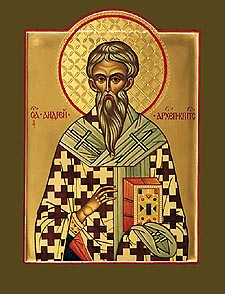
Saint Andrew of Crete
(bishop)

Let us go together to meet Christ on the Mount of Olives. Today he returns from Bethany and proceeds of his own free will toward his holy and blessed passion, to consummate the mystery of our salvation. He who came down from heaven to raise us from the depths of sin, to raise us with himself, we are told in Scripture, above every sovereignty, authority, and power, and every other name that can be named, now comes of his own free will to make his journey to Jerusalem. He comes without pomp or ostentation. As the psalmist says: He will not dispute or raise his voice to make it heard in the streets. He will be meek and humble, and he will make his entry in simplicity.

Let us run to accompany him as he hastens toward Jerusalem, and imitate those who met him then, not by covering his path with garments, olive branches or palms, but by doing all we can to prostrate ourselves before him by being humble and by trying to live as he would wish. Then we shall be able to receive the Word at his coming, and God, whom no limits can contain, will be within us.

In his humility Christ entered the dark regions of our fallen world and he is glad that he became so humble for our sake, glad that he came and lived among us and shared in our nature in order to raise us up again to himself. And even though we are told that he has now ascended above the highest heavens—the proof, surely, of his power and godhead—his love for man will never rest until he has raised our earthbound nature from glory to glory, and made it one with his own in heaven.

So let us spread before his feet, not garments or soulless olive branches, which delight the eye for a few hours and then wither, but ourselves, clothed in his grace, or rather, clothed completely in him. We who have been baptized into Christ must ourselves be the garments that we spread before him. Now that the crimson stains of our sins have been washed away in the saving waters of baptism and we have become white as pure wool, let us present the conqueror of death, not with mere branches of palms but with the real rewards of his victory. Let our souls take the place of the welcoming branches as we join today in the children’s holy song: Blessed is he who comes in the name of the Lord. Blessed is the king of Israel.

Glory to the Father
and to the Son
and to the Holy Spirit:
as it was in the beginning,
is now, and will be forever. Amen


Lent: Saturday of the Fifth Week

“My dwelling shall be with them; I will be their God, and they will be my people.” (Ezekiel 37:27)

Saint Cyril of Alexandria reflects on this verse from today’s First Reading, writes:

“To be made partakers of Christ, both intellectually and by our senses, fills us with every blessing. For he dwells in us, first, by the Holy Spirit, and we are his abode, according to that which was said of old by one of the holy prophets.”


Collect
O God,
who have made all those reborn in Christ
a chosen race and a royal priesthood,
grant us, we pray,
the grace to will and to do what you command,
that the people called to eternal life
may be one in the faith of their hearts
and the homage of their deeds.
Through our Lord Jesus Christ, Your Son,
Who lives and reigns with You
in the unity of the Holy Spirit,
one God, for ever and ever. Amen.


Glory to the Father
and to the Son
and to the Holy Spirit:
as it was in the beginning,
is now, and will be forever. Amen


We are soon going to share in the Passover

Today’s Second Reading from the
Office of Readings (Liturgy of the Hours)
Lent: Saturday of the Fifth Week

An excerpt from: Oration 45
Saint Gregory of Nazianzus
(bishop and Father of the Church)

We are soon going to share in the Passover, and although we still do so only in a symbolic way, the symbolism already has more clarity than it possessed in former times because, under the law, the Passover was, if I may dare to say so, only a symbol of a symbol. Before long, however, when the Word drinks the new wine with us in the kingdom of his Father, we shall be keeping the Passover in a yet more perfect way, and with deeper understanding. He will then reveal to us and make clear what he has so far only partially disclosed. For this wine, so familiar to us now, is eternally new.

It is for us to learn what this drinking is, and for him to teach us. He has to communicate this knowledge to his disciples, because teaching is food, even for the teacher.

So let us take our part in the Passover prescribed by the law, not in a literal way, but according to the teaching of the Gospel; not in an imperfect way, but perfectly; not only for a time, but eternally. Let us regard as our home the heavenly Jerusalem, not the earthly one; the city glorified by angels, not the one laid waste by armies. We are not required to sacrifice young bulls or rams, beasts with horns and hoofs that are more dead than alive and devoid of feeling; but instead, let us join the choirs of angels in offering God upon his heavenly altar a sacrifice of praise. We must now pass through the first veil and approach the second, turning our eyes toward the Holy of Holies. I will say more: we must sacrifice ourselves to God, each day and in everything we do, accepting all that happens to us for the sake of the Word, imitating his passion by our sufferings, and honoring his blood by shedding our own. We must be ready to be crucified.

If you are a Simon of Cyrene, take up your cross and follow Christ. If you are crucified beside him like one of the thieves, now, like the good thief, acknowledge your God. For your sake, and because of your sin, Christ himself was regarded as a sinner; for his sake, therefore, you must cease to sin. Worship him who was hung on the cross because of you, even if you are hanging there yourself. Derive some benefit from the very shame; purchase salvation with your death. Enter paradise with Jesus, and discover how far you have fallen. Contemplate the glories there, and leave the other scoffing thief to die outside in his blasphemy.

If you are a Joseph of Arimathea, go to the one who ordered his crucifixion, and ask for Christ’s body. Make your own the expiation for the sins of the whole world. If you are a Nicodemus, like the man who worshiped God by night, bring spices and prepare Christ’s body for burial. If you are one of the Marys, or Salome, or Joanna, weep in the early morning. Be the first to see the stone rolled back, and even the angels perhaps, and Jesus himself.

Glory to the Father
and to the Son
and to the Holy Spirit:
as it was in the beginning,
is now, and will be forever. Amen


Lent: Friday of the Fifth Week

“LORD of hosts, you test the just, you see mind and heart, Let me see the vengeance you take on them, for to you I have entrusted my cause.” (Jeremiah 20:12)

Saint Jerome offers the following insight on these verses from today’s First Reading:

“The Lord alone is able to certify justice, in the same way that he alone sees the interior of a person’s heart. Hence, Jesus knows the thoughts of people not as an acquired skill, as some allege, but because he is God by nature. Such is what the psalmist sings: “No living creature will be justified in your presence.” If none of those living in virtue are justified, how much more true will this be of those who are dead from sin! Even though the just person knows himself to have God as a defender, the impatience of human fragility desires to see right now what it knows to be coming. Jeremiah also entrusted his cause to God, to the one who said elsewhere, “Vengeance is mine. I will repay, says the Lord.” But the conscience is happy whose cause is entrusted to the Lord, as the apostle said: “Anything that is visible is light.” (Six Books on Jeremiah, 4)


Collect
Pardon the offenses of Your peoples,
we pray, O Lord,
and in Your goodness set us free
from the bonds of the sins
we have committed in our weakness.
Through our Lord Jesus Christ, your Son,
Who lives and reigns with You
in the unity of the Holy Spirit,
one God, for ever and ever.


Glory to the Father
and to the Son
and to the Holy Spirit:
as it was in the beginning,
is now, and will be forever. Amen


Christ offered himself for us

Today’s Second Reading from the
Office of Readings (Liturgy of the Hours)
Lent: Friday of the Fifth Week

An excerpt from: A Treatise on Faith
Saint Fulgentius of Ruspe
(bishop)

The sacrifices of animal victims which our forefathers were commanded to offer to God by the holy Trinity itself, the one God of the old and the new testaments, foreshadowed the most acceptable gift of all. This was the offering which in his compassion the only Son of God would make of himself in his human nature for our sake.

The Apostle teaches that Christ offered himself for us to God as a fragrant offering and sacrifice. He is the true God and the true high priest who for our sake entered once for all into the holy of holies, taking with him not the blood of bulls and goats but his own blood. This was foreshadowed by the high priest of old when each year he took blood and entered the holy of holies.

Christ is therefore the one who in himself alone embodied all that he knew to be necessary to achieve our redemption. He is at once priest and sacrifice, God and temple. He is the priest through whom we have been reconciled, the sacrifice by which we have been reconciled, the temple in which we have been reconciled, the God with whom we have been reconciled. He alone is priest, sacrifice and temple because he is all these things as God in the form of a servant; but he is not alone as God, for he is this with the Father and the Holy Spirit in the form of God.

Hold fast to this and never doubt it: the only-begotten Son, God the Word, becoming man offered himself for us to God as a fragrant offering and sacrifice. In the time of the old testament, patriarchs, prophets and priests sacrificed animals in his honor, and in honor of the Father and the Holy Spirit as well. Now in the time of the new testament the holy catholic Church throughout the world never ceases to offer the sacrifice of bread and wine, in faith and love, to him and to the Father and the Holy Spirit, with whom he shares one godhead.

Those animal sacrifices foreshadowed the flesh of Christ which he would offer for our sins, though himself without sin, and the blood which he would pour out for the forgiveness of our sins. In this sacrifice there is thanksgiving for, and commemoration of, the flesh of Christ that he offered for us, and the blood that the same God poured out for us. On this Saint Paul says in the Acts of the Apostles: Keep watch over yourselves and over the whole flock, in which the Holy Spirit has appointed you as bishops to rule the Church of God, which he won for himself by his blood.

Those sacrifices of old pointed in sign to what was to be given to us. In this sacrifice we see plainly what has already been given to us. Those sacrifices foretold the death of the Son of God for sinners. In this sacrifice he is proclaimed as already slain for sinners, as the Apostle testifies: Christ died for the wicked at a time when we were still powerless, and when we were enemies we were reconciled with God through the death of his Son.

Glory to the Father
and to the Son
and to the Holy Spirit:
as it was in the beginning,
is now, and will be forever. Amen


Lent: Thursday of the Fifth Week

“No longer will you be called Abram; your name will be Abraham, for I am making you the father of a multitude of nations.” (Genesis 17:5)

Origen of Alexandria (part 2 of Pope Benedict’s reflections on Origen) comments on this verse from the First Reading proclaimed at Mass today:

“Many responses are given to Abraham by God, but they are not all delivered to one and the same man. For some are to Abram and some to Abraham; that is, some are expressed after the change of name and others while he was still known by his name given at birth. And first indeed, before the change of name, God delivered to Abraham the oracle that says, “Go out from your country and from your kindred and from your father’s house,” and the rest. But no order is given in this about the covenant of God, no order about circumcision. For it was not possible while he was still Abram and was bearing the name of his physical birth to receive the covenant of God and the mark of circumcision. But when “he went out from his country and his kindred,” then responses of a more sacred kind are delivered to him at this time. First God says to him, “You shall no longer be called Abram, but Abraham shall be your name.” Then at once he received the covenant of God and accepted circumcision as a sign of faith that he could not accept while he was still in his father’s house and in the relationship of flesh and while he was still called Abram.” (Homilies on Genesis, 3)


Collect
Be near, O Lord, to those who plead before You,
and look kindly on those
who place their hope in Your mercy,
that, cleansed from the stain of their sins,
they may persevere in holy living
and be made full heirs of Your promise.
Through our Lord Jesus Christ, Your Son,
Who lives and reigns with You
in the unity of the Holy Spirit,
one God, for ever and ever. Amen.


Glory to the Father
and to the Son
and to the Holy Spirit:
as it was in the beginning,
is now, and will be forever. Amen


The Church as sacrament of unity and salvation

Today’s Second Reading from the
Office of Readings (Liturgy of the Hours)
Lent Week 5: Thursday

An excerpt from:
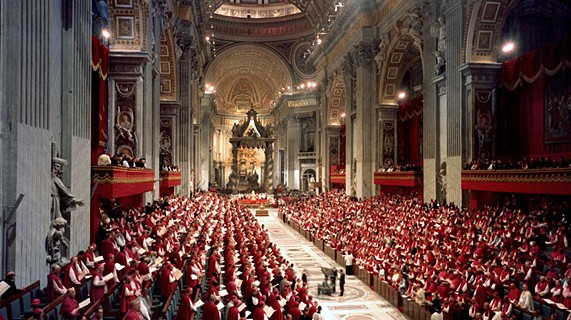
Dogmatic Constitution on the Church
(Lumen Gentium)

See, the days are coming, says the Lord, when I will make a new covenant with the house of Israel and the house of Judah ... I will plant my law within them and inscribe it in their hearts. I will be their God and they shall be my people ... All shall know me, from the least to the greatest, says the Lord.

It was Christ who established this new covenant, the new testament in his blood, calling into being, from Jews and Gentiles, a people that was to form a unity, not in human fashion but in the Spirit, as the new people of God. Those who believe in Christ, reborn not of corruptible but of incorruptible seed through the word of the living God, not from the flesh but from water and the Holy Spirit, are constituted in the fullness of time as a chosen race, a royal priesthood, a holy nation, a people God has made his own ..., once no people but now the people of God.

This messianic people has Christ as its head: Christ who was given up for our sins and rose again for our justification; bearing now the name that is above every name, he reigns in glory in heaven. His people enjoy the dignity and freedom of the children of God, in whose hearts the Holy Spirit dwells as in a temple. They have as their law the new commandment of loving as Christ himself has loved us. They have as their goal the kingdom of God, begun on earth by God himself and destined to grow until it is also brought to perfection by him at the end of time, when Christ, our life, will appear, and creation itself will be freed from slavery to corruption and take on the freedom of the glory of God’s children.

This messianic people, then, though it does not in fact embrace all mankind and often seems to be a tiny flock, is yet the enduring source of unity, hope and salvation for the whole human race. It is established by Christ as a communion of life, of love and of truth; it is also used by him as an instrument for the redemption of all, and is sent out into the whole world as the light of the world and the salt of the earth.

The Israel of old was already called the Church of God while it was on pilgrimage through the desert. So the new Israel, as it makes its way in this present age, seeking a city that is to come, a city that will remain, is also known as the Church of Christ, for he acquired it by his own blood, filled it with his Spirit, and equipped it with appropriate means to be a visible and social unity. God has called together the assembly of those who in faith look on Jesus, the author of salvation and the principle of unity and peace, and so has established the Church to be for each and all the visible sacrament of this unity which brings with it salvation.

Glory to the Father
and to the Son
and to the Holy Spirit:
as it was in the beginning,
is now, and will be forever. Amen


Solemnity of the Annunciation of the Lord

“Therefore the Lord himself will give you a sign; the virgin, pregnant and about to bear a son, shall name him Emmanuel.” (Jeremiah 11:18)

Saint Jerome offers the following insight on these verses from today’s First Reading:

“By no means will God speak in many and various ways, according to the apostle Paul, nor according to another prophet will he be represented through the hands of the prophets, but he who previously spoke through others will himself say “Here I am.” The bride in the Song of Songs also asked in this regard: “O that you would kiss me with the kisses of your mouth!” For “the Lord of hosts is himself the King of glory.” He will descend to a virginal womb and will enter and exit through the eastern gate that always remains closed, concerning which Gabriel said to the virgin: “The Holy Spirit will come upon you, and the power of the Most High will overshadow you; therefore the one who will be born to you is holy and will be called the Son of God.” And Proverbs writes, “Wisdom built itself a home.” Thus when it is said, “The Lord himself will give you a sign,” this should refer to something new and marvelous.” (Commentary on Isaiah, 3)


Collect
O God, who willed that your Word
should take on the reality of human flesh
in the womb of the Virgin Mary,
grant, we pray,
that we,
who confess our Redeemer to be God and man,
may merit to become partakers even in his divine nature.
Who lives and reigns with You
in the unity of the Holy Spirit,
one God, for ever and ever.


Glory to the Father
and to the Son
and to the Holy Spirit:
as it was in the beginning,
is now, and will be forever. Amen


Solemnity
Annunciation of the Lord
— The Incarnation of our Lord, Jesus Christ —

Today’s Second Reading from the
Office of Readings (Liturgy of the Hours)
Solemnity of the Annunciation of the Lord

The Incarnation of our Lord, Jesus Christ

An excerpt from: Letter 28 to flavius
Pope Saint Leo the Great
(pope and Father of the Church)


Lowliness is assured by majesty, weakness by power, mortality by eternity. To pay the debt of our sinful state, a nature that was incapable of suffering was joined to one that could suffer. Thus, in keeping with the healing that we needed, one and the same mediator between God and men, the man Jesus Christ, was able to die in one nature, and unable to die in the other.

He who is true God was therefore born in the complete and perfect nature of a true man, whole in his own nature, whole in ours. By our nature we mean what the Creator had fashioned in us from the beginning, and took to himself in order to restore it.

For in the Savior there was no trace of what the deceiver introduced and man, being misled, allowed to enter. It does not follow that because he submitted to sharing in our human weakness he therefore shared in our sins.

He took the nature of a servant without stain of sin, enlarging our humanity without diminishing his divinity. He emptied himself; though invisible he made himself visible, though Creator and Lord of all things he chose to be one of us mortal men. Yet this was the condescension of compassion, not the loss of omnipotence. So he who in the nature of God had created man, became in the nature of a servant, man himself.

Thus the Son of God enters this lowly world. He comes down from the throne of heaven, yet does not separate himself from the Father’s glory. He is born in a new condition, by a new birth.

He was born in a new condition, for, invisible in his own nature, he became visible in ours. Beyond our grasp, he chose to come within our grasp. Existing before time began, he began to exist at a moment in time. Lord of the universe, he hid his infinite glory and took the nature of a servant. Incapable of suffering as God, he did not refuse to be a man, capable of suffering. Immortal, he chose to be subject to the laws of death.

He who is true God is also true man. There is no falsehood in this unity as long as the lowliness of man and the pre-eminence of God coexist in mutual relationship.

As God does not change by his condescension, so man is not swallowed up by being exalted. Each nature exercises its own activity, in communion with the other. The Word does what is proper to the Word, the flesh fulfills what is proper to the flesh.

One nature is resplendent with miracles, the other falls victim to injuries. As the Word does not lose equality with the Father’s glory, so the flesh does not leave behind the nature of our race.

One and the same person—this must be said over and over again—is truly the Son of God and truly the son of man. He is God in virtue of the fact that in the beginning was the Word, and the Word was with God, and the Word was God. He is man in virtue of the fact that the Word was made flesh, and dwelt among us.

Glory to the Father
and to the Son
and to the Holy Spirit:
as it was in the beginning,
is now, and will be forever. Amen


Lent: Tuesday of the Fifth Week

“Accordingly Moses made a bronze serpent and mounted it on a pole, and whenever the serpent bit someone, the person looked at the bronze serpent and recovered.” (Numbers 21:9)

Saint Gregory of Nazianzus reflects on this verse from today’s First Reading:

“That brazen serpent was hung up as a remedy for the biting serpents, not as a type of him that suffered for us but as a contrast. It saved those that looked upon it, not because they believed it to live but because it was killed, and killed with it were the powers that were subject to it, being destroyed as it deserved. And what is the fitting epitaph for it from us? “O death, where is your sting? O grave, where is your victory?” You are overthrown by the cross. You are slain by him who is the giver of life. You are without breath, dead, without motion, even though you keep the form of a serpent lifted up high on a pole.” (Oration 45)


Collect
Grant us, we pray, O Lord,
perseverance in obeying your will,
that in our days
the people dedicated to your service
may grow in both merit and number.
Through our Lord Jesus Christ, your Son,
Who lives and reigns with You
in the unity of the Holy Spirit,
one God, for ever and ever.


Glory to the Father
and to the Son
and to the Holy Spirit:
as it was in the beginning,
is now, and will be forever. Amen