The way to come to true life


Priest and Doctor of the Church

An excerpt from his Exposition on John

Saturday of the Ninth Week in Ordinary Time

Christ himself is the way, and therefore he says: I am the way. This certainly is eminently right for through him we have access to the Father. Since this way is not separate from its end, but joined to it, he adds the truth and the life; thus he is himself at once both the way and the goal. In his human nature he is the way, and in his divine nature he is the goal. Therefore, speaking as man he says: I am the way; and speaking as God he adds: the truth and the life. These two words are an apt description of this goal.

For this goal is the object of human desire, and a man desires two things above all. In the first place he wants to know the truth, which is peculiar to him; and secondly he wants to continue to exist, which is common to all things. Christ is the way by which we come to know truth, though he is also that truth: Lead me, O Lord, in truth, and I shall enter into your way. Christ is also the way to come to life, though he is also that life: You have made known the ways of life.

Therefore, he designated the end of this way by truth and life, about which we have spoken above with reference to Christ. First, he himself is life, for life was in him; then, he is truth, because he was the light of men, and light is truth.

If, then, you are looking for the way by which you should go, take Christ, because he himself is the way: This is the way; walk in it. And Augustine says: Make man your way and you shall arrive at God. It is better to limp along the way than stride along off the way. For a man who limps along the way, even if he only makes slow progress, comes to the end of the way; but one who is off the way, the more quickly he runs, the further away is he from his goal.

If you are looking for a goal, hold fast to Christ, because he himself is the truth, where we desire to be. My mouth shall reflect on the truth. If you are looking for a resting place, hold fast to Christ, because he himself is the life. Whoever finds me finds life, and receives salvation from the Lord.

Therefore hold fast to Christ if you wish to be safe. You will not be able to go astray, because he is the way. He who remains with him does not wander in trackless places; he is on the right way. Moreover he cannot be deceived, because he is the truth, and he teaches every truth. And he says: For this I was born and for this I have come, to bear witness to the truth. Nor can he be disturbed, because he is both life and the giver of life. For he says: I have come that they may have life, and have it more abundantly.


Glory to the Father
and to the Son
and to the Holy Spirit:
as it was in the beginning,
is now, and will be forever. Amen


Memorial of Saint Boniface,
Bishop and Martyr


“David himself calls him ‘Lord’; so how is he his son?” [The] great crowd heard this with delight.” (Mark 12:37.)

Saint Augustine of Hippo comments on this verse from the Gospel proclaimed during today’s Mass:

“For that through which Mary had been made was not dying, but that which was made from Mary was dying. The eternity of [his] divinity was not dying, but the weakness of [his] flesh was dying. Therefore he made that reply, distinguishing in the faith of believers the one who came from the one through whom he came. For he, God and Lord of heaven and earth, came through a woman as his mother. In regard to the fact that he was Lord of the world, Lord of heaven and earth, he was also, of course, Lord of Mary; and in regard to the fact that he was creator of the world, creator of heaven and earth, he was also the creator of Mary. But insofar as it was said, “made of a woman, made under the law,” he was the son of Mary. He was the Lord of Mary, he was the son of Mary; he was the creator of Mary, he was created from Mary. Do not be amazed that he is both son and Lord. For as he was [the son] of Mary, so, also, he was said to be the son of David; indeed the son of David precisely because the son of Mary. Hear the apostle speaking clearly: “who was born of the seed of David, according to the flesh.” Hear that he was also the Lord of David; and let David himself say this: “The Lord said to my Lord, ‘Sit at my right hand.’” And Jesus himself proposed this to the Jews, and by it refuted them. Therefore just as he was both the son and the Lord of David, the son of David according to the flesh, the Lord of David according to [his] divinity, so he was the son of Mary according to the flesh and the Lord of Mary according to [his] majesty. Because, therefore, she was not the mother of [his] divinity and what she sought would be a miracle through [his] divinity, he answered her, “What is it to me and to you, woman?” But that you may not think that I am denying you as my mother, “My hour has not yet come.” For there shall I acknowledge you when the weakness of which you are the mother has begun to hang on the cross.” (Tractate on John, 8.)


Collect
May the Martyr Saint Boniface
be our advocate, O Lord,
that we may firmly hold the faith
he taught with his lips and sealed in his blood
and confidently profess it by our deeds.
Through our Lord Jesus Christ, Your Son,
Who lives and reigns with You
in the unity of the Holy Spirit,
God, for ever and ever. Amen.


Glory to the Father
and to the Son
and to the Holy Spirit:
as it was in the beginning,
is now, and will be forever. Amen


The careful shepherd
watches over Christ’s flock


Bishop and Martyr

An excerpt from his Letter 78

Memorial of Saint Boniface, Bishop and Martyr

In her voyage across the ocean of this world, the Church is like a great ship being pounded by the waves of life’s different stresses. Our duty is not to abandon ship but to keep her on her course.

The ancient fathers showed us how we should carry out this duty: Clement, Cornelius and many others in the city of Rome, Cyprian at Carthage, Athanasius at Alexandria. They all lived under emperors who were pagans; they all steered Christ’s ship—or rather his most dear spouse, the Church. This they did by teaching and defending her, by their labors and sufferings, even to the shedding of blood.

I am terrified when I think of all this. Fear and trembling came upon me and the darkness of my sins almost covered me. I would gladly give up the task of guiding the Church which I have accepted if I could find such an action warranted by the example of the fathers or by holy Scripture.

Since this is the case, and since the truth can be assaulted but never defeated or falsified, with our tired mind let us turn to the words of Solomon: Trust in the Lord with all your heart and do not rely on your own prudence. Think on him in all your ways, and he will guide your steps. In another place he says: The name of the Lord is an impregnable tower. The just man seeks refuge in it and he will be saved.

Let us stand fast in what is right and prepare our souls for trial. Let us wait upon God’s strengthening aid and say to him: O Lord, you have been our refuge in all generations.

Let us trust in him who has placed this burden upon us. What we ourselves cannot bear let us bear with the help of Christ. For he is all-powerful and he tells us: My yoke is easy and my burden is light.

Let us continue the fight on the day of the Lord. The days of anguish and of tribulation have overtaken us; if God so wills, let us die for the holy laws of our fathers, so that we may deserve to obtain an eternal inheritance with them.

Let us be neither dogs that do not bark nor silent onlookers nor paid servants who run away before the wolf. Instead let us be careful shepherds watching over Christ’s flock. Let us preach the whole of God’s plan to the powerful and to the humble, to rich and to poor, to men of every rank and age, as far as God gives us the strength, in season and out of season, as Saint Gregory writes in his book of Pastoral Instruction.


Glory to the Father
and to the Son
and to the Holy Spirit:
as it was in the beginning,
is now, and will be forever. Amen


Thursday of the Ninth Week in Ordinary Time


“You shall love the Lord your God with all your heart, with all your soul, with all your mind, and with all your strength...” (Mark 12:30.)

Saint Gregory of Nyssa (part 2 of the background of Saint Gregory of Nyssa is found here) offers the following insight on this verse from today’s Gospel:

“Human life consists in a threefold unity. We are taught similarly by the apostle in what he says to the Ephesians, praying for them that the complete grace of their “body and soul and spirit” may be preserved at the coming of the Lord. We use the word “body,” for the nutritive part, the word for the vital, “soul,” and the word “spirit” for the intellective dimension. In just this way the Lord instructs the writer of the Gospel that he should set before every commandment that love to God which is exercised with all the heart and soul and mind.9 This single phrase [NT Vol. II, p. 165] embraces the human whole: the corporeal heart, the mind as the higher intellectual and mental nature, and the soul as their mediator.” (On the Making of Man, 8.)


Collect
O God,
Whose providence never fails in its design,
keep from us, we humbly beseech you,
all that might harm us
and grant all that works for our good.
Through our Lord Jesus Christ, your Son,
Who lives and reigns with You
in the unity of the Holy Spirit,
God, for ever and ever. Amen.


Glory to the Father
and to the Son
and to the Holy Spirit:
as it was in the beginning,
is now, and will be forever. Amen


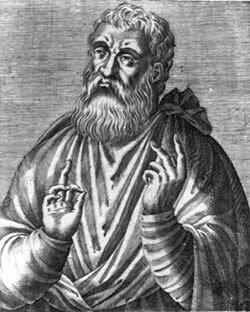
The Church moves forward like the advancing dawn


Bishop of Rome and Great Western Father of the Church

An excerpt from Moral Reflections on Job, Book 29.

Thursday of the Ninth Week in Ordinary Time

Since the daybreak or the dawn is changed gradually from darkness into light, the Church, which comprises the elect, is fittingly styled daybreak or dawn. While she is being led from the night of infidelity to the light of faith, she is opened gradually to the splendor of heavenly brightness, just as dawn yields to the day after darkness. The Song of Songs says aptly: Who is this who moves forward like the advancing dawn? Holy Church, inasmuch as she keeps searching for the rewards of eternal life, has been called the dawn. While she turns her back on the darkness of sins, she begins to shine with the light of righteousness.

This reference to the dawn conjures up a still more subtle consideration. The dawn intimates that the night is over; it does not yet proclaim the full light of day. While it dispels the darkness and welcomes the light, it holds both of them, the one mixed with the other, as it were. Are not all of us who follow the truth in this life daybreak and dawn? While we do some things which already belong to the light, we are not free from the remnants of darkness. In Scripture the Prophet says to God: No living being will be justified in your sight. Scripture also says: In many ways all of us give offense.

When he writes, the night is passed. Paul does not add, the day is come, but rather, the day is at hand. Since he argues that after the night has passed, the day as yet is not come but is rather at hand, he shows that the period before full daylight and after darkness is without doubt the dawn, and that he himself is living in that period.

It will be fully day for the Church of the elect when she is no longer darkened by the shadow of sin. It will be fully day for her when she shines with the perfect brilliance of interior light. This dawn is aptly shown to be an ongoing process when Scripture says: And you showed the dawn its place. A thing which is shown its place is certainly called from one place to another. What is the place of the dawn but the perfect clearness of eternal vision? When the dawn has been brought there, it will retain nothing belonging to the darkness of night. When the Psalmist writes: My soul thirsts for the living God; when shall I go and see the face of God?, does he not refer to the effort made by the dawn to reach its place? Paul was hastening to the place which he knew the dawn would reach when he said he wished to die and to be with Christ. He expressed the same idea when he said: For me to live is Christ, and to die is gain.


Glory to the Father
and to the Son
and to the Holy Spirit:
as it was in the beginning,
is now, and will be forever. Amen


Memorial of
Saint Charles Lwanga and Companions

“Some Sadducees, who say there is no resurrection, came to Him and put this question to Him …” (Mark 12:18.)

Tertullian of Carthage comments on this verse from the First Reading proclaimed at Mass today:

“They put to him the strongest case they could to impair his credibility. They fashioned a contorted argument to pursue the question which they had initiated. Their deceptive inquiry concerned the flesh, whether or not it would be subject to marriage after the resurrection. They assumed the case of a woman who had married seven brothers, so as to make it doubtful as to which of them she should be restored.1 Now, let the gist both of the question and the answer be kept steadily in view, and the discussion is settled at once in this way: The Sadducees indeed denied the resurrection, while the Lord affirmed it. In affirming it, he reproached them as being both ignorant of the Scriptures—which declare the resurrection—and disbelieving of the power of God as able to raise the dead. He then spoke without ambiguity of the dead being raised.” (On the Resurrection of the Flesh, 36.)


Collect
O God,
Who have made the blood of Martyrs
the seed of Christians, mercifully grant
that the field which is Your Church,
watered by the blood
shed by Saints Charles Lwanga
and his companions, may be fertile and
always yield You an abundant harvest.
Through our Lord Jesus Christ, Your Son,
Who lives and reigns with You
in the unity of the Holy Spirit,
God, for ever and ever. Amen


Glory to the Father
and to the Son
and to the Holy Spirit:
as it was in the beginning,
is now, and will be forever. Amen


The glory of the martyrs — a sign of rebirth


Bishop of Rome

An excerpt from the Canonization Homily of Saint Charles Lwanga and Companions

Memorial of Saint Charles Lwanga and Companions, Martyrs

The African martyrs add another page to the martyrology —  the Church’s roll of honor — an occasion both of mourning and of joy. This is a page worthy in every way to be added to the annals of that Africa of earlier times which we, living in this era and being men of little faith, never expected to be repeated.

In earlier times, there occurred those famous deeds, so moving to the spirit, of the martyrs of Scilli, of Carthage, and of that “white robed army” of Utica commemorated by Saint Augustine and Prudentius; of the martyrs of Egypt so highly praised by Saint John Chrysostom, and of the martyrs of the Vandal persecution. Who would have thought that in our days we should have witnessed events as heroic and glorious?

Who could have predicted to the famous African confessors and martyrs such as Cyprian, Felicity, Perpetua and — the greatest of all — Augustine, that we would one day add names so dear to us as Charles Lwanga and Matthias Mulumba Kalemba and their twenty companions? Nor must we forget those members of the Anglican Church who also died for the name of Christ.

These African martyrs herald the dawn of a new age. If only the mind of man might be directed not toward persecutions and religious conflicts but toward a rebirth of Christianity and civilization!

Africa has been washed by the blood of these latest martyrs, the first of this new age (and, God willing, let them be the last, although such a holocaust is precious indeed). Africa is reborn free and independent.

The infamous crime by which these young men were put to death was so unspeakable and so expressive of the times. It shows us clearly that a new people needs a moral foundation, needs new spiritual customs firmly planted, and to be handed down to posterity. Symbolically, this crime also reveals that a simple and rough way of life—enriched by many fine human qualities yet enslaved by its own weakness and corruption—must give way to a more civilized life wherein the higher expressions of the mind and better social conditions prevail.


Glory to the Father
and to the Son
and to the Holy Spirit:
as it was in the beginning,
is now, and will be forever. Amen


Tuesday of the Ninth Week in Ordinary Time


“They came and said to him, “Teacher, we know that you are a truthful man and that you are not concerned with anyone’s opinion. You do not regard a person’s status but teach the way of God in accordance with the truth. Is it lawful to pay the census tax to Caesar or not? Should we pay or should we not pay?” (Mark 12:14.)

Saint Justin of Rome comments on this verse from the Gospel proclaimed at Mass today:

“So we worship God only, but in temporal matters we gladly serve you, recognizing you as emperors and rulers, and praying that along with your imperial power you may also be found to have a sound mind. Suppose you pay no attention to our prayers and our frank statements about everything. That will not injure us, since we believe, and are convinced without doubt, that everyone will finally experience the restraint of divine judgment in relation to their voluntary actions. Each will be required to give account for the responsibilities which he has been given by God” (First Apology, 17.)


Collect
O God,
Whose providence never fails in its design,
keep from us, we humbly beseech You,
all that might harm us and
grant all that works for our good.
Through our Lord Jesus Christ, your Son,
Who lives and reigns with You
in the unity of the Holy Spirit,
God, for ever and ever.


Glory to the Father
and to the Son
and to the Holy Spirit:
as it was in the beginning,
is now, and will be forever. Amen


Top


On false spiritual peace


Abbot

An excerpt from his collection of teachings

Tuesday of the Ninth Week in Ordinary Time

The man who finds fault with himself accepts all things cheerfully—misfortune, loss, disgrace, dishonor and any other kind of adversity. He believes that he is deserving of all these things and nothing can disturb him. No one could be more at peace than this man.

But perhaps you will offer me this objection: “Suppose my brother injures me, and on examining myself I find that I have not given him any cause. Why should I blame myself?”

Certainly if someone examines himself carefully and with fear of God, he will never find himself completely innocent. He will see that he has given some provocation by an action, a word or by his manner. If he does find that he is not guilty in any of these ways, certainly he must have injured that brother somehow at some other time. Or perhaps he has been a source of annoyance to some other brother. For this reason he deserves to endure the injury because of many other sins that he has committed on other occasions.

Someone else asks why he should accuse himself when he was sitting peacefully and quietly when a brother came upon him with an unkind or insulting word. He cannot tolerate it, and so he thinks that his anger is justified. If that brother had not approached him and said those words and upset him, he never would have sinned.

This kind of thinking is surely ridiculous and has no rational basis. For the fact that he has said anything at all in this situation breaks the cover on the passionate anger within him, which is all the more exposed by his excessive anxiety. If he wished, he would do penance. He has become like a clean, shiny grain of wheat that, when broken, is full of dirt inside.

The man who thinks that he is quiet and peaceful has within him a passion that he does not see. A brother comes up, utters some unkind word and immediately all the venom and mire that lie hidden within him are spewed out. If he wishes mercy, he must do penance, purify himself and strive to become perfect. He will see that he should have returned thanks to his brother instead of returning the injury, because his brother has proven to be an occasion of profit to him. It will not be long before he will no longer be bothered by these temptations. The more perfect he grows, the less these temptations will affect him. For the more the soul advances, the stronger and more powerful it becomes in bearing the difficulties that it meets.


Glory to the Father
and to the Son
and to the Holy Spirit:
as it was in the beginning,
is now, and will be forever. Amen


Memorial of Saint Justin of Rome,
Martyr


“... may grace and peace be yours in abundance through knowledge of God and of Jesus our Lord....” (2 Peter 1:2-7.)

In commenting on these verses from today’s First Reading, Saint John Chrysostom writes:

“There is nothing to equal this, which is why we pray and seek after the angel of peace. Everywhere we pray for peace in the churches—in the prayers, in the supplications and in the sermons. And the Guardian of the church gives it to us not once or twice but many times over: “Peace be unto you.” Why? Because peace is the mother of all good things and the foundation of our joy. For this reason Christ taught his disciples that when they entered people’s houses they were to say: “Peace be unto you.” Without peace everything else is useless.” (Catena)


Collect
O God, Who through the folly of the Cross
wondrously taught Saint Justin the Martyr
the surpassing knowledge of Jesus Christ,
grant us, through his intercession,
that, having rejected deception and error,
we may become steadfast in the faith.
Through our Lord Jesus Christ, Your Son,
Who lives and reigns with You in the
unity of the Holy Spirit,
God, for ever and ever.


Glory to the Father
and to the Son
and to the Holy Spirit:
as it was in the beginning,
is now, and will be forever. Amen


Top