Friday of the Ninth Week in Ordinary Time


“David himself calls him ‘Lord’; so how is he his son?” [The] great crowd heard this with delight.” (Mark 12:37.)

Saint Augustine of Hippo comments on this verse from the Gospel proclaimed during today’s Mass:

“For that through which Mary had been made was not dying, but that which was made from Mary was dying. The eternity of [his] divinity was not dying, but the weakness of [his] flesh was dying. Therefore he made that reply, distinguishing in the faith of believers the one who came from the one through whom he came. For he, God and Lord of heaven and earth, came through a woman as his mother. In regard to the fact that he was Lord of the world, Lord of heaven and earth, he was also, of course, Lord of Mary; and in regard to the fact that he was creator of the world, creator of heaven and earth, he was also the creator of Mary. But insofar as it was said, “made of a woman, made under the law,” he was the son of Mary. He was the Lord of Mary, he was the son of Mary; he was the creator of Mary, he was created from Mary. Do not be amazed that he is both son and Lord. For as he was [the son] of Mary, so, also, he was said to be the son of David; indeed the son of David precisely because the son of Mary. Hear the apostle speaking clearly: “who was born of the seed of David, according to the flesh.” Hear that he was also the Lord of David; and let David himself say this: “The Lord said to my Lord, ‘Sit at my right hand.’” And Jesus himself proposed this to the Jews, and by it refuted them. Therefore just as he was both the son and the Lord of David, the son of David according to the flesh, the Lord of David according to [his] divinity, so he was the son of Mary according to the flesh and the Lord of Mary according to [his] majesty. Because, therefore, she was not the mother of [his] divinity and what she sought would be a miracle through [his] divinity, he answered her, “What is it to me and to you, woman?” But that you may not think that I am denying you as my mother, “My hour has not yet come.” For there shall I acknowledge you when the weakness of which you are the mother has begun to hang on the cross.” (Tractate on John, 8.)


Collect
O God,
Whose providence never fails in its design,
keep from us, we humbly beseech You,
all that might harm us and
grant all that works for our good.
Through our Lord Jesus Christ, Your Son,
Who lives and reigns with You
in the unity of the Holy Spirit,
God, for ever and ever. Amen


Glory to the Father
and to the Son
and to the Holy Spirit:
as it was in the beginning,
is now, and will be forever. Amen


Top


The Lord sees our thoughts and the intentions of our hearts


Bishop
An excerpt from Tractate 6

Friday of the Ninth Week in Ordinary Time


The Lord knows the thoughts and intentions of our hearts. Without a doubt, every one of them is known to him, while we know only those which he lets us read by the grace of discernment. The spirit of man does not know all that is in man, nor all of the thoughts which he has, willingly or unwillingly. Man does not always perceive his thoughts as they really are. Having clouded vision, he does not discern them clearly with his mind’s eye.

Often under the guise of devotion a suggestion occurs to our mind—coming from our own thoughts or from another person or from the tempter—and in God’s eyes we do not deserve any reward for our virtue. For there are certain imitations of true virtues as also of vices which play tricks with the heart and bedazzle the mind’s vision. As a result, the appearance of goodness often seems to be in something which is evil, and equally the appearance of evil seems to be in something good. This is part of our wretchedness and ignorance, causing us anguish and anxiety.

It has been written: There are paths which seem to man to be right, but which in the end lead him to hell. To avoid this peril, Saint John gives us these words of advice: Test the spirits to see if they are from God. Now no one can test the spirits to see if they are from God unless God has given him discernment of spirits to enable him to investigate spiritual thoughts, inclinations and intentions with honest and true judgment. Discernment is the mother of all the virtues; everyone needs it either to guide the lives of others or to direct and reform his own life.

In the sphere of action, a right thought is one ruled by the will of God, and intentions are holy when directed single-mindedly toward him. In a word, we could see clearly through any action of ours, or into our entire lives, if we had a simple eye. A simple eye is an eye, and it is simple. This means that we see by right thinking what is to be done, and by our good intention we carry it out with simple honesty, because deceitful action is wrong. Right thinking does not permit mistakes; a good intention rules out pretence. This then is true discernment, a combination of right thinking and good intention.

Therefore, we must do all our actions in the light of discernment as if in God and in his presence.


Glory to the Father
and to the Son
and to the Holy Spirit:
as it was in the beginning,
is now, and will be forever. Amen


Memorial of Saint Charles Lwanga and Companions, Martyrs


“The second is this: ‘You shall love your neighbor as yourself.’ There is no other commandment greater than these.”” (Mark 12:31.)

Saint Augustine of Hippo comments on this verse from the Gospel proclaimed during today’s Mass:

“This virtue consists in nothing else but in loving what is worthy of love; it is prudence to choose this, fortitude to be turned from it by no obstacles, temperance to be enticed by no allurements, justice to be diverted by no pride. Why do we choose what we exclusively love, except that we find nothing better? But this is God, and if we prefer or equate any creature with God, we know nothing about loving ourselves. We are made better by approaching closer to him than whom nothing is better. We go to him not by walking, but by loving. We will have him more present to us in proportion as we are able to purify the love by which we draw near to him, for he is not spread through or confined by corporeal space; he is everywhere present and everywhere wholly present, and we go to him not by the motion of our feet but by our conduct. Conduct is not usually discerned by what one knows but by what one loves; good or bad love makes good or bad conduct.” (Letter 155 (To Macedonius))


Collect
O God,
Who have made the blood of Martyrs
the seed of Christians, mercifully grant
that the field which is Your Church,
watered by the blood
shed by Saints Charles Lwanga
and his companions, may be fertile and
always yield You an abundant harvest.
Through our Lord Jesus Christ, Your Son,
Who lives and reigns with You
in the unity of the Holy Spirit,
God, for ever and ever. Amen


Glory to the Father
and to the Son
and to the Holy Spirit:
as it was in the beginning,
is now, and will be forever. Amen


Top


The glory of the martyrs — a sign of rebirth


Bishop of Rome

An excerpt from the Canonization Homily of Saint Charles Lwanga and Companions

Memorial of Saint Charles Lwanga and Companions, Martyrs

The African martyrs add another page to the martyrology —  the Church’s roll of honor — an occasion both of mourning and of joy. This is a page worthy in every way to be added to the annals of that Africa of earlier times which we, living in this era and being men of little faith, never expected to be repeated.

In earlier times, there occurred those famous deeds, so moving to the spirit, of the martyrs of Scilli, of Carthage, and of that “white robed army” of Utica commemorated by Saint Augustine and Prudentius; of the martyrs of Egypt so highly praised by Saint John Chrysostom, and of the martyrs of the Vandal persecution. Who would have thought that in our days we should have witnessed events as heroic and glorious?

Who could have predicted to the famous African confessors and martyrs such as Cyprian, Felicity, Perpetua and — the greatest of all — Augustine, that we would one day add names so dear to us as Charles Lwanga and Matthias Mulumba Kalemba and their twenty companions? Nor must we forget those members of the Anglican Church who also died for the name of Christ.

These African martyrs herald the dawn of a new age. If only the mind of man might be directed not toward persecutions and religious conflicts but toward a rebirth of Christianity and civilization!

Africa has been washed by the blood of these latest martyrs, the first of this new age (and, God willing, let them be the last, although such a holocaust is precious indeed). Africa is reborn free and independent.

The infamous crime by which these young men were put to death was so unspeakable and so expressive of the times. It shows us clearly that a new people needs a moral foundation, needs new spiritual customs firmly planted, and to be handed down to posterity. Symbolically, this crime also reveals that a simple and rough way of life—enriched by many fine human qualities yet enslaved by its own weakness and corruption—must give way to a more civilized life wherein the higher expressions of the mind and better social conditions prevail.


Glory to the Father
and to the Son
and to the Holy Spirit:
as it was in the beginning,
is now, and will be forever. Amen


Wednesday of the Ninth Week in Ordinary Time


“Then sad at heart, I groaned and wept aloud. With sobs I began to pray: ...” (Tobit 3:1.)

Origen of Alexandria (part 2 of Pope Benedict’s reflections on Origen) comments on this verse from the First Reading proclaimed at Mass today:

“Regarding the second kind of prayer, see Daniel: “And Azarias standing up prayed in this manner and opening his mouth in the midst of the fire he said.” And Tobias: “And I began to pray with tears, saying, You are just, O Lord, and all your works are just and all your ways mercy and truth. And your judgments are true and just forever.” And since the passage in Daniel has been obelized on the ground that it is not found in the Hebrew text, and those of the circumcision reject the book of Tobias as not being canonical, I shall quote the words of Anna from the first book of Kings: “And she prayed the Lord, shedding many tears. And she made a vow, saying, O Lord of hosts, if you will look down on the affliction of your servant,” and so on. And in Habakkuk: “A prayer of Habakkuk the prophet with song. O Lord, I have heard your voice and was afraid. O Lord, I reflected on your works and was astonished. In the midst of two animals you will be known; in the approach of the years you will be recognized.” The example just given illustrates very well the definition of prayer inasmuch as he who offers it unites it with praise of God. And again, in the book of Jonah: “Jonah prayed to the Lord his God out of the belly of the fish. And he said, I cried out of my affliction to the Lord my God, and he heard me. Out of the belly of hell you heard the screams of my voice. And you have thrown me into the deep in the heart of the sea, and a flood has surrounded me.” (On Prayer, 14.)


Collect
O God,
Whose providence never fails in its design,
keep from us, we humbly beseech You,
all that might harm us
and grant all that works for our good.
Through our Lord Jesus Christ, Your Son,
Who lives and reigns with You
in the unity of the Holy Spirit,
God, for ever and ever. Amen.


Glory to the Father
and to the Son
and to the Holy Spirit:
as it was in the beginning,
is now, and will be forever. Amen




True doctrine dispels arrogance


Bishop of Rome and Great Western Father of the Church

An excerpt from his Moral Reflections on Job, Book 23-24.

Wednesday of the Ninth Week in Ordinary Time

Listen, Job, to what I say and ponder all my words. The teaching of the arrogant has this characteristic: they do not know how to introduce their teaching humbly and they cannot convey correctly to others the things they understand correctly themselves. With their words they betray what they teach; they give the impression that they live on lofty heights from which they look down disdainfully on those whom they are teaching; they regard the latter as inferiors, to whom they do not deign to listen as they talk; indeed they scarcely deign to talk to them at all—they simply lay down the law.

To teachers of this kind the Lord through the prophet says rightly: But you will rule them with severity and with power. There is no doubt that such as are prone not to correct their subjects with quiet reasoning, but to compel them to change by rough and domineering methods, rule with severity and power.

On the contrary true doctrine all the more effectively shuns the voice of arrogance through reflection, in which it pursues the arrogant teacher himself with the arrows of its words. It ensures that the pride which it attacks in the hearts of those listening to the sacred words will not in fact be preached by arrogant conduct. For true doctrine tries both to teach by words and to demonstrate by living example—humility, which is the mother and mistress of virtues. Its goal is to express humility among the disciples of truth more by deeds than by words.

Accordingly, when addressing the Thessalonians, Paul is oblivious of his own eminent dignity as an apostle; he actually says: We became as little children in your midst. Similarly, the apostle Peter enjoins: Be always prepared to satisfy everybody who asks a reason for the hope which is in you, and by adding the words, with a good conscience, speak gently and respectfully, Peter draws attention to the manner in which sacred doctrine should be taught.

When he tells his disciples: These things command and teach with all power, Paul really recommends the credibility that goes hand in hand with good behavior rather than the domineering exercise of power. When one practices first and preaches afterwards, one is really teaching with power. Doctrine loses credibility, if conscience tethers the tongue. Paul, therefore, in the saying quoted above, does not refer to the power of lofty rhetoric but to the confidence elicited by good deeds. Of the Lord, too, it is said: He taught with authority unlike the Scribes and the Pharisees. He alone in a unique and sovereign way spoke from the power of his goodness because no evil weakness led him into sin. For he had from the power of his own divine nature what he gave to us through the sinlessness of his human nature.


Glory to the Father
and to the Son
and to the Holy Spirit:
as it was in the beginning,
is now, and will be forever. Amen


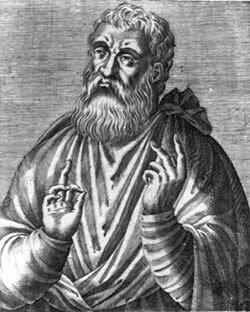
Saint Justin of Rome, Martyr


“They came and said to him, “Teacher, we know that you are a truthful man and that you are not concerned with anyone’s opinion. You do not regard a person’s status but teach the way of God in accordance with the truth. Is it lawful to pay the census tax to Caesar or not? Should we pay or should we not pay?” (Mark 12:14.)

Saint Justin of Rome comments on this verse from the Gospel proclaimed at Mass today:

“So we worship God only, but in temporal matters we gladly serve you, recognizing you as emperors and rulers, and praying that along with your imperial power you may also be found to have a sound mind. Suppose you pay no attention to our prayers and our frank statements about everything. That will not injure us, since we believe, and are convinced without doubt, that everyone will finally experience the restraint of divine judgment in relation to their voluntary actions. Each will be required to give account for the responsibilities which he has been given by God” (First Apology, 17.)


Collect
O God, Who through the folly of the Cross
wondrously taught Saint Justin the Martyr
the surpassing knowledge of Jesus Christ,
grant us, through his intercession,
that, having rejected deception and error,
we may become steadfast in the faith.
Through our Lord Jesus Christ, Your Son,
Who lives and reigns with You in the
unity of the Holy Spirit,
God, for ever and ever.


Glory to the Father
and to the Son
and to the Holy Spirit:
as it was in the beginning,
is now, and will be forever. Amen


Top


I have accepted the true doctrines of the Christians


Martyr and Apologist

An excerpt from his First Apology in the Defense of Christians

Memorial: Saint Justin of Rome, Martyr

The saints were seized and brought before the prefect of Rome, whose name was Rusticus. As they stood before the judgement seat, Rusticus the prefect said to Justin: “Above all, have faith in the gods and obey the emperors.” Justin said: “We cannot be accused or condemned for obeying the commands of our Savior, Jesus Christ.”

Rusticus said: “What system of teaching do you profess?” Justin said: “I have tried to learn about every system, but I have accepted the true doctrines of the Christians, though these are not approved by those who are held fast by error.”

The prefect Rusticus said: “Are those doctrines approved by you, wretch that you are?” Justin said: “Yes, for I follow them with their correct teaching.”

The prefect Rusticus said: “What sort of teaching is that?” Justin said: “Worship the God of the Christians. We hold him to be from the beginning the one creator and maker of the whole creation, of things seen and things unseen. We worship also the Lord Jesus Christ, the Son of God. He was foretold by the prophets as the future herald of salvation for the human race and the teacher of distinguished disciples. For myself, since I am a human being, I consider that what I say is insignificant in comparison with his infinite godhead. I acknowledge the existence of a prophetic power, for the one I have just spoken of as the Son of God was the subject of prophecy. I know that the prophets were inspired from above when they spoke of his coming among men.”

Rusticus said: “You are a Christian, then?” Justin said: “Yes, I am a Christian.”

The prefect said to Justin: “You are called a learned man and think that you know what is true teaching. Listen: if you were scourged and beheaded, are you convinced that you would go up to heaven?” Justin said: “I hope that I shall enter God’s house if I suffer that way. For I know that God’s favor is stored up until the end of the whole world for all who have lived good lives.”

The prefect Rusticus said: “Do you have an idea that you will go up to heaven to receive some suitable rewards?” Justin said: “It is not an idea that I have; it is something I know well and hold to be most certain.”

The prefect Rusticus said: “Now let us come to the point at issue, which is necessary and urgent. Gather round then and with one accord offer sacrifice to the gods.” Justin said: “No one who is right thinking stoops from true worship to false worship.”

The prefect Rusticus said: “If you do not do as you are commanded you will be tortured without mercy.” Justin said: “We hope to suffer torment for the sake of our Lord Jesus Christ, and so be saved. For this will bring us salvation and confidence as we stand before the more terrible and universal judgment-seat of our Lord and Savior.”

In the same way the other martyrs also said: “Do what you will. We are Christians; we do not offer sacrifice to idols.”

The prefect Rusticus pronounced sentence, saying: “Let those who have refused to sacrifice to the gods and to obey the command of the emperor be scourged and led away to suffer capital punishment according to the ruling of the laws.” Glorifying God, the holy martyrs went out to the accustomed place. They were beheaded, and so fulfilled their witness of martyrdom in confessing their faith in their Savior.


Glory to the Father
and to the Son
and to the Holy Spirit:
as it was in the beginning,
is now, and will be forever. Amen


Feast of the Visitation of the Blessed Virgin Mary


“The LORD has removed the judgment against you, he has turned away your enemies; The King of Israel, the LORD, is in your midst, you have no further misfortune to fear.” (Zephaniah 3:15.)

Saint Cyril of Jerusalem comments on this verse from the First Reading proclaimed at Mass today:

“Take heart, O Jerusalem, the Lord will take away your iniquities. The Lord will wash away the filth of his sons and daughters by the spirit of judgment and the spirit of burning. He will pour upon you clean water, and you shall be cleansed from all your sins. Choiring angels shall encircle you, chanting, “Who is it that comes up all white and leaning upon her beloved?” For the soul that was formerly a slave has now accounted its Lord as its kinsman, and he, acknowledging its sincere purpose, will answer, “Ah, you are beautiful, my beloved, ah, you are beautiful — your teeth are like a flock of ewes to be shorn” — a sincere confession is a spiritual shearing. And further: “all of them big with twins,” signifying the twofold grace, either that perfected by water and the Spirit or that announced in the Old and in the New Testament. God grant that all of you, your course of fasting finished, mindful of the teaching, fruitful in good works, standing blameless before the spiritual bridegroom, may obtain the remission of your sins from God, in Christ Jesus our Lord, to whom be the glory forever and ever.” (Catechetical Lecture, 3.)


Collect
Almighty, ever-living God,
Who, while the Blessed Virgin Mary
was carrying Your Son in her womb,
inspired her to visit Elizabeth,
grant us, we pray, that,
faithful to the promptings of the Spirit,
we may magnify Your greatness
with the Virgin Mary at all times.
Through our Lord Jesus Christ, Your Son,
Who lives and reigns with You
in the unity of the Holy Spirit,
God, for ever and ever.


Glory to the Father
and to the Son
and to the Holy Spirit:
as it was in the beginning,
is now, and will be forever. Amen


Top


Mary proclaims the greatness of the Lord working in her


Priest and Doctor of the Church

An excerpt from a Homily, Book 1

Feast of the Visitation of the Blessed Virgin Mary

My soul proclaims the greatness of the Lord, and my spirit rejoices in God my savior. With these words Mary first acknowledges the special gifts she has been given. Then she recalls God’s universal favors, bestowed unceasingly on the human race.

When a man devotes all his thoughts to the praise and service of the Lord, he proclaims God’s greatness. His observance of God’s commands, moreover, shows that he has God’s power and greatness always at heart. His spirit rejoices in God his savior and delights in the mere recollection of his creator who gives him hope for eternal salvation.

These words are often for all God’s creations, but especially for the Mother of God. She alone was chosen, and she burned with spiritual love for the son she so joyously conceived. Above all other saints, she alone could truly rejoice in Jesus, her savior, for she knew that he who was the source of eternal salvation would be born in time in her body, in one person both her own son and her Lord.

For the Almighty has done great things for me, and holy is his name. Mary attributes nothing to her own merits. She refers all her greatness to the gift of the one whose essence is power and whose nature is greatness, for he fills with greatness and strength the small and the weak who believe in him.

She did well to add: and holy is his name, to warn those who heard, and indeed all who would receive his words, that they must believe and call upon his name. For they too could share in everlasting holiness and true salvation according to the words of the prophet: and it will come to pass, that everyone who calls on the name of the Lord will be saved. This is the name she spoke of earlier: and my spirit rejoices in God my savior.

Therefore it is an excellent and fruitful custom of holy Church that we should sing Mary’s hymn at the time of evening prayer. By meditating upon the incarnation, our devotion is kindled, and by remembering the example of God’s Mother, we are encouraged to lead a life of virtue. Such virtues are best achieved in the evening. We are weary after the day’s work and worn out by our distractions. The time for rest is near, and our minds are ready for contemplation.


Glory to the Father
and to the Son
and to the Holy Spirit:
as it was in the beginning,
is now, and will be forever. Amen