Thursday of the Second Week of Advent


“In the wilderness I will plant the cedar, acacia, myrtle, and olive; in the wasteland I will set the cypress, together with the plane tree and the pine ...” (Isaiah 41:19.)

Saint Jerome offers the following insight on this verses from today’s First Reading:

“All these [types of trees] are equally placed in solitude, lest even one chord from the harp of the Lord and any virtue of the graces of the church seem to be missing. They are planted in the desert so that all might understand and recognize with a common mind that the hand of the Lord has accomplished all these things, so that in the desert of the nations there came rivers of virtues and in a land once a desert and full of salty water the cedar and cypress and other trees may grow, whose height and stature rush to the skies. The olive tree is the same tree that supplies both light and relaxation after working.” (Commentary on Isaiah, 12.)


Collect
Stir up our hearts, O Lord,
to make ready the paths
of Your Only Begotten Son,
that through His coming,
we may be found worthy to serve You
with minds made pure.
Through our Lord Jesus Christ, your Son,
Who lives and reigns with You
in the unity of the Holy Spirit,
one God, for ever and ever. Amen.


Glory to the Father
and to the Son
and to the Holy Spirit:
as it was in the beginning,
is now, and will be forever. Amen


Top


Love desires to see God


Bishop

An excerpt from his Sermon 147

Thursday of the Second Week of Advent

When God saw the world falling to ruin because of fear, he immediately acted to call it back to himself with love. He invited it by his grace, preserved it by his love, and embraced it with compassion. When the earth had become hardened in evil, God sent the flood both to punish and to release it. He called Noah to be the father of a new era, urged him with kind words, and showed that he trusted him; he gave him fatherly instruction about the present calamity, and through his grace consoled him with hope for the future. But God did not merely issue commands; rather with Noah sharing the work, he filled the ark with the future seed of the whole world. The sense of loving fellowship thus engendered removed servile fear, and a mutual love could continue to preserve what shared labor had effected.

God called Abraham out of the heathen world, symbolically lengthened his name, and made him the father of all believers. God walked with him on his journeys, protected him in foreign lands, enriched him with earthly possessions, and honored him with victories. He made a covenant with him, saved him from harm, accepted his hospitality, and astonished him by giving him the offspring he had despaired of. Favored with so many graces and drawn by such great sweetness of divine love, Abraham was to learn to love God rather that fear him, and love rather than fear was to inspire his worship.

God comforted Jacob by a dream during his flight, roused him to combat upon his return, and encircled him with a wrestler’s embrace to teach him not to be afraid of the author of the conflict, but to love him. God called Moses as a father would, and with fatherly affection invited him to become the liberator of his people.

In all the events we have recalled, the flame of divine love enkindled human hearts and its intoxication overflowed into men’s senses. Wounded by love, they longed to look upon God with their bodily eyes. Yet how could our narrow human vision apprehend God, whom the whole world cannot contain? But the law of love is not concerned with what will be, what ought to be, what can be. Love does not reflect; it is unreasonable and knows no moderation. Love refuses to be consoled when its goal proves impossible, despises all hindrances to the attainment of its object. Love destroys the lover if he cannot obtain what he loves; love follows its own promptings, and does not think of right and wrong. Love inflames desire which impels it toward things that are forbidden. But why continue?

It is intolerable for love not to see the object of its longing. That is why whatever reward they merited was nothing to the saints if they could not see the Lord. A love that desires to see God may not have reasonableness on its side, but it is the evidence of filial love. It gave Moses the temerity to say: If I have found favor in your eyes, show me your face. It inspired the psalmist to make the same prayer: Show me your face. Even the pagans made their images for this purpose: they wanted actually to see what they mistakenly revered.


Glory to the Father
and to the Son
and to the Holy Spirit:
as it was in the beginning,
is now, and will be forever. Amen


Wednesday of the Second Week of Advent


“Lift up your eyes on high and see who created these: He leads out their army and numbers them, calling them all by name. By his great might and the strength of his power not one of them is missing!” (Isaiah 40:26)

Origen of Alexandria (part 2 of Pope Benedict’s reflections on Origen) comments on this verse from the Gospel proclaimed at Mass today:

““Lift up your eyes” occurs in many places in Scripture when the divine Word admonishes us to exalt and lift up our thoughts, to elevate the insight that lies below in a rather sickly condition, and is stooped and completely incapable of looking up, as it is written, for instance, in Isaiah: “Lift up your eyes on high and see. Who has made all these things known?” (Commentary on the Gospel of Luke, 13.)


Collect
Almighty God, who command us
to prepare the way for Christ the Lord,
grant in your kindness, we pray,
that no infirmity may weary us
as we long for the comforting presence
of our heavenly physician.
Who lives and reigns with You
in the unity of the Holy Spirit,
one God, for ever and ever.


Glory to the Father
and to the Son
and to the Holy Spirit:
as it was in the beginning,
is now, and will be forever. Amen


Top


Wednesday of the Second Week of Advent


Bishop and Great Western Father of the Church

An excerpt his On the Psalms

Wednesday of the Second Week of Advent

God established a time for his promises and a time for their fulfillment.

The time for promises was in the time of the prophets, until John the Baptist; from John until the end is the time of fulfillment.

God, who is faithful, put himself in our debt, not by receiving anything but by promising so much. A promise was not sufficient for him; he chose to commit himself in writing as well, as it were making a contract of his promises. He wanted us to be able to see the way in which his promises were redeemed when he began to discharge them. And so the time of the prophets was, as we have often said, the foretelling of the promises.

He promised eternal salvation, everlasting happiness with the angels, an immortal inheritance, endless glory, the joyful vision of his face, his holy dwelling in heaven, and after resurrection from the dead no further fear of dying. This is as it were his final promise, the goal of all our striving. When we reach it, we shall ask for nothing more. But as to the way in which we are to arrive at our final goal, he has revealed this also, by promise and prophecy.

He has promised men divinity, mortals immortality, sinners justification, the poor a rising to glory.

But, brethren, because God’s promises seemed impossible to men — equality with the angels in exchange for mortality, corruption, poverty, weakness, dust and ashes — God not only made a written contract with men, to win their belief but also established a mediator of his good faith, not a prince or angel or archangel, but his only Son. He wanted, through his Son, to show us and give us the way he would lead us to the goal he has promised.

It was not enough for God to make his Son our guide to the way; he made him the way itself, that you might travel with him as leader, and by him as the way.

Therefore, the only Son of God was to come among men, to take the nature of men, and in this nature to be born as a man. He was to die, to rise again, to ascend into heaven, to sit at the right hand of the Father, and to fulfill his promises among the nations, and after that to come again, to exact now what he had asked for before, to separate those deserving his anger from those deserving his mercy, to execute his threats against the wicked, and to reward the just as he had promised.

All this had therefore to be prophesied, foretold, and impressed on us as an event in the future, in order that we might wait for it in faith, not find it a sudden and dreadful reality.

Glory to the Father
and to the Son
and to the Holy Spirit:
as it was in the beginning,
is now, and will be forever. Amen


Solemnity of the Immaculate Conception of the Blessed Virgin Mary


“And coming to her [Mary], he [Gabriel] said, “Hail, favored one! The Lord is with you.” (Luke 1:28)

Origen of Alexandria (part 2 of Pope Benedict’s reflections on Origen) comments on this verse from the Gospel proclaimed at Mass today:

“The angel greeted Mary with a new address, which I could not find anywhere else in Scripture. I ought to explain this expression briefly. The angel says, “Hail, full of grace.” I do not remember having read this word elsewhere in Scripture. An expression of this kind, “Hail, full of grace,” is not addressed to a male. This greeting was reserved for Mary alone. Mary knew the Law; she was holy, and had learned the writings of the prophets by meditating on them daily. If Mary had known that someone else had been greeted by words like these, she would never have been frightened by this strange greeting. Hence the angel says to her, “Do not be afraid, Mary! You have found grace in God’s eyes. Behold, you will conceive in your womb. You will bear a son, and you will name him ‘Jesus.’ He will be great, and will be called ‘Son of the Most High.’” (Homilies on the Gospel of Luke, 6.)


Collect
O God,
Who by the Immaculate Conception
of the Blessed Virgin prepared a worthy dwelling
for your Son, grant, we pray,
that, as you preserved her from every stain
by virtue of the Death of your Son,
which you foresaw,
so, through her intercession, we, too,
may be cleansed and admitted to your presence.
Through our Lord Jesus Christ, Your Son,
Who lives and reigns with You
in the unity of the Holy Spirit,
one God, for ever and ever.


Glory to the Father
and to the Son
and to the Holy Spirit:
as it was in the beginning,
is now, and will be forever. Amen


Top


Virgin Mary, all nature is blessed by you


Priest, Abbot and Doctor of the Church

An excerpt from Oration 52

Solemnity of the Immaculate Conception of the Blessed Virgin Mary

Blessed Lady, sky and stars, earth and rivers, day and night — everything that is subject to the power or use of man — rejoice that through you they are in some sense restored to their lost beauty and are endowed with inexpressible new grace. All creatures were dead, as it were, useless for men or for the praise of God, who made them. The world, contrary to its true destiny, was corrupted and tainted by the acts of men who served idols. Now all creation has been restored to life and rejoices that it is controlled and given splendor by men who believe in God. The universe rejoices with new and indefinable loveliness. Not only does it feel the unseen presence of God himself, its Creator, it sees him openly, working and making it holy. These great blessings spring from the blessed fruit of Mary’s womb.

Through the fullness of the grace that was given you, dead things rejoice in their freedom, and those in heaven are glad to be made new. Through the Son who was the glorious fruit of your virgin womb, just souls who died before his life-giving death rejoice as they are freed from captivity, and the angels are glad at the restoration of their shattered domain.

Lady, full and overflowing with grace, all creation receives new life from your abundance. Virgin, blessed above all creatures, through your blessing all creation is blessed, not only creation from its Creator, but the Creator himself has been blessed by creation.

To Mary God gave his only-begotten Son, whom he loved as himself. Through Mary God made himself a Son, not different but the same, by nature Son of God and Son of Mary. The whole universe was created by God, and God was born of Mary. God created all things, and Mary gave birth to God. The God who made all things gave himself form through Mary, and thus he made his own creation. He who could create all things from nothing would not remake his ruined creation without Mary.

God, then, is the Father of the created world and Mary the mother of the re-created world. God is the Father by whom all things were given life, and Mary the mother through whom all things were given new life. For God begot the Son, through whom all things were made, and Mary gave birth to him as the Savior of the world. Without God’s Son, nothing could exist; without Mary’s Son, nothing could be redeemed.

Truly the Lord is with you, to whom the Lord granted that all nature should owe as much to you as to himself.


Glory to the Father
and to the Son
and to the Holy Spirit:
as it was in the beginning,
is now, and will be forever. Amen


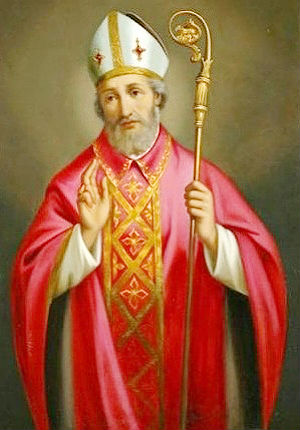
Memorial of Saint Ambrose, Bishop and Doctor of the Church


“The wilderness and the parched land will exult; the Arabah will rejoice and bloom ...” (Isaiah 35:1.)

Saint Gregory of Nyssa (part 2 of the background of Saint Gregory of Nyssa is found here) offers the following insight on this verse from today’s First Reading:

“I said, “What are the fire, the gulf, or the other things which are mentioned, if they are not what they are said to be?”

“And where shall we place that oracle of Isaiah, which cries to the wilderness, “Be glad, O thirsty wilderness. Let the desert rejoice and blossom as a lily, and the desolate places of Jordan shall blossom and shall rejoice”? For it is clear that it is not to places without soul or sense that he proclaims the good tidings of joy, but he speaks, by the figure of the desert, of the soul that is parched and unadorned.

And “the excellence of Carmel” is given to the soul that bears the likeness to the desert, that is, the grace bestowed through the Spirit. For since Elijah dwelt in Carmel, and the mountain became famous and renowned by the virtue of him who dwelt there, and since moreover John the Baptist, illustrious in the spirit of Elijah, sanctified the Jordan, therefore the prophet foretold that “the excellence of Carmel” should be given to the river.

And “the glory of Lebanon,” from the similitude of its lofty trees, he transfers to the river. For as great Lebanon presents a sufficient cause of wonder in the very trees that it brings forth and nourishes, so is the Jordan glorified by regenerating people and planting them in the paradise of God. And of them, as the words of the psalmist say, ever blooming and bearing the foliage of virtues, “the leaf shall not wither,” and God shall be glad, receiving their fruit in due season, rejoicing, like a good planter, in his own works.” (On the Baptism of Christ)


Collect
O God,
Who made the Bishop Saint Ambrose
a teacher of the Catholic faith
and a model of apostolic courage,
raise up in Your Church
men after Your own heart
to govern her with courage and wisdom.
Through our Lord Jesus Christ, Your Son
Who lives and reigns with You
in the unity of the Holy Spirit,
one God, for ever and ever.


Glory to the Father
and to the Son
and to the Holy Spirit:
as it was in the beginning,
is now, and will be forever. Amen


By the grace of your words win over your people


Bishop and Great Latin Father of the Church

An excerpt from Letter 2

Memorial of Saint Ambrose, Bishop and Doctor of the Church

You have entered upon the office of bishop. Sitting at the helm of the Church, you pilot the ship against the waves. Take firm hold of the rudder of faith so that the severe storms of this world cannot disturb you. The sea is mighty and vast, but do not be afraid, for as Scripture says: he has founded it upon the seas, and established it upon the waters.

The Church of the Lord is built upon the rock of the apostles among so many dangers in the world; it therefore remains unmoved. The Church’s foundation is unshakeable and firm against the assaults of the raging sea. Waves lash at the Church but do not shatter it. Although the elements of this world constantly beat upon the Church with crashing sounds, the Church possesses the safest harbor of salvation for all in distress. Although the Church is tossed about on the sea, it rides easily on rivers, especially those rivers that Scripture speaks of: The rivers have lifted up their voice. These are the rivers flowing from the heart of the man who is given drink by Christ and who receives from the Spirit of God. When these rivers overflow with the grace of the Spirit, they lift up their voice.

There is also a stream which flows down on God’s saints like a torrent. There is also a rushing river giving joy to the heart that is at peace and makes for peace. Whoever has received from the fullness of this river, like John the Evangelist, like Peter and Paul, lifts up his voice. Just as the apostles lifted up their voices and preached the Gospel throughout the world, so those who drink these waters begin to preach the good news of the Lord Jesus.

Drink, then, from Christ, so that your voice may also be heard. Store up in your mind the water that is Christ, the water that praises the Lord. Store up water from many sources, the water that rains down from the clouds of prophecy.

Whoever gathers water from the mountains and leads it to himself or draws it from springs, is himself a source of dew like the clouds. Fill your soul, then, with this water, so that your land may not be dry, but watered by your own springs.

He who reads much and understands much, receives his fill. He who is full, refreshes others. So Scripture says: If the clouds are full, they will pour rain upon the earth.

Therefore, let your words be rivers, clean and limpid, so that in your exhortations you may charm the ears of your people. And by the grace of your words win them over to follow your leadership. Let your sermons be full of understanding. Solomon says: The weapons of the understanding are the lips of the wise; and in another place he says: Let your lips be bound with wisdom. That is, let the meaning of your words shine forth, let understanding blaze out. See that your addresses and expositions do not need to invoke the authority of others, but let your words be their own defence. Let no word escape your lips in vain or be uttered without depth of meaning.


Glory to the Father
and to the Son
and to the Holy Spirit:
as it was in the beginning,
is now, and will be forever. Amen


When preparing is preparing ...


εὐαγγελίζω (euaggelizo)
“to announce the Good News of victory in battle”

“The beginning of the gospel (Αρχὴ τοῦ εὐαγγελίου) of Jesus Christ [the Son of God]. As it is written in Isaiah the prophet:
“Behold, I am sending my messenger ahead of you;
he will prepare (κατασκευάσει) your way.
A voice of one crying out in the desert:
Prepare (ἑτοιμάσατε) the way of the Lord,
make straight his paths.’”
John [the] Baptist appeared in the desert (ἐν τῇ ἐρήμῳ)
proclaiming a baptism of repentance (μετανοίας) for the forgiveness of sins.”
(Mark 1:1-4)


θεωρέω (theoreo)
(“to perceive, discover, ponder a deeper meaning”)

Do you have a favorite Advent Text from the Book of the Prophet Isaiah? For many, this Sunday’s proclamation from the Prophet of Hope is the signature Word of Advent found in the Old Testament only overshadowed by Isaiah 7:14 (“Therefore the Lord himself will give you a sign, the virgin will be with child and you shall name him Emmanuel.”) George Frederick Handel enshrined Isaiah 40 as the opening movement in Messiah.


As for the Sacred Text at hand, all four Evangelists employ some aspects of Isaiah 40 as Jesus’ Public Ministry commences in the region of Galilee. The Synoptic Evangelists also include the command “Prepare (ἑτοιμάσατε) [Mark 1:2, Matthew 3:3 and Luke 3:4].” Take note of the verses in this Sunday’s proclamation from Mark: “Behold, … he will prepare (κατασκευάσει) your way (Mark 1:2)” and “A voice … ‘Prepare (ἑτοιμάσατε) the way of the Lord’ (Mark 1:3).” The English word prepare appears twice in 2 verses, yet the Greek verbs are different: κατασκευάζω (kataskeuazo in verse 2) and ἑτοιμάζω (hetoimazo, in verse 3). Is the Evangelist making a point here by using two separate verbs or is he simply availing himself of a theological thesaurus, varying the words to keep our attention?


Considering the myriad of insights one could bring to the Marcan Gospel, ‘fluff’ is not one of the Evangelist’s characteristics. In fact, when one examines the Greek Text of what is perhaps the first written Gospel, one quickly discovers difficulty in reading. Saint Mark’s favorite word is AND (καί, kai in Greek). It seems he grammatically has confused the word and with a period. Many note that he writes in ‘run-on’ sentences and the over use of and joining 1 thought to another is a nightmare for teachers and professors of writing. But this gives us an insight into the Evangelist. For Mark, time is short – not necessarily chronologically but time in the sense of acting now to prevent a situation from getting worse. One might liken this to an infection in the body: far better to ‘nip it [the infection] in the bud’ because if it is permitted to fester, one runs the risk of a loss of limb or even one’s physical life despite aggressive antibiotics. The Evangelist bluntly, boldly and urgently records the events of Jesus’ Words and Deeds with the intent that one will permit the Person Jesus to transform the hard heart and open one’s heart to God the Father's way of living, known in the Gospels as the Kingdom of God (more on the Kingdom of God, to repent and to believe when we return to Ordinary Time in January).

This background is meant to form a basis not only for our reception of Mark’s Gospel this Liturgical Year, but also to make a case, from a human perspective, that the 2 distinct verbs – both translated into English as prepare – is intentional on Saint Mark’s part. In verse 3, notice the proximity of the command (yes, a command!) ἑτοιμάσατε (hetoimasate) to the verse concerning John the Baptist’s proclamation of “baptism of repentance (μετανοίας) for the forgiveness of sins.” While μετάνοια (metanoia) is often translated “repentance,” it is composed of 2 Greek words: “beyond (μετά, meta)” and “mind (νοῦς, nous).” To go “beyond the mind” in antiquity was the equivalent of “going to/from the heart.” ἑτοιμάσατε (hetoimasate) is about putting ‘heart’ into your thoughts, your words and your actions. Permitting your heart to invade thoughts, words and actions minimally raises the bar of attentiveness. Increasing attentiveness is more properly perceived and received as recognizing that the Holy Spirit is guiding our lives. When you and I are inattentive and attempt to run life according to personal agendas, life gets messed-up and messed-up big time! Recall what happened in the Garden: when humanity stopped listening to the words of the Creator our guard dropped. Our inattentiveness to the words and instructions for life from the Creator resulted in listening to another voice, a divided voice that brought division and alienation into human nature requiring the incarnate and consubstantial intervention of Jesus the Christ.

Speaking of the Garden … there is still another prepare verb to consider: κατασκευάζω (kataskeuazo in verse 2). Many English translations of the Sacred Scriptures render this verb prepare, and do so perhaps because the verb is not frequently used in the New Testament. Literally κατασκευάζω (kataskeuazo) means ‘to create’ or ‘to fashion vessels necessary for persons to live.’ This verb has a decidedly concrete, touchable, tangible – CREATED focus. Notice the proximity of this verse to the opening verse: “The beginning of the gospel (Αρχὴ τοῦ εὐαγγελίου) of Jesus Christ” (verse 1). Biblically, Αρχὴ (arche, beginning) has a connection with THE beginning, Genesis. This is the same Greek word that Saint John uses to begin the Fourth Gospel and it is the same word that is used in the Greek translation of the Old Testament, the Septuagint (LXX). The Creation motif is certainly not out of place here and it ties in well with Advent being both a time and a way of living in which something is new, something new is being created. Naturally the question arises, what? What is being created? What is new?

In one way, Advent is a time of a new creation – a creation that is not only spiritual (change of heart) but also something that is quite touchable, tangible and visible. While the Season is about being made ready for the celebration of Jesus’ birth, the readiness for His Nativity requires the creation of a new attitude in us who bear His Name. The attitude or disposition is this: as a Christian is Jesus the singularly, unique Person Who grounds my life and the life of our parishes? This is one of the fundamental questions the εὐαγγελίον (euaggelion, Good News, Gospel) - Who is Jesus? Those who self-identify as “Christian” may have varying levels of intellectual, catechetical, and cultural ‘knowledge’ ABOUT Jesus. But timely Advent question is, ‘has this knowledge been permitted to become love FOR, WITH and OF Jesus?’ Knowing what we have done and do for people we love can be a pattern for growing in love that Christ offers. Being with Him, hanging out in silent prayer, attentive celebration of the Sacraments and pondering His Word, saying NO to anything not of Him and charitable service in His Name are some of the simple acts to respond to His invitation of love. Accepting this invitation permits His work of loving creation to continue in our lives and the lives of our communities. These graced works prepare and prepare each of us for Jesus.


Glory to the Father
and to the Son
and to the Holy Spirit:
as it was in the beginning,
is now, and will be forever. Amen



Second Sunday of Advent


“A voice proclaims: In the wilderness prepare the way of the LORD! Make straight in the wasteland a highway for our God!” (Isaiah 40:3)

Origen of Alexandria comments on these verses from the Gospel proclaimed at Mass today:

“The Lord wants to find in you a path by which he can enter into your souls and make his journey. Prepare for him the path of which it is said, “Make straight his path.” “The voice of one crying in the desert” — the voice cries, “prepare the way.

Now the way of the Lord is made straight in two ways: by contemplation, which is clarified by truth unmixed with falsehood, and by activity, which follows sound contemplation of the appropriate action to be taken, which is conformed to the correct sense of these things to be done.” (Homilies on Gospel of Luke, 21)

A reflection on preparing in light of this Sunday’s Scriptures.

Collect
Almighty and merciful God,
may no earthly undertaking hinder those
who set out in haste to meet Your Son,
but may our learning of heavenly wisdom
gain us admittance to His company.
Who lives and reigns with You
in the unity of the Holy Spirit,
one God, for ever and ever. Amen.


Glory to the Father
and to the Son
and to the Holy Spirit:
as it was in the beginning,
is now, and will be forever. Amen