Thursday of the Ninth Week in Ordinary Time


“This saying is trustworthy: If we have died with him we shall also live with him ...” (2 Timothy 2:11.)

Origen of Alexandria (part 2 of Pope Benedict’s reflections on Origen) comments on this verse from the First Reading proclaimed at Mass today:

The Savior, too, first granted you this very thing — that you should fall. You were a Gentile. Let the Gentile in you fall. You loved prostitutes. Let the lover of prostitutes in you perish first. You were a sinner. Let the sinner in you fall. Then you can rise again and say, “If we have died with him, we shall also live with him,” and, “If we have been made like him in death, we shall also be like him in resurrection.” (Homilies on Luke, 17.)


Collect
O God,
Whose providence never fails in its design,
keep from us, we humbly beseech You,
all that might harm us and
grant all that works for our good.
Through our Lord Jesus Christ, Your Son,
who lives and reigns with you in the
unity of the Holy Spirit,
one God, for ever and ever.


Glory to the Father
and to the Son
and to the Holy Spirit:
as it was in the beginning,
is now, and will be forever. Amen


Top


The Church moves forward like the advancing dawn


Bishop of Rome and Great Western Father of the Church

An excerpt from Moral Reflections on Job, Book 29.

Thursday of the Ninth Week in Ordinary Time

Since the daybreak or the dawn is changed gradually from darkness into light, the Church, which comprises the elect, is fittingly styled daybreak or dawn. While she is being led from the night of infidelity to the light of faith, she is opened gradually to the splendor of heavenly brightness, just as dawn yields to the day after darkness. The Song of Songs says aptly: Who is this who moves forward like the advancing dawn? Holy Church, inasmuch as she keeps searching for the rewards of eternal life, has been called the dawn. While she turns her back on the darkness of sins, she begins to shine with the light of righteousness.

This reference to the dawn conjures up a still more subtle consideration. The dawn intimates that the night is over; it does not yet proclaim the full light of day. While it dispels the darkness and welcomes the light, it holds both of them, the one mixed with the other, as it were. Are not all of us who follow the truth in this life daybreak and dawn? While we do some things which already belong to the light, we are not free from the remnants of darkness. In Scripture the Prophet says to God: No living being will be justified in your sight. Scripture also says: In many ways all of us give offense.

When he writes, the night is passed. Paul does not add, the day is come, but rather, the day is at hand. Since he argues that after the night has passed, the day as yet is not come but is rather at hand, he shows that the period before full daylight and after darkness is without doubt the dawn, and that he himself is living in that period.

It will be fully day for the Church of the elect when she is no longer darkened by the shadow of sin. It will be fully day for her when she shines with the perfect brilliance of interior light. This dawn is aptly shown to be an ongoing process when Scripture says: And you showed the dawn its place. A thing which is shown its place is certainly called from one place to another. What is the place of the dawn but the perfect clearness of eternal vision? When the dawn has been brought there, it will retain nothing belonging to the darkness of night. When the Psalmist writes: My soul thirsts for the living God; when shall I go and see the face of God?, does he not refer to the effort made by the dawn to reach its place? Paul was hastening to the place which he knew the dawn would reach when he said he wished to die and to be with Christ. He expressed the same idea when he said: For me to live is Christ, and to die is gain.


Glory to the Father
and to the Son
and to the Holy Spirit:
as it was in the beginning,
is now, and will be forever. Amen


Memorial of Saint Charles Lwanga and Companions, Martyrs


“Jesus said to them, “Are you not misled because you do not know the scriptures or the power of God?"” (Mark 12:24.)

Saint Augustine of Hippo comments on this verse from the Gospel proclaimed during today’s Mass:

“Sadducees do not have our hope for the resurrection, since they “know neither the scriptures nor the power of God,”5 who is able to restore what is lost, to raise what is dead to life, to revive what has rotted away, to gather together what is corruptible and finite. The Lord promised to do this, and he gives as a guarantee the promises he has already fulfilled. So let your faith speak of this to you, since your hope will not be disappointed even though your love may be put to the test.” (Letter 263 (To Sapida))


Collect
O God, who have made the blood of Martyrs
the seed of Christians,
mercifully grant
that the field which is your Church,
watered by the blood
shed by Saints Charles Lwanga
and his companions,
may be fertile and
always yield you an abundant harvest.
Through our Lord Jesus Christ, your Son,
Who lives and reigns with You
in the unity of the Holy Spirit,
one God, for ever and ever. Amen.


Glory to the Father
and to the Son
and to the Holy Spirit:
as it was in the beginning,
is now, and will be forever. Amen


Top


The glory of the martyrs — a sign of rebirth


Bishop of Rome

An excerpt from the Canonization Homily of Saint Charles Lwanga and Companions

Saint Charles Lwanga and Companions

The African martyrs add another page to the martyrology —  the Church’s roll of honor — an occasion both of mourning and of joy. This is a page worthy in every way to be added to the annals of that Africa of earlier times which we, living in this era and being men of little faith, never expected to be repeated.

In earlier times, there occurred those famous deeds, so moving to the spirit, of the martyrs of Scilli, of Carthage, and of that “white robed army” of Utica commemorated by Saint Augustine and Prudentius; of the martyrs of Egypt so highly praised by Saint John Chrysostom, and of the martyrs of the Vandal persecution. Who would have thought that in our days we should have witnessed events as heroic and glorious?

Who could have predicted to the famous African confessors and martyrs such as Cyprian, Felicity, Perpetua and — the greatest of all — Augustine, that we would one day add names so dear to us as Charles Lwanga and Matthias Mulumba Kalemba and their twenty companions? Nor must we forget those members of the Anglican Church who also died for the name of Christ.

These African martyrs herald the dawn of a new age. If only the mind of man might be directed not toward persecutions and religious conflicts but toward a rebirth of Christianity and civilization!

Africa has been washed by the blood of these latest martyrs, the first of this new age (and, God willing, let them be the last, although such a holocaust is precious indeed). Africa is reborn free and independent.

The infamous crime by which these young men were put to death was so unspeakable and so expressive of the times. It shows us clearly that a new people needs a moral foundation, needs new spiritual customs firmly planted, and to be handed down to posterity. Symbolically, this crime also reveals that a simple and rough way of life—enriched by many fine human qualities yet enslaved by its own weakness and corruption—must give way to a more civilized life wherein the higher expressions of the mind and better social conditions prevail.


Glory to the Father
and to the Son
and to the Holy Spirit:
as it was in the beginning,
is now, and will be forever. Amen


Tuesday of the Ninth Week in Ordinary Time


“They came and said to him, “Teacher, we know that you are a truthful man and that you are not concerned with anyone’s opinion. You do not regard a person’s status but teach the way of God in accordance with the truth. Is it lawful to pay the census tax to Caesar or not? Should we pay or should we not pay?” (Mark 12:14.)

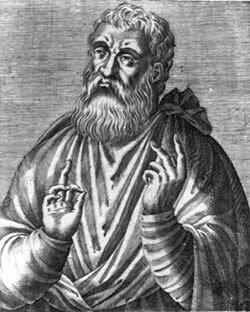
Saint Justin of Rome comments on this verse from the Gospel proclaimed at Mass today:

“So we worship God only, but in temporal matters we gladly serve you, recognizing you as emperors and rulers, and praying that along with your imperial power you may also be found to have a sound mind. Suppose you pay no attention to our prayers and our frank statements about everything. That will not injure us, since we believe, and are convinced without doubt, that everyone will finally experience the restraint of divine judgment in relation to their voluntary actions. Each will be required to give account for the responsibilities which he has been given by God” (First Apology, 17.)


Collect
O God,
Whose providence never fails in its design,
keep from us, we humbly beseech You,
all that might harm us and
grant all that works for our good.
Through our Lord Jesus Christ, your Son,
Who lives and reigns with You
in the unity of the Holy Spirit,
one God, for ever and ever.


Glory to the Father
and to the Son
and to the Holy Spirit:
as it was in the beginning,
is now, and will be forever. Amen


Top


On false spiritual peace


Abbot

An excerpt from his collection of teachings

Tuesday of the Ninth Week in Ordinary Time

The man who finds fault with himself accepts all things cheerfully—misfortune, loss, disgrace, dishonor and any other kind of adversity. He believes that he is deserving of all these things and nothing can disturb him. No one could be more at peace than this man.

But perhaps you will offer me this objection: “Suppose my brother injures me, and on examining myself I find that I have not given him any cause. Why should I blame myself?”

Certainly if someone examines himself carefully and with fear of God, he will never find himself completely innocent. He will see that he has given some provocation by an action, a word or by his manner. If he does find that he is not guilty in any of these ways, certainly he must have injured that brother somehow at some other time. Or perhaps he has been a source of annoyance to some other brother. For this reason he deserves to endure the injury because of many other sins that he has committed on other occasions.

Someone else asks why he should accuse himself when he was sitting peacefully and quietly when a brother came upon him with an unkind or insulting word. He cannot tolerate it, and so he thinks that his anger is justified. If that brother had not approached him and said those words and upset him, he never would have sinned.

This kind of thinking is surely ridiculous and has no rational basis. For the fact that he has said anything at all in this situation breaks the cover on the passionate anger within him, which is all the more exposed by his excessive anxiety. If he wished, he would do penance. He has become like a clean, shiny grain of wheat that, when broken, is full of dirt inside.

The man who thinks that he is quiet and peaceful has within him a passion that he does not see. A brother comes up, utters some unkind word and immediately all the venom and mire that lie hidden within him are spewed out. If he wishes mercy, he must do penance, purify himself and strive to become perfect. He will see that he should have returned thanks to his brother instead of returning the injury, because his brother has proven to be an occasion of profit to him. It will not be long before he will no longer be bothered by these temptations. The more perfect he grows, the less these temptations will affect him. For the more the soul advances, the stronger and more powerful it becomes in bearing the difficulties that it meets.


Glory to the Father
and to the Son
and to the Holy Spirit:
as it was in the beginning,
is now, and will be forever. Amen


Memorial of the Blessed Virgin Mary, Mother of the Church


“All these devoted themselves with one accord to prayer, together with some women, and Mary the mother of Jesus, and his brothers...” (Acts 1:14.)

Arator comments on this verse from the First Reading proclaimed during today’s Mass:

“They sought by a swift path, with which it was possible to go a mile on their sabbath, the well-known walls where Mary, the gateway of God, the virgin mother of her Creator, formed by her own son, was sitting at a religious gathering. The second virgin put to flight the woes of Eve’s crime; there is no harm done to the sex; she restored what the first took away. Let grief not raise up complaints or vex mourning hearts with groaning over the old law; these very forms of wickedness and crime rather cause delight at this bargain, and a better lot comes to the redeemed world from the fall. The person, not the nature [of a woman], caused ruin; in those days [of Eve] a pregnant woman [brought forth] peril. In these [of Mary] one grew great to bring forth God, the one begetting mortal things and the other bearing divine—she through whom the Mediator came forth into the world and carried actual flesh to the heavens.” (On the Acts of the Apostles, 1.)


Collect
O God, Father of mercies,
Whose Only Begotten Son,
as He hung upon the Cross,
chose the Blessed Virgin Mary, His Mother,
to be our Mother also,
grant, we pray, that with her loving help
your Church may be more fruitful day by day
and, exulting in the holiness of her children,
may draw to her embrace
all the families of the peoples.
Through our Lord Jesus Christ, Your Son
Who lives and reigns with You
in the unity of the Holy Spirit,
one God, for ever and ever. Amen.


Glory to the Father
and to the Son
and to the Holy Spirit:
as it was in the beginning,
is now, and will be forever. Amen




Mary’s motherhood in the order of grace


Second Vatican Council

An excerpt from Lumen Gentium, 61-62.

Memorial of the Blessed Virgin Mary, Mother of the Church

The Blessed Virgin was predestined to be the Mother of God in the eternal plan for the incarnation of God’s Word. By decree of God’s providence she was, here on earth, the loving mother of the divine Redeemer, the noblest of all his companions, and the humble servant of the Lord. In conceiving Christ, in bearing him, in nursing him, in presenting him to the Father in the temple, in sharing her Son’s passion as he was dying on the cross, by her obedience, her faith, her hope and burning love, she cooperated, in a way that was quite unique, in the work of the Savior in restoring supernatural life to souls. She is therefore a mother to us in the order of grace.

This motherhood of Mary in the order of grace — from the consent which she gave in faith at the annunciation, and which she continued to give unhesitatingly at the foot of the cross — lasts without interruption until all the elect enter into eternal fulfillment. When she was taken up into heaven, she did not lay aside this saving role but she continues by her intercession for all to gain for us the gifts of eternal salvation.

In her maternal love she cares for the brothers and sisters of her Son as they journey on earth in the midst of dangers and hardships, until they are brought safely home to the happiness of heaven.

The Blessed Virgin is thus invoked in the Church under the titles of Advocate, Auxiliatrix, Adjutrix and Mediatrix. These titles must not, however, be understood as in any way detracting from, or adding to, the dignity and effectiveness of Christ, the one Mediator.

No creature can ever be classed as an equal with the incarnate Word, the Redeemer. But just as the priesthood of Christ is shared in various ways by his ministers and his faithful people, and as the goodness of God, one though it is, is, in different ways, really shared with creatures, so also the unique meditation of Christ does not exclude but brings about a variety of shared cooperation, deriving from the one unique source.

The Church does not hesitate to acknowledge this kind of subordinate role in the person of Mary. The Church has continuous experience of its effects, and commends it to the hearts of the faithful, so that as they lean on her motherly protection they may be brought into closer union with the Mediator, our Savior.


Glory to the Father
and to the Son
and to the Holy Spirit:
as it was in the beginning,
is now, and will be forever. Amen


Pentecost Sunday — Mass during the Day


“And when He had said this, He breathed on them and said to them, “Receive the holy Spirit.” (John 20:22.)

Saint Cyril of Jerusalem comments on this verse from the First Reading proclaimed at Mass today:

“This was the second time he breathed on human beings — his first breath having been stifled through willful sins. But though he bestowed his grace then, he was to lavish it yet more bountifully. And he says to them, I am ready to give it even now, but the vessel cannot yet hold it. For awhile therefore receive as much grace as you can bear. And look forward for yet more. “But stay in the city, until you are clothed with power from on high.” Receive it in part now. Then, you shall wear it in its fullness. For the one who receives often possesses only a part of the gift. But the one who is clothed is completely enfolded by his robe.” (Catechetical Lectures, 17.)


Collect
O God,
Who by the mystery of today’s great feast
sanctify Your whole Church
in every people and nation,
pour out, we pray,
the gifts of the Holy Spirit
across the face of the earth
and, with the divine grace that was at work
when the Gospel was first proclaimed,
fill now once more the hearts of believers.
Through our Lord Jesus Christ, your Son,
who lives and reigns with you in the
unity of the Holy Spirit,
one God, for ever and ever.


Glory to the Father
and to the Son
and to the Holy Spirit:
as it was in the beginning,
is now, and will be forever. Amen


Top


The sending of the Holy Spirit


Bishop, Father of the Church and Martyr

An excerpt from his Against Heresies, Book 1

Pentecost Sunday

When the Lord told his disciples to go and teach all nations and baptize them in the name of the Father and of the Son and of the Holy Spirit, he conferred on them the power of giving men new life in God.

He had promised through the prophets that in these last days he would pour out his Spirit on his servants and handmaids, and that they would prophesy. So when the Son of God became the Son of Man, the Spirit also descended upon him, becoming accustomed in this way to dwelling with the human race, to living in men and to inhabiting God’s creation. The Spirit accomplished the Father’s will in men who had grown old in sin, and gave them new life in Christ. Luke says that the Spirit came down on the disciples at Pentecost, after the Lord’s ascension, with power to open the gates of life to all nations and to make known to them the new covenant. So it was that men of every language joined in singing one song of praise to God, and scattered tribes, restored to unity by the Spirit, were offered to the Father as the first-fruits of all the nations.

This was why the Lord had promised to send the Advocate: he was to prepare us as an offering to God. Like dry flour, which cannot become one lump of dough, one loaf of bread, without moisture, we who are many could not become one in Christ Jesus without the water that comes down from heaven. And like parched ground, which yields no harvest unless it receives moisture, we who were once like a waterless tree could never have lived and borne fruit without this abundant rainfall from above. Through the baptism that liberates us from change and decay we have become one in body; through the Spirit we have become one in soul.

The Spirit of wisdom and understanding, the Spirit of counsel and strength, the Spirit of knowledge and the fear of God came down upon the Lord, and the Lord in turn gave this Spirit to his Church, sending the Advocate from heaven into all the world into which, according to his own words, the devil too had been cast down like lightning.

If we are not to be scorched and made unfruitful, we need the dew of God. Since we have our accuser, we need an advocate as well. And so the Lord in his pity for man, who had fallen into the hands of brigands, having himself bound up his wounds and left for his care two coins bearing the royal image, entrusted him to the Holy Spirit. Now, through the Spirit, the image and inscription of the Father and the Son have been given to us, and it is our duty to use the coin committed to our charge and make it yield a rich profit for the Lord.


Glory to the Father
and to the Son
and to the Holy Spirit:
as it was in the beginning,
is now, and will be forever. Amen