EASTER SEASON


Week 4: Thursday


“From this man’s descendants God, according to his promise, has brought to Israel a savior, Jesus.” (Acts 13:23.)

In commenting on these verses from today’s First Reading, Saint John Chrysostom writes:

“Notice how [Paul] weaves his discourse from things present and from the prophets. Thus he says, “from [this man’s] seed according to the promise,” and then adduces John again, saying, “By condemning they fulfilled all that was written.” Both the apostles as witnesses of the resurrection, and David bearing witness. For neither do the Old Testament proofs seem so cogent when taken by themselves, nor the later testimonies apart from the former. Therefore it is through both that he makes his discourse trustworthy.” (Homilies on the Acts of the Apostles, 29.)


Collect
O God, who restore human nature
to yet greater dignity than at its beginnings,
look upon the amazing mystery
of your loving kindness,
and in those you have chosen to make new
through the wonder of rebirth
may you preserve the gifts
of your enduring grace and blessing
Through our Lord Jesus Christ, your Son,
Who lives and reigns with You
in the unity of the Holy Spirit,
one God, for ever and ever. Amen.


Glory to the Father
and to the Son
and to the Holy Spirit:
as it was in the beginning,
is now, and will be forever. Amen


EASTER SEASON


Week 4: Tuesday


“Then he went to Tarsus to look for Saul ...” (Acts 11:25.)

Origen of Alexandria (part 2 of Pope Benedict’s reflections on Origen) comments on this verse from the Reading proclaimed at Mass today.:

“Now it is good to read through the history what Jeremiah suffered among the people, in reference to whom he said, “I said: No more shall I speak or name the name of the Lord,” and again elsewhere, “I have unceasingly been an object of derision.” But whatever he also suffered at the hand of the reigning king of Israel has been written in his prophecy. But that those from among the people came frequently to stone even Moses has also been written, and the stones of that place were not his homeland, but those following him were, that is, the people, by whom he too was dishonored. And Isaiah is reported to have been cut up by the people. Now, if someone does not accept this report because it is found in the apocryphal Isaiah, let him believe in what is written in the letter to the Hebrews: “They were stoned, cut up, put to the test.” The “cut up” is referred to Isaiah, just as the verse “they were murdered by the sword” applies to Zechariah, who was murdered “between the temple and the altar,” as the Savior taught bearing witness, I believe, to a writing not contained in the shared and publicly accepted books but to one that is probably apocryphal. But they were dishonored by the Jews and went about “in sheepskins, in goatskins, impoverished, suffering tribulation” and the following. For “all who desire to live uprightly in Christ Jesus will suffer persecution.” Now it is probably because he learned that a prophet cannot have honor “in his homeland,” that Paul, having proclaimed the word in many other places, did not preach in Tarsus.” (Commentary on the Matthew, 10.)


Collect
Grant, we pray, almighty God,
that, celebrating the mysteries
of the Lord’s Resurrection,
we may merit
to receive the joy of our redemption.
Through our Lord Jesus Christ, your Son,
who lives and reigns with you in the
unity of the Holy Spirit,
one God, for ever and ever.


Glory to the Father
and to the Son
and to the Holy Spirit:
as it was in the beginning,
is now, and will be forever. Amen


Top


EASTER SEASON


Week 4: Sunday


“I said to him, “My lord, you are the one who knows.” He said to me, “These are the ones who have survived the time of great distress; they have washed their robes and made them white in the blood of the Lamb.” (Revelation 7:14.)

Caesarius of Arles comments on this verse from the Second Reading proclaimed at Mass today:

“These are not, as some think, only martyrs, but rather the whole people in the church. For it does not say that they washed their robes in their own blood but in the blood of the Lamb, that is, in the grace of God through Jesus Christ, our Lord. As it is written, “And the blood of his Son has cleansed us.” (Exposition on the Apocalypse, 7)


Reflection on Sunday’s Gospel


Collect
Almighty ever-living God,
lead us to a share in the joys of heaven,
so that the humble flock may reach
where the brave Shepherd has gone before.,
Who lives and reigns with You
in the unity of the Holy Spirit,
one God, for ever and ever.


Glory to the Father
and to the Son
and to the Holy Spirit:
as it was in the beginning,
is now, and will be forever. Amen


Top


EASTER SEASON


Week 3: Friday


"He fell to the ground and heard a voice saying to him, “Saul, Saul, why are you persecuting me?” (Acts 9:4.)

Saint Augustine of Hippo comments on this verse from the First Reading proclaimed during today’s Mass:

“How can we show that he is there and that he is also here? Let Paul answer for us, who was previously Saul. First of all, the Lord’s own voice from heaven shows this: “Saul, Saul, why are you persecuting me?” Had Paul climbed up to heaven then? Had Paul even thrown a stone at heaven? It was Christians he was persecuting, them he was tying up, them he was dragging off to be put to death, them he was everywhere hunting out of their hiding places and never sparing when he found them. To him the Lord said, “Saul, Saul.” Where is he crying out from? Heaven. So he’s up above. “Why are you persecuting me?” So he’s down below.” (Sermon 122)


Collect
Grant, we pray, almighty God,
that we, who have come to know
the grace of the Lord’s Resurrection,
may, through the love of the Spirit,
ourselves rise to newness of life.
Through our Lord Jesus Christ, your Son,
who lives and reigns with you in the
unity of the Holy Spirit,
one God, for ever and ever.


Glory to the Father
and to the Son
and to the Holy Spirit:
as it was in the beginning,
is now, and will be forever. Amen


Top


MEMORIAL


Saint Stanislaus


“Now Stephen, filled with grace and power, was working great wonders and signs among the people...” (Acts 6:8.)

In commenting on these verses from today’s First Reading, Saint John Chrysostom writes:

“See how even among the seven there was one who was preeminent and who won the first prize. For although the ordination was common to all seven, he drew upon himself greater grace. And notice how he worked no [signs and wonders] before this, but only when he became publicly known. This was to show that the gift of preaching alone is not sufficient and that there is also need of the ordination. Thus was the assistance of the Spirit gained. For if they were full of the Spirit, clearly it came from the bath of baptism.” (Homilies On the Acts of the Apostles, 15.)


Collect
O God, for whose honor the Bishop Saint Stanislaus
fell beneath the swords of his persecutors,
grant, we pray,
that we may persevere
strong in faith even until death.
Through our Lord Jesus Christ, Your Son
Who lives and reigns with You
in the unity of the Holy Spirit,
one God, for ever and ever. Amen.


Glory to the Father
and to the Son
and to the Holy Spirit:
as it was in the beginning,
is now, and will be forever. Amen


The celebration of the eucharist


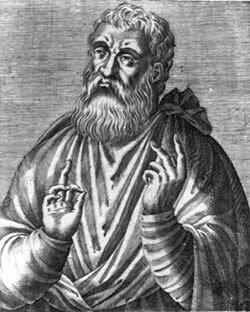
(Martyr and Apologist)

An excerpt from a First Apology in the Defense of Christians

Easter Week 3: Sunday

No one may share the eucharist with us unless he believes that what we teach is true, unless he is washed in the regenerating waters of baptism for the remission of his sins, and unless he lives in accordance with the principles given us by Christ.

We do not consume the eucharistic bread and wine as if it were ordinary food and drink, for we have been taught that as Jesus Christ our Savior became a man of flesh and blood by the power of the Word of God, so also the food that our flesh and blood assimilates for its nourishment becomes the flesh and blood of the incarnate Jesus by the power of his own words contained in the prayer of thanksgiving.

The apostles, in their recollections, which are called gospels, handed down to us what Jesus commanded them to do. They tell us that he took bread, gave thanks and said: Do this in memory of me. This is my body. In the same way he took the cup, he gave thanks and said: This is my blood. The Lord gave this command to them alone. Ever since then we have constantly reminded one another of these things. The rich among us help the poor and we are always united. For all that we receive we praise the Creator of the universe through his Son Jesus Christ and through the Holy Spirit.

On Sunday we have a common assembly of all our members, whether they live in the city or the outlying districts. The recollections of the apostles or the writings of the prophets are read, as long as there is time. When the reader has finished, the president of the assembly speaks to us; he urges everyone to imitate the examples of virtue we have heard in the readings. Then we all stand up together and pray.

On the conclusion of our prayer, bread and wine and water are brought forward. The president offers prayers and gives thanks to the best of his ability, and the people give assent by saying, “Amen.” The eucharist is distributed, everyone present communicates, and the deacons take it to those who are absent.

The wealthy, if they wish, may make a contribution, and they themselves decide the amount. The collection is placed in the custody of the president, who uses it to help the orphans and widows and all who for any reason are in distress, whether because they are sick, in prison, or away from home. In a word, he takes care of all who are in need.

We hold our common assembly on Sunday because it is the first day of the week, the day on which God put darkness and chaos to flight and created the world, and because on that same day our savior Jesus Christ rose from the dead. For he was crucified on Friday and on Sunday he appeared to his apostles and disciples and taught them the things that we have passed on for your consideration.


Reflection on Sunday’s Gospel.


Glory to the Father
and to the Son
and to the Holy Spirit:
as it was in the beginning,
is now, and will be forever. Amen


EASTER OCTAVE


— The Lord’s Day —


Easter, the Second Sunday


Pondering Jesus’ victorious Word


εὐαγγελίζω (euaggelizo)
“to announce the Good News of victory in battle”

“I, John, your brother, who share with you
the distress, the kingdom,
and the endurance we have in Jesus,
found myself on the island called Patmos
because I proclaimed God’s word
and gave testimony to Jesus.
I was caught up in spirit on the Lord’s day
and heard behind me a voice
as loud as a trumpet, which said,
“Write on a scroll what you see.”
Then I turned to see whose voice
it was that spoke to me,
and when I turned, I saw seven gold lampstands
and in the midst of the lampstands
one like a son of man,
wearing an ankle-length robe,
with a gold sash around his chest.

When I caught sight of him, I fell down
at his feet as though dead.
He touched me with his right hand and said,
“Do not be afraid.
I am the first and the last, the one who lives.
Once I was dead,
but now I am alive forever and ever.
I hold the keys to death and the netherworld.
Write down, therefore, what you have seen,
and what is happening,
and what will happen afterwards.”


θεωρέω (theoreo)
(“to perceive, discover, ponder a deeper meaning”)

In this present Cycle of Sunday Scriptures, we will listen each Sunday of Easter to a lesson from the Acts of the Apostles, the Book of Revelation and the Gospel according to Saint John. The ‘Sunday’ Word of God will form us as the proclamation of God’s Word ‘travels’ to the world stage of Rome in the Acts of the Apostles while offering hope in the midst of persecution (Book of Revelation) as Jesus, the new day of Creation, makes all things new in our midst (Gospel according to Saint John). The Acts of the Apostles and Gospel according to Saint John are also proclaimed, for the most part, during daily Mass in the Easter Season and the Book of Revelation is the principle source of Scripture for the Office of Readings in this Liturgical season. With such consistency in the proclamation of God’s Word, I think it helpful to explore 1 of these Books more thoroughly through the lens of the Sunday celebration. Hence over the course of these Easter Sundays, we will examine the Lord’s message to us from the Book of Revelation as it presents, among many insights, hope for the faithful whose connection to the Person Jesus undergoes a variety of tests, struggles and persecutions.


The apocalyptic Text proclaimed this Sunday is a shortened introduction to the Book of Revelation. We meet John on “the Lord’s Day” on the “island called Patmos,” a place where dissidents were banished to live out their days in silence. The introduction also draws us into one of Revelation’s more fascinating elements: visions. Throughout the Sacred Text the many visions are vivid and often troubling, capturing the imagination with all sorts of questions that ponder connections between the text and events of the biblical era as well as our own. While preachers and a host of people throughout the centuries have used (abused?) Revelation’s imagery for a variety of reasons, it is important to situate everything in the Text within a holistic context. Problems arise with any part of Scripture that is divorced from its context and Revelation is no different. ‘Keeping everything together’ is essential for a proper grasp of the salvific meaning of this apocalyptic Text.

In the vision before us this Sunday, John speaks of “seven gold lampstands,” a reference to 7 specific Churches that will be addressed individually. In both ancient and contemporary scholarship, many have asked, ‘why these Churches?’ Apringius of Beja, for example, writes in the sixth century: “We have already said that he addressed one church which exists during the time of the whole world, that is, from that time when he spoke to the consummation of the world. Since he now mentions the names of these churches specifically, let us see what meanings they have. . . . There is a mighty mystery in the names which we will examine and discuss to the extent that God allows. Ephesus means “my will” or “my plan.” Pergamum means “to him who divides their horns.” This refers either to the insolence of the powers of the air, or to the arrogance of the heretics. He writes to Thyatira, that is “enlightened.” This signifies that, after the expulsion of heretical pride and after the defeat of temptations from the powers of the air, the holy church is deserving of the light of righteousness. Sardis means the “beginning of beauty.” The church is seized by the sun of righteousness and is illumined by the light of truth, so that she might have the beginning of beauty, the Lord Jesus Christ, and might always shine in perpetual light. Philadelphia means “preserving devotion to the Lord.” After possessing the sun of righteousness, after the illumination of holiness, after the comeliness of holy beauty, the church rightly is devoted to the Lord and preserves herself by an inviolable observation of devotion. Laodicea means either “a tribe beloved of the Lord,” or, as some would have it, “a birth is expected.” Both are meaningful, for she who has merited the beauty of faith and the sun of righteousness and knows that through faith the Lord cleaves to her, might also be a tribe whom the Lord loves, who is both loved by the Lord and preserved by the Lord. (Tractate on the Apocalypse).” While one may debate the basis upon which Apringius ‘defines’ the meaning of each Church, a vast majority contend that the 7 gold lampstands is a way of speaking of the universal Church whose presence in the world is expressed through local communities.

That being said, the introductory vision is vital for a proper view of the visions, for in the midst of the 7 lampstands is the Person Jesus. His centrality in the Church and indeed in the midst of all reality is a consistent and significant message of the Apocalypse. His presence as the Risen Savior is the light against which the lives of the Churches and believers will be measured. As the Word unfolds on these Easter Sundays, the challenge will be to permit the light of Easter to shine in such a way that our ecclesial and individual lives are grounded in the security and peace that Jesus alone brings and gives to a waiting world.



EASTER OCTAVE


Easter, the Second Sunday


“Then I turned to see whose voice it was that spoke to me, and when I turned, I saw seven gold lampstands...” (Revelation 1:12.)

In commenting on these verses from today’s Second Reading, Saint Irenaeus of Lyons writes:

“Neither Moses nor Elijah nor Ezekiel, who all had many celestial visions, saw God. Rather, what they did see were likenesses of the splendor of the Lord and prophecies of things to come. It is evident that the Father is indeed invisible, of whom also the Lord said, “No man has seen God at any time.” But his Word, as he himself willed it, and for the benefit of those who beheld, did show the Father’s brightness and explained his purposes, as also the Lord said, “The only begotten God, which is in the bosom of the Father, he has declared [him].” John also, the Lord’s disciple, when seeing the priestly and glorious advent of his kingdom, says in the Apocalypse: “I turned to see the voice that spoke with me. And, being turned, I saw seven golden candlesticks, and in their midst One like the Son of man, clothed with a garment reaching to the feet, and wrapped around the chest with a golden girdle. His head and his hair were white, as white as wool, and as snow. His eyes were like a flame of fire. His feet were like fine brass, as if they were forged in a furnace. His voice [was] like the sound of waters. He had in his right hand seven stars. Out of his mouth came a sharp twoedged sword. He looked like the sun shining at full strength.” For in these words he sets forth something of the glory [which he has received] from his Father, as the head. He sets forth something of the priestly office, as in the case of the long garment reaching to the feet. And this was the reason why Moses vested the high priest after this fashion. Something also alludes to the end [of all things], as [where he speaks of] the fine brass being forged in the fire, which denotes the power of faith, and constant prayer, because of the consuming fire which is to come at the end of time.” (Against Heresies, 4.)


Reflection on this Sunday’s Scriptures.


Collect
God of everlasting mercy,
Who in the very recurrence
of the paschal feast
kindle the faith of the people
You have made Your own,
increase, we pray,
the grace You have bestowed,
that all may grasp and rightly understand
in what font they have been washed,
by Whose Spirit they have been reborn,
by Whose Blood they have been redeemed.
Through our Lord Jesus Christ, Your Son
Who lives and reigns with You
in the unity of the Holy Spirit,
one God, for ever and ever. Amen.


Glory to the Father
and to the Son
and to the Holy Spirit:
as it was in the beginning,
is now, and will be forever. Amen


EASTER TRIDUUM


Easter, the First Sunday
Evening


"Then they said to each other, “Were not our hearts burning [within us] while he spoke to us on the way and opened the scriptures to us?” (Luke 24:31.)

Saint Augustine of Hippo comments on this verse from the Gospel proclaimed during Easter Mass this evening:

“The Lord Jesus was made known, and after being made known he appeared no more. He withdrew from them in the body, since he was held by them in faith. That indeed is why the Lord absented himself in the body from the whole church, and ascended into heaven, for the building up of faith.” (Sermon 235)


Collect
O God,
Who on this day,
through your Only Begotten Son,
have conquered death
and unlocked for us the path to eternity,
grant, we pray, that we who keep
the solemnity of the Lord’s Resurrection
may, through the renewal
brought by Your Spirit,
rise up in the light of life.
Through our Lord Jesus Christ, your Son,
who lives and reigns with you in the
unity of the Holy Spirit,
one God, for ever and ever.


Glory to the Father
and to the Son
and to the Holy Spirit:
as it was in the beginning,
is now, and will be forever. Amen


Top


GOOD FRIDAY


25 March


As Good Friday falls on 25 March this year, it is interesting to note that this is normally the date that celebrates the moment of the Incarnation of the Divine Person, Jesus Christ as He was conceived in the womb of the Most Blessed Virgin Mary.

In On the Holy Trinity, one of Saint Augustine’s important works, the saintly bishop of Hippo speaks about the Incarnation, Birth and Death of Jesus all occurring on the 25th of the March and December. Such helps us to approach the importance of these Mysteries as a whole:


“And not without reason is the number six understood to be put for a year in the building up of the body of the Lord, as a figure of which He said that He would raise up in three days the temple destroyed by the Jews. For they said, Forty and six years was this temple in building. And six times forty-six makes two hundred and seventy-six. And this number of days completes nine months and six days, which are reckoned, as it were, ten months for the travail of women; not because all come to the sixth day after the ninth month, but because the perfection itself of the body of the Lord is found to have been brought in so many days to the birth, as the authority of the church maintains upon the tradition of the elders. For He is believed to have been conceived on the 25th of March, upon which day also He suffered; so the womb of the Virgin, in which He was conceived, where no one of mortals was begotten, corresponds to the new grave in which He was buried, wherein was never man laid, neither before nor since. But He was born, according to tradition, upon December the 25th. If, then you reckon from that day to this you find two hundred and seventy-six days which is forty-six times six. And in this number of years the temple was built, because in that number of sixes the body of the Lord was perfected; which being destroyed by the suffering of death, He raised again on the third day. For He spoke this of the temple of His body, as is declared by the most clear and solid testimony of the Gospel; where He said, For as Jonas was three days and three nights in the whale's belly, so shall the Son of man be three days and three nights in the heart of the earth.” (On the Holy Trinity, Book IV, 9.)


Glory to the Father
and to the Son
and to the Holy Spirit:
as it was in the beginning,
is now, and will be forever. Amen


Top