Christ is present to his Church


Second Vatican Council
An excerpt from Sacrosanctum Concilium, 7-8.

ORDINARY TIME 3: SUNDAY
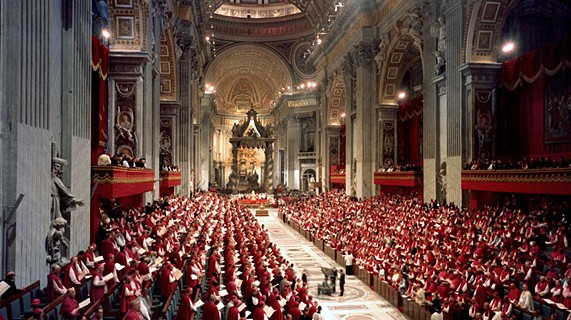
Christ is always present to his Church, especially in the actions of the liturgy. He is present in the sacrifice of the Mass, in the person of the minister (it is the same Christ who formerly offered himself on the cross that now offers by the ministry of priests) and most of all under the eucharistic species. He is present in the sacraments by his power, in such a way that when someone baptizes, Christ himself baptizes. He is present in his word, for it is he himself who speaks when the holy Scriptures are read in the Church. Finally, he is present when the Church prays and sings, for he himself promised: Where two or three are gathered in my name, I am there in their midst.

Indeed, in this great work which gives perfect glory to God and brings holiness to men, Christ is always joining in partnership with himself his beloved Bride, the Church, which calls upon its Lord and through him gives worship to the eternal Father.

It is therefore right to see the liturgy as an exercise of the priestly office of Jesus Christ, in which through signs addressed to the senses man’s sanctification is signified and, in a way proper to each of these signs, made effective, and in which public worship is celebrated in its fullness by the mystical body of Jesus Christ, that is, by the head and by his members.

Accordingly, every liturgical celebration, as an activity of Christ the priest and of his body, which is the Church, is a sacred action of a pre-eminent kind. No other action of the Church equals its title to power or its degree of effectiveness.

In the liturgy on earth we are given a foretaste and share in the liturgy of heaven, celebrated in the holy city of Jerusalem, the goal of our pilgrimage, where Christ is seated at the right hand of God, as minister of the sanctuary and of the true tabernacle. With the whole company of heaven we sing a hymn of praise to the Lord; as we reverence the memory of the saints, we hope to have some part with them, and to share in their fellowship; we wait for the Savior, our Lord Jesus Christ, until he, who is our life, appears, and we appear with him in glory.

By an apostolic tradition taking its origin from the very day of Christ’s resurrection, the Church celebrates the paschal mystery every eighth day, the day that is rightly called the Lord’s day. On Sunday the Christian faithful ought to gather together, so that by listening to the word of God and sharing in the Eucharist they may recall the passion, death and resurrection of the Lord Jesus and give thanks to God who has given them a new birth with a lively hope through the resurrection of Jesus Christ from the dead. The Lord’s day is therefore the first and greatest festival, one to be set before the loving devotion of the faithful and impressed upon it, so that it may be also a day of joy and of freedom from work. Other celebrations must not take precedence over it, unless they are truly of the greatest importance, since it is the foundation and the kernel of the whole liturgical year.

Click for a reflection on this Sunday’s Gospel.


Glory to the Father
and to the Son
and to the Holy Spirit:
as it was in the beginning,
is now, and will be forever. Amen


ORDINARY TIME


Week 2: Saturday


“How can the warriors have fallen in the thick of battle! Jonathan — slain upon your heights!” (2 Samuel 1:25.)

In commenting on these verses from today’s First Reading, Saint John Chrysostom writes:

“I will now cite from the Scriptures a wonderful instance of friendship. Jonathan, the son of Saul, loved David, and his soul was so knit to him that David in mourning over him says, “Your love to me was wonderful, passing the love of women. You were wounded fatally.” What then? Did Jonathan envy David? Not at all, though he had great reason. Why? Because, by the events he perceived that the kingdom would pass from himself to him, yet he felt nothing of the kind. He did not say, “This one is depriving me of my paternal kingdom,” but he favored David obtaining the sovereignty; and he didn’t spare his father for the sake of his friend. Yet let not any one think him a parricide, for he did not injure his father but restrained Saul’s unjust attempts. He rather spared than injured him. He did not permit Saul to proceed to an unjust murder. He was many times willing even to die for his friend, and far from accusing David, he restrained even his father’s accusation. Instead of envying, Jonathan joined in obtaining the kingdom for him. Why do I speak of wealth? He even sacrificed his own life for David. For the sake of his friend, he did not even stand in awe of his father, since his father entertained unjust designs, but his conscience was free from all such [things]. Thus justice was conjoined with friendship.

Such then was Jonathan. Let us now consider David. He had no opportunity of returning the favor, for his benefactor was taken away before the reign of David and slain before he whom Jonathan had served came to his kingdom. What then? As far as it was allowed him and left in his power, let us see how that righteous man manifested his friendship. “Very pleasant,” he says, “have you been to me, Jonathan; you were wounded fatally.” Is this all? This indeed was no slight tribute, but he also frequently rescued from danger his son and his grandson, remembrance of the kindness of the father, and he continued to support and protect his children, as he would have done those of his own son. Such friendship I would wish all to entertain both toward the living and the dead.” (Homilies on 2 Timothy, 7.)


Collect
Almighty ever-living God,
Who govern all things,
both in heaven and on earth,
mercifully hear the pleading of Your people
and bestow Your peace on our times.
Through our Lord Jesus Christ, Your Son,
who lives and reigns with You
in the unity of the Holy Spirit,
one God, for ever and ever.


Glory to the Father
and to the Son
and to the Holy Spirit:
as it was in the beginning,
is now, and will be forever. Amen


ORDINARY TIME


Day of Prayer
for the Legal Protection of
Unborn Children


“David’s servants said to him, “This is the day about which the LORD said to you: I will deliver your enemy into your hand; do with him as you see fit.” So David moved up and stealthily cut off an end of Saul’s robe.” (1 Samuel 24:5.)

Saint Gregory of Nyssa (part 2 of the background of Saint Gregory of Nyssa is found here) offers the following insight on this verse from today’s First Reading:

“When, therefore, he was alone and had removed his robe and laid it down somewhere beside him, the light from the mouth of the cave made him visible to those hidden within the darkness. All of David’s companions wanted to rush upon the enemy and avenge themselves on the one who had come to kill them, since God had given the enemy into the hands of those who were being pursued for slaughter. But David forbade them to attack, considering an assault against their king unlawful. He drew his own sword from its sheath and imperceptibly stood behind Saul. There was no witness to his undertaking against Saul, for the darkness in the cave concealed his appearance and prevented scrutiny of what was happening. When, then, he could have driven his whole sword through Saul’s heart from behind with one blow, he neither touched his body nor was he about to. But he secretly cut off the end of his robe with his sword, so that the garment might be a witness later of his clemency toward Saul and prove the power that he had had to strike a blow against Saul’s body by means of the cut at its end.

By this it became obvious that David had been trained in forbearance. When he held the bare sword in his palm, and the body of his enemy lay under his hand, he had the power to kill him, but he conquered his anger with reason, and his power to strike the blow with the fear of God. Not only did he become superior to his own anger, but he also restrained his shield bearer who was eager to murder Saul, addressing him with that saying famous in song, “Destroy not the anointed of the Lord.” (On the Inscriptions of the Psalms, 2.)


Collect
God our Creator,
we give thanks to You,
Who alone have the power
to impart the breath of life
as you form each of us in our mother’s womb;
grant, we pray,
that we, whom You have made stewards of creation,
may remain faithful to this sacred trust
and constant in safeguarding
the dignity of every human life.
Through our Lord Jesus Christ, your Son,
Who lives and reigns with You
in the unity of the Holy Spirit,
one God, for ever and ever. Amen.


Glory to the Father
and to the Son
and to the Holy Spirit:
as it was in the beginning,
is now, and will be forever. Amen


MEMORIAL


Saint Agnes


“... The women played and sang: “Saul has slain his thousands, David his tens of thousands.” (I Samuel 18:7.)

Saint Basil the Great offers the following insight on this verse from today's First Reading:

“Why do you grieve, my friend, when you yourself have suffered no misfortune? Why are you hostile to someone who is enjoying prosperity, when he has in no way caused your own possessions to decrease? If you are vexed even upon receiving a kindness [from the object of your spite], are you not quite clearly envious of your own good? Saul is an example of this. He made David’s great favors to himself a motive for enmity with him. First, after he had been cured of insanity by the divine and melodious strains of David’s harp, he attempted to run his benefactor through with a spear. Then, on another occasion, it happened that he and his army were delivered from the hands of the enemy and saved from embarrassment before Goliath. In singing the triumphal songs commemorating this victory, however, the dancers attributed to David a tenfold greater share in the achievement, saying, “Saul killed his thousands and David his ten thousands.” For this one utterance and because truth itself was its witness, Saul first attempted murder and tried to slay David by treachery, then forced him to flee.” (Concerning Envy)


Collect
Almighty ever-living God,
Who choose what is weak in the world
to confound the strong,
mercifully grant,
that we, who celebrate the heavenly birthday
of Your Martyr Saint Agnes,
may follow her constancy in the faith. Through our Lord Jesus Christ, your Son,
Who lives and reigns with You
in the unity of the Holy Spirit,
one God, for ever and ever. Amen.


Glory to the Father
and to the Son
and to the Holy Spirit:
as it was in the beginning,
is now, and will be forever. Amen


ORDINARY TIME


Week 2: Wednesday


“David put his hand into the bag and took out a stone, hurled it with the sling, and struck the Philistine on the forehead. The stone embedded itself in his brow, and he fell on his face to the ground.” (1 Samuel 17:49.)

Saint Ambrose of Milan offers the following insight on this verse from today’s First Reading:

“David never waged war unless he was driven to it. Thus prudence was combined in him with fortitude in the battle. For even when about to fight single-handed against Goliath, the enormous giant, he rejected the armor with which he was laden. His strength depended more on his own arm than on the weapons of others. Then, at a distance, to get a stronger throw, with one cast of a stone, he killed his enemy. DUTIES OF THE CLERGY 1.” (Duties of the Clergy, 1)


Collect
Almighty ever-living God,
Who govern all things,
both in heaven and on earth,
mercifully hear the pleading of Your people
and bestow Your peace on our times.
Through our Lord Jesus Christ, Your Son,
who lives and reigns with You
in the unity of the Holy Spirit,
one God, for ever and ever.


Glory to the Father
and to the Son
and to the Holy Spirit:
as it was in the beginning,
is now, and will be forever. Amen


See, I will save my people


Second Vatican Council
An excerpt from Lumen Gentium, 2.

ORDINARY TIME 2: WEDNESDAY


In his wisdom and goodness the eternal Father created the whole world according to his supremely free and mysterious purpose and decreed that men should be raised up to share in the divine life. When they fell in Adam, he did not abandon them but always kept providing them with aids to salvation, in consideration of Christ, who is the image of the invisible God, the firstborn of all creation. Before the ages the Father already knew all the elect and predestined them to be made into the likeness of his Son, so that he should be the firstborn among many brothers.

God resolved to gather into holy Church all who believe in Christ. The Church, foreshadowed even from the beginning of the world, so marvelously prepared in the history of the people of Israel, established in these last times and revealed by the outpouring of the Holy Spirit, will be made perfect in glory at the end of time. Then, as we read in the Fathers of the Church, all the righteous from Adam onward—from Abel, the righteous, to the last of the elect—will be gathered in the universal Church in the presence of the Father.

Finally, those who have not yet received the Gospel are in their different ways related to God’s people.

In the first place, there is that people which was given the covenants and the promises and from which Christ was born by human descent: the people which is by God’s choice most dear on account of the patriarchs. God never repents of his gifts or his call.

God’s plan of salvation embraces those also who acknowledge the Creator. Among these are especially the Mohammedans; they profess their faith as the faith of Abraham, and with us they worship the one, merciful God who will judge men on the last day.

God himself is not far from those others who seek the unknown God in darkness and shadows, for it is he who gives to all men life and inspiration and all things, and who as Savior desires all men to be saved.

Eternal salvation is open to those who, through no fault of their own, do not know Christ and his Church but seek God with a sincere heart, and under the inspiration of grace try in their lives to do his will, made known to them by the dictates of their conscience. Nor does Divine Providence deny the aids necessary for salvation to those who, without blame on their part, have not yet reached an explicit belief in God, but strive to lead a good life, under the influence of God’s grace.

Whatever goodness and truth is found among them is seen by the Church as a preparation for the Gospel, and as given by him who shines on all men, so that they may at last have life.

Glory to the Father
and to the Son
and to the Holy Spirit:
as it was in the beginning,
is now, and will be forever. Amen


ORDINARY TIME


Week 2: Tuesday


“The LORD said to Samuel: How long will you grieve for Saul, whom I have rejected as king of Israel? Fill your horn with oil, and be on your way. I am sending you to Jesse of Bethlehem, for from among his sons I have decided on a king.” (1 Samuel 16:1.)

Saint Gregory the Great comments on this verse from the First Reading proclaimed at Mass today:

“We have touched on these things as they pertain to the literal meaning; now let us see the election of our nobles as we look at the meaning beneath the literal one. When Samuel was told to fill the horn with oil, what else could it mean than this: he who is to be selected as a pastor in the holy church must not be someone clearly known as a transgressor but must be commended by wondrous praise as an example to others. The horn, you see, is the spear of an animal. But the authority and rebuke of even the highest bishop is nothing but his weapon. Indeed, they strike with their horn, whenever they lock horns with sinners as they issue their rebukes. They strike with their horn whenever they sharply confute sinners. The horn is filled with oil, then, whenever the loftiness of preachers does not have the harshness of threats but the allurements of grace. Or the horn is filled with oil when both the sublimity of the heights and the virtue of unction are given to a chosen pastor at the same time, that is, when he both ascends to a high degree, but the one who is taken into the heights is filled with the riches of merits. The priests were anointed with a full horn of oil, inasmuch as they arrived at the highest degree with a full possession of graces. When a fire is lit in a lamp of oil, the oil of the teacher is the love of the heart. A fire is lit in it, for the virtue and grace of the Holy Spirit burns in the richness of the mouth. Since a teacher ought to have the richness of great love, the king is said to have been anointed with a full horn of oil when he was ordered to be anointed. The fullness of the horn refers to the perseverance of the graces. For those who fail before they reach the end are not worthy to be anointed with a full horn of oil. ” (Six Books on 1 Kings)


Collect
Almighty ever-living God,
Who govern all things,
both in heaven and on earth,
mercifully hear the pleading of Your people
and bestow Your peace on our times.
Through our Lord Jesus Christ, Your Son,
who lives and reigns with You
in the unity of the Holy Spirit,
one God, for ever and ever.

Glory to the Father
and to the Son
and to the Holy Spirit:
as it was in the beginning,
is now, and will be forever. Amen


The Word of the Father
gives order, direction and unity to creation


(Bishop and Father of the Church)
An excerpt from Against the Pagans

ORDINARY TIME 1: THURSDAY

By his own wisdom and Word, who is our Lord and Savior Christ, the all-holy Father (whose excellence far exceeds that of any creature), like a skillful steersman guides to safety all creation, regulating and keeping it in being, as he judges right. It is right that creation should exist as he has made it and as we see it happening, because this is his will, which no one would deny. For if the movement of the universe were irrational, and the world rolled on in random fashion, one would be justified in disbelieving what we say. But if the world is founded on reason, wisdom and science, and is filled with orderly beauty, then it must owe its origin and order to none other than the Word of God.

He is God, the living and creative God of the universe, the Word of the good God, who is God in his own right. The Word is different from all created things: he is the unique Word belonging only to the good Father. This is the Word that created this whole world and enlightens it by his loving wisdom. He who is the good Word of the good Father produced the order in all creation, joining opposites together, and forming from them one harmonious sound. He is God, one and only-begotten, who proceeds in goodness from the Father as from the fountain of goodness, and gives order, direction and unity to creation.

By his eternal Word the Father created all things and implanted a nature in his creatures. He did not want to see them tossed about at the mercy of their own natures, and so be reduced to nothingness. But in his goodness he governs and sustains the whole of nature by his Word (who is himself also God), so that under the guidance, providence and ordering of that Word, the whole of nature might remain stable and coherent in his light. Nature was to share in the Father’s Word, whose reality is true, and be helped by him to exist, for without him it would cease to be. For unless the Word, who is the very image of the invisible God, the firstborn of all creation, kept it in existence it could not exist. For whatever exists, whether visible or invisible, remains in existence through him and in him, and he is also the head of the Church, as we are taught by the ministers of truth in their sacred writings.

The almighty and most holy Word of the Father pervades the whole of reality, everywhere unfolding his power and shining on all things visible and invisible. He sustains it all and binds it together in himself. He leaves nothing devoid of his power but gives life and keeps it in being throughout all of creation and in each individual creature.

Glory to the Father
and to the Son
and to the Holy Spirit:
as it was in the beginning,
is now, and will be forever. Amen


MEMORIAL


Saint Hilary of Poitiers


“Rising very early before dawn, he left and went off to a deserted place, where he prayed.” (Mark 1:35.)

Origen of Alexandria (part 2 of Pope Benedict’s reflections on Origen) comments on this verse from the Gospel proclaimed at Mass today:

“Jesus prayed and did not pray in vain, since he received what he asked for in prayer when he might have done so without prayer. If so, who among us would neglect to pray? Mark says that “in the morning, a great while before day, he rose and went out to a lonely place, and there he prayed.” And Luke says, “He was praying in a certain place, and when he ceased, one of his disciples said to him, ‘Lord, teach us to pray,’” and elsewhere, “And all night he continued in prayer to God.” And John records his prayer, saying, “When Jesus had spoken these words, he lifted up his eyes to heaven and said, ‘Father, the hour has come; glorify your Son that the Son may glorify you.’” The same Evangelist writes that the Lord said that he knew “you hear me always.” All this shows that the one who prays always is always heard.” (On Prayer, 13.)


Collect
Grant, we pray, almighty God,
that we may rightly understand
and truthfully profess
the divinity of your Son,
which the Bishop Saint Hilary
taught with such constancy.
Through our Lord Jesus Christ, Your Son,
Who lives and reigns with You
in the unity of the Holy Spirit,
one God, for ever and ever.


Glory to the Father
and to the Son
and to the Holy Spirit:
as it was in the beginning,
is now, and will be forever. Amen


Top


May I serve you by making you known


(Bishop and Father of the Church)
An excerpt from a Sermon on the Holy Trinity

Memorial: Saint Hilary of Poitiers

I am well aware, almighty God and Father, that in my life I owe you a most particular duty. It is to make my every thought and word speak of you.

In fact, you have conferred on me this gift of speech, and it can yield no greater return than to be at your service. It is for making you known as Father, the Father of the only-begotten God, and preaching this to the world that knows you not and to the heretics who refuse to believe in you.

In this matter the declaration of my intention is only of limited value. For the rest, I need to pray for the gift of your help and your mercy. As we spread our sails of trusting faith and public avowal before you, fill them with the breath of your Spirit, to drive us on as we begin this course of proclaiming your truth. We have been promised, and he who made the promise is trustworthy: Ask, and it will be given to you; seek, and you will find; knock, and it will be opened to you.

Yes, in our poverty we will pray for our needs. We will study the sayings of your prophets and apostles with unflagging attention, and knock for admittance wherever the gift of understanding is safely kept. But yours it is, Lord, to grant our petitions, to be present when we seek you and to open when we knock.

There is an inertia in our nature that makes us dull; and in our attempt to penetrate your truth we are held within the bounds of ignorance by the weakness of our minds. Yet we do comprehend divine ideas by earnest attention to your teaching and by obedience to the faith which carries us beyond mere human apprehension.

So we trust in you to inspire the beginnings of this ambitious venture, to strengthen its progress, and to call us into a partnership in the spirit with the prophets and the apostles. To that end, may we grasp precisely what they meant to say, taking each word in its real and authentic sense. For we are about to say what they already have declared as part of the mystery of revelation: that you are the eternal God, the Father of the eternal, only-begotten God; that you are one and not born from another; and that the Lord Jesus is also one, born of you from all eternity. We must not proclaim a change in truth regarding the number of gods. We must not deny that he is begotten of you who are the one God; nor must we assert that he is other than the true God, born of you who are truly God the Father.

Impart to us, then, the meaning of the words of Scripture and the light to understand it, with reverence for the doctrine and confidence in its truth. Grant that we may express what we believe. Through the prophets and apostles we know about you, the one God the Father, and the one Lord Jesus Christ. May we have the grace, in the face of heretics who deny you, to honor you as God, who is not alone, and to proclaim this as truth.

Glory to the Father
and to the Son
and to the Holy Spirit:
as it was in the beginning,
is now, and will be forever. Amen