ADVENT


Week I: Wednesday


“On this mountain the LORD of hosts will provide for all peoples a feast of rich food and choice wines, juicy, rich food and pure, choice wines.” (Isaiah 25:6.)

Saint Cyril of Jerusalem comments on this verse from the First Reading proclaimed at Mass today:

“Having been counted worthy of this holy chrism, you are called Christians, verifying the name also by your new birth. For before you were deemed worthy of this grace, you had properly no right to this title but were advancing on your way toward being Christians.

Moreover, you shall know that in the old Scripture there lies the symbol of this chrism. For at the time Moses imparted to his brother the command of God and made him high priest, he anointed him after bathing him in water. And Aaron was called Christ or anointed, evidently from the typical anointing. So also the high priest, in advancing Solomon to the kingdom, anointed him after he had bathed in Gihon. To them, however, these things happened in a figure, but to you not in a figure but in truth; because you were truly anointed by the Holy Spirit. Christ is the beginning of your salvation. He is truly the first fruit, and you are what follow. If the first fruit is holy, obviously its holiness will pass to the remainder also.

Keep this teaching unspotted, for it shall teach you all things, if it abide in you. For this holy thing is a spiritual safeguard of the body and salvation of the soul. Of this the blessed Isaiah prophesying of old time said, “On this mountain shall the Lord make for all nations a feast; they shall drink wine, they shall drink gladness, they shall anoint themselves with ointment.” (Catechetical Lectures, 11.)


Collect
Prepare our hearts, we pray,
O Lord our God,
by your divine power,
so that at the coming of
Christ your Son
we may be found worthy
of the banquet of eternal life
and merit to receive
heavenly nourishment from his hands.
Who lives and reigns with You
in the unity of the Holy Spirit,
one God, for ever and ever. Amen.

Glory to the Father
and to the Son
and to the Holy Spirit:
as it was in the beginning,
is now, and will be forever. Amen

Top


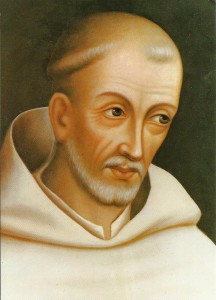
God’s Word will come to us


(Abbot and Doctor of the Church)
An excerpt from Sermon 5: On the Coming of the Lord

Advent I: Wednesday


We know that there are three comings of the Lord. The third lies between the other two. It is invisible, while the other two are visible. In the first coming he was seen on earth, dwelling among men; he himself testifies that they saw him and hated him. In the final coming all flesh will see the salvation of our God, and they will look on him whom they pierced. The intermediate coming is a hidden one; in it only the elect see the Lord within their own selves, and they are saved. In his first coming our Lord came in our flesh and in our weakness; in this middle coming he comes in spirit and in power; in the final coming he will be seen in glory and majesty.

Because this coming lies between the other two, it is like a road on which we travel from the first coming to the last. In the first, Christ was our redemption; in the last, he will appear as our life; in this middle coming, he is our rest and consolation.

In case someone should think that what we say about this middle coming is sheer invention, listen to what our Lord himself says: If anyone loves me, he will keep my word, and my Father will love him, and we will come to him. There is another passage of Scripture which reads: He who fears God will do good, but something further has been said about the one who loves, that is, that he will keep God’s word. Where is God’s word to be kept? Obviously in the heart, as the prophet says: I have hidden your words in my heart, so that I may not sin against you.

Keep God’s word in this way. Let it enter into your very being, let it take possession of your desires and your whole way of life. Feed on goodness, and your soul will delight in its richness. Remember to eat your bread, or your heart will wither away. Fill your soul with richness and strength.

If you keep the word of God in this way, it will also keep you. e Son with the Father will come to you. The great Prophet who will build the new Jerusalem will come, the one who makes all things new. His coming will fulfill what is written: As we have borne the likeness of the earthly man, we shall also bear the likeness of the heavenly man. Just as Adam’s sin spread through all mankind and took hold of all, so Christ, who created and redeemed all, will glorify all, once he takes possession of all.

Glory to the Father
and to the Son
and to the Holy Spirit:
as it was in the beginning,
is now, and will be forever. Amen


ADVENT


Week I: Tuesday


“But a shoot shall sprout from the stump of Jesse, and from his roots a bud shall blossom.” (Isaiah 11:1.)

Saint Jerome offers the following insight on this verses from today’s First Reading:

“Until the beginning of the vision, or the burden of Babylon, which Isaiah the son of Amos saw, his entire prophecy was about Christ, a prophecy that we want to explain piecemeal lest the ideas and discussions thereof together confuse the reader’s memory. The Jews interpreted the branch and the flower from the root of Jesse to be the Lord himself because the power of his governance is demonstrated in the branch and his beauty in the flower. But we understand the branch from the root of Jesse to be the holy Virgin Mary, who had no shoot connatural to herself. About her we read above: “Behold, a virgin will conceive and bear a son.” And the flower is the Lord our Savior, who said in the Song of Songs, “I am the flower of the field and the lily of the valleys.” In place of “root,” which only the Septuagint translated, the Hebrew text has geza, which Aquila and Symmachus and Theodotus interpret as kormon, that is, “stem.” And they translated “flower,” which the Hebrew text calls nēṣer, as “bud” to show that after a long time in Babylonian captivity, no longer possessing any glory from the sprout of the old kingdom of David, Christ would rise from Mary as though from her stem. The educated of the Hebrews believe that what all the ecclesiastics sought in the Gospel of Matthew but could not find, where it was written “Because he will be called a Nazarene,” was taken from this place. But it should be noted that nēṣer was written here with the [Hebrew] letter ṣade [צ], the peculiar sound of which —s omewhere between z and s — the Latin language does not express.” (Commentary on Isaiah, 4.)


Collect
Look with favor, Lord God, on our petitions,
and in our trials grant us Your compassionate help,
that, consoled by the presence of Your Son,
Whose coming we now await,
we may be tainted no longer
by the corruption of former ways.
Through our Lord Jesus Christ, your Son,
Who lives and reigns with You
in the unity of the Holy Spirit,
one God, for ever and ever. Amen.

Glory to the Father
and to the Son
and to the Holy Spirit:
as it was in the beginning,
is now, and will be forever. Amen


Top


ADVENT


Week I: Sunday


“The days are coming — oracle of the LORD — when I will fulfill the promise I made to the house of Israel and the house of Judah.” (Jeremiah 33:14.)

Pope Saint Leo the Great comments on this verse from the First Reading proclaimed at Mass today:

“But the majesty of the Son of God, in which he is equal with the Father in its garb of a slave’s humility, feared no diminution, required no augmentation. And the very effect of his mercy, which he expended on the restitution of humanity, he was able to bring about solely by the power of his Godhead, thus rescuing the creature that was made in the image of God from the yoke of his cruel oppressor. But because the devil had not shown himself so violent in his attack on the first man as to bring him over to his side without the consent of his free will, the voluntary sin and hostile desires of humanity had to be destroyed in such a way that the standard of justice should not stand in the way of the gift of grace. And therefore in the general ruin of the entire human race there was but one remedy in the secret of the divine plan which could help the fallen, and that was that one of the sons of Adam should be born free and innocent of original transgression, to prevail for the rest both by his example and his merits. Still further, because this was not permitted by natural generation, and because there could be no offspring from our faulty stock without seed, of which the Scripture says, “Who can make a clean thing conceived of an unclean seed? Is it not you who are alone?” David’s Lord was made David’s Son, and sprang from the fruit of the promised branch—One without fault, the twofold nature coming together into one Person, that by one and the same conception and birth might spring our Lord Jesus Christ, in whom was present both true Godhead for the performance of mighty works and true humanity for the endurance of sufferings.” (Sermon 28)


Collect
Grant your faithful, we pray, almighty God,
the resolve to run forth to meet your Christ
with righteous deeds at his coming,
so that, gathered at his right hand,
they may be worthy
to possess the heavenly Kingdom.
Through our Lord Jesus Christ, your Son,
Who lives and reigns with You
in the unity of the Holy Spirit,
one God, for ever and ever. Amen.

Glory to the Father
and to the Son
and to the Holy Spirit:
as it was in the beginning,
is now, and will be forever. Amen


Top


On the threshold of Advent


What comes to mind when you hear the word Advent? Perhaps the phrase “coming to” or “preparation” recalls homilies or lessons from the past. Perhaps Advent triggers a word of frustration: ugh! - Christmas is close and there is much to do in a short period of time. Seemingly, we blink and Advent is over, that is if we even entered into it with the Christmas crush.

In the prayer following the Lord’s Prayer at every Mass, the Church prays: “Deliver us, Lord, we pray, from every evil, graciously grant peace in our days, that, by the help of Your mercy, we may be always free from sin and safe from all distress, as we await the blessed hope and the coming of our Savior, Jesus Christ.”
  1. Deliverance from every evil.
  2. Peace in our days.
  3. Freedom from sin.
  4. Safe[ty] from all distress.
Might any of these four be a dream that you nurture deep within, wondering if any or all 4 will ever become a reality in your life? The world repeats and old message: there will always be evil in the world, peace will never come, we will always sin and we will have to find ways to medicate and to cope with distress in our lives. The repetitive and old message of pessimism and despair is real in the sense that anyone of us can give into its life-robbing power. The irony is that in the Face of Jesus Christ, these realities have no power; but WE give them power when we acknowledge their repetitive and old existence. Discovering the singular, unique newness Who is Jesus the Christ destroys evil, provides peace, gives freedom from sin and safety from distress.

Thus we come to the “work” of Advent. Yes, Advent as a way of life is a work, a work of responding to the new creation in our midst that is Jesus. Centuries ago, Saint Irenaeus wrote: “You must realize that He Who was promised has brought something totally new by giving us Himself.” Advent is a way of living life that proclaims boldly Jesus makes all things new (Revelation 21:5) and consequently there is no room for a repetitive, old message of evil, unrest, sin and distress. Allowing oneself to be found by Jesus Christ (in other words, not seeking after as if “I” must find Him) unleashes power that floods life with deliverance, peace, no sin and no distress.


ORDINARY TIME


Week XXXIV: Saturday


“The ten horns shall be ten kings rising out of that kingdom; another shall rise up after them, Different from those before him, who shall lay low three kings.” (Daniel 7:24.)

Saint Cyril of Jerusalem comments on this verse from the First Reading proclaimed at Mass today:

“These doctrines are not the fruit of ingenuity but are derived from the sacred Scriptures read in the church, particularly as gathered out of the prophecy of Daniel, in today’s selection, and according to the interpretation given by the archangel Gabriel, who spoke as follows, “the fourth beast shall be the fourth kingdom on earth, which shall surpass all kingdoms.” Ecclesiastical commentators have traditionally taken this kingdom to be the Roman Empire. Further on Gabriel continues his interpreting and says, “And the ten horns out of this kingdom are ten kings that shall arise; and another king shall rise up after them, and he shall surpass in wickedness all who were before him” (not merely the ten kings, you note, but all kings that ever were) “and he shall subdue three kings” (clearly out of the ten that preceded him; and he had reduced three of the ten to powerlessness; it is equally clear that he will reign as the eighth king) “and he will speak great words against the Most High.” Antichrist is a blasphemer and flouter of all law. He will not succeed to the empire but will usurp it by means of sorcery.” (Catechetical Lectures, 15.)


Collect
Stir up the will of Your faithful,
we pray, O Lord,
that, striving more eagerly
to bring Your divine work to fruitful completion,
they may receive in greater measure
the healing remedies Your kindness bestows.
Through our Lord Jesus Christ, your Son,
Who lives and reigns with You
in the unity of the Holy Spirit,
one God, for ever and ever. Amen.

Glory to the Father
and to the Son
and to the Holy Spirit:
as it was in the beginning,
is now, and will be forever. Amen


Top


ORDINARY TIME


Week XXXIV: Friday


“The first was like a lion, but with eagle’s wings.* While I watched, the wings were plucked; it was raised from the ground to stand on two feet like a human being, and given a human mind.” (Daniel 7:4.)

Saint Jerome offers the following insight on this verses from today’s First Reading:

“The kingdom of the Babylonians was not called a lion but a lioness, on account of its brutality and cruelty, or else because of its luxurious, lust-serving manner of life. For writers on the natural history of beasts assert that lionesses are fiercer than lions, especially if they are nursing their cubs, and constantly are passionate in their desire for sexual relations. And as for the fact that she possessed eagle’s wings, this indicates the pride of the all-powerful kingdom, the ruler of which declares in Isaiah, “Above the stars of heaven I will place my throne, and I shall be like unto the Most High.” Therefore he is told, “Though you are borne on high like an eagle, from there I will drag you down.” Moreover, just as the lion occupies kingly rank among beasts, so also the eagle among the birds. But it should also be said that the eagle enjoys a long span of life and that the kingdom of Assyrians had held sway for many generations. And as for the fact that the wings of the lioness or eagle were torn away, this signifies the other kingdoms over which it had ruled and soared about in the world.” (Commentary on Daniel, 7.)


Collect
Stir up the will of Your faithful,
we pray, O Lord,
that, striving more eagerly
to bring Your divine work to fruitful completion,
they may receive in greater measure
the healing remedies Your kindness bestows.
Through our Lord Jesus Christ, your Son,
Who lives and reigns with You
in the unity of the Holy Spirit,
one God, for ever and ever. Amen.

Glory to the Father
and to the Son
and to the Holy Spirit:
as it was in the beginning,
is now, and will be forever. Amen


Top


(In the United States of America)


Thanksgiving Day


“I give thanks to my God always on your account for the grace of God bestowed on you in Christ Jesus ...” (1 Corinthians 1:4.)

Origen of Alexandria (part 2 of Pope Benedict’s reflections on Origen) comments on this verse from the First Reading proclaimed at Mass today:

“Paul does not just give thanks for the Corinthians some of the time, nor only when they do good. He puts himself in the position of a father, who is thankful for his children all the time, whatever they may have done.” (Commentary on First Corinthians, 1)


Collect
Father all-powerful,
Your gifts of love are countless
and Your goodness infinite;
as we come before You on Thanksgiving Day
with gratitude for Your kindness,
open our hearts to have concern
for every man, woman, and child,
so that we may share Your gifts
in loving service.
Through our Lord Jesus Christ, your Son,
Who lives and reigns with You
in the unity of the Holy Spirit,
one God, for ever and ever. Amen.


Glory to the Father
and to the Son
and to the Holy Spirit:
as it was in the beginning,
is now, and will be forever. Amen


Top


If we are sheep, we overcome,
if wolves, we are overcome


Saint John Chrysostom
(Bishop and Father of the Church)
An excerpt from Homily 33

ORDINARY TIME XXXIV: Thursday


As long as we are sheep, we overcome and, though surrounded by countless wolves, we emerge victorious; but if we turn into wolves, we are overcome, for we lose the shepherd’s help. He, after all, feeds the sheep not wolves, and will abandon you if you do not let him show his power in you.

What he says is this: “Do not be upset that, as I send you out among the wolves, I bid you be as sheep and doves. I could have managed things quite differently and sent you, not to suffer evil nor to yield like sheep to the wolves, but to be fiercer than lions. But the way I have chosen is right. It will bring you greater praise and at the same time manifest my power.” That is what he told Paul: My grace is enough for you, for in weakness my power is made perfect. “I intend,” he says, “to deal the same way with you.” For, when he says, I am sending you out like sheep, he implies: “But do not therefore lose heart, for I know and am certain that no one will be able to overcome you.”

The Lord, however, does want them to contribute something, lest everything seem to be the work of grace, and they seem to win their reward without deserving it. Therefore he adds: You must be clever as snakes and innocent as doves. But, they may object, what good is our cleverness amid so many dangers? How can we be clever when tossed about by so many waves? However great the cleverness of the sheep as he stands among the wolves—so many wolves!—what can it accomplish? However great the innocence of the dove, what good does it do him, with so many hawks swooping upon him? To all this I say: Cleverness and innocence admittedly do these irrational creatures no good, but they can help you greatly.

What cleverness is the Lord requiring here? The cleverness of a snake. A snake will surrender everything and will put up no great resistance even if its body is being cut in pieces, provided it can save its head. So you, the Lord is saying, must surrender everything but your faith: money, body, even life itself. For faith is the head and the root; keep that, and though you lose all else, you will get it back in abundance. The Lord therefore counseled the disciples to be not simply clever or innocent; rather he joined the two qualities so that they become a genuine virtue. He insisted on the cleverness of the snake so that deadly wounds might be avoided, and he insisted on the innocence of the dove so that revenge might not be taken on those who injure or lay traps for you. Cleverness is useless without innocence.

Do not believe that this precept is beyond you power. More than anyone else, the Lord knows the true natures of created things; he knows that moderation, not a fierce defense, beats back a fierce attack.

Glory to the Father
and to the Son
and to the Holy Spirit:
as it was in the beginning,
is now, and will be forever. Amen


ORDINARY TIME


Week XXXIV: Wednesday


“King Belshazzar gave a great banquet for a thousand of his nobles, with whom he drank.” (Daniel 5:1.)

Saint Jerome offers the following insight on this verses from today’s First Reading:

“Belshazzar the king made a great feast for his one thousand nobles; and each one drank in the order of his age.” It should be known that this man was not the son of Nebuchadnezzar, as readers commonly imagine; but according to Berosus, who wrote the history of the Chaldeans, and also Josephus, who follows Berosus, after Nebuchadnezzar’s reign of forty-three years, a son named Evil-merodach succeeded to his throne. It was concerning this king that Jeremiah wrote that in the first year of his reign he raised the head of Jehoiachin, king of Judah, and took him out of his prison. Josephus likewise reports that after the death of Evil-merodach, his son Neriglissar succeeded to his father’s throne; after whom in turn came his son Labosordach. On the latter’s death, his son, Belshazzar, obtained the kingdom, and it is of him that the Scripture now makes mention. After he had been killed by Darius, king of the Medes, who was the maternal uncle of Cyrus, king of the Persians, the empire of the Chaldeans was destroyed by Cyrus the Persian. It was these two kingdoms that Isaiah in chapter 21 addresses as a charioteer of a vehicle drawn by a camel and an ass. Indeed, Xenophon also writes the same thing in connection with the childhood of Cyrus the Great; likewise Pompeius Trogus and many others who have written up the history of the barbarians. Some authorities think that this Darius was the Astyages mentioned in the Greek writings, while others think it was Astyages’ son, and that he was called by the other name among the barbarians. “And each one of the princes who had been invited drank in the order of his own age.” Or else, as other translators have rendered it, “The king himself was drinking in the presence of all the princes whom he had invited.” (Commentary on Daniel, 5.)


Collect
Stir up the will of Your faithful,
we pray, O Lord,
that, striving more eagerly
to bring Your divine work to fruitful completion,
they may receive in greater measure
the healing remedies Your kindness bestows.
Through our Lord Jesus Christ, your Son,
Who lives and reigns with You
in the unity of the Holy Spirit,
one God, for ever and ever. Amen.

Glory to the Father
and to the Son
and to the Holy Spirit:
as it was in the beginning,
is now, and will be forever. Amen


Top