MEMORIAL


Saint Pius of Pietrelcina


“Then, at the time of the evening sacrifice, I rose in my wretchedness, and with cloak and mantle torn I fell on my knees, stretching out my hands to the LORD, my God.” (Ezra 9:5.)

Saint Bede the Venerable comments on this verse from today’s First Reading:

“Ezra had prepared himself through compunction of heart and through bodily affliction so that he might be made worthy to hear heavenly mercy, and only then did he begin to break forth in words of prayer. He bends his knees, spreads out his hands and pours forth prayers to the Lord at the time of the evening sacrifice, not doubting that this sacrifice that is offered with a humble spirit and contrite heart would be more pleasing to God than one offered with the flesh or blood of cattle. Typologically, however, in the fact that with his garment torn he falls on his knees, spreads out his hands to God and turns the mind of very many to repentance by pouring out prayers and tears, as is written in what follows, he represents the Lord Savior, who deigned to pray for our sins both before and at the very time of his passion and who allowed his hands to be stretched out on the cross and the garment of his own flesh to be torn with wounds and mortified at the appointed time on behalf of our restoration, so that, as the apostle says, he who “died on behalf of our sins” might rise “for our justification.” This was aptly done at the time of evening sacrifice either because the Lord at the end of the age offered the sacrifice of his own flesh and blood to the Father and ordered that it should be offered by us in bread and wine or because with legal sacrifice coming to an end, he freed us through his own passion and, separating us from the people of the lands, made us become heavenly and allowed those who are chaste in heart and body to adhere to him.” (On Ezra and Nehemiah, 2.)


Collect
Almighty ever-living God,
Who, by a singular grace,
gave the Priest Saint Pius
a share in the Cross of Your Son
and, by means of his ministry,
renewed the wonders of Your mercy,
grant that through his intercession
we may be united constantly
to the sufferings of Christ,
and so brought happily
to the glory of the resurrection.
Through our Lord Jesus Christ, your Son,
Who lives and reigns with You
in the unity of the Holy Spirit,
one God, for ever and ever. Amen.


Glory to the Father
and to the Son
and to the Holy Spirit:
as it was in the beginning,
is now, and will be forever. Amen

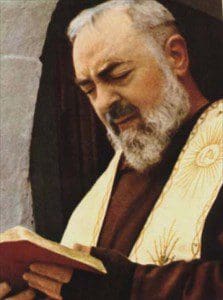


I will raise my voice and
will not stop imploring Him


(Priest)
An excerpt from his Letters

Out of obedience I am obliged to manifest to you what happened to me on the evening of the 5th of this month of August 1918 and all day on the 6th.

I am quite unable to convey to you what occurred during this period of utter torment. While I was hearing the boys’ confessions on the evening of the 5th, I was suddenly terrorized by the sight of a celestial person who presented himself to my mind’s eye. He had in his hand a sort of weapon like a very long sharp-pointed steel blade which seemed to emit fire. At the very instant that I saw all this, I saw that person hurl the weapon into my soul with all his might. I cried out with difficulty and felt I was dying. I asked the boys to leave because I felt ill and no longer had the strength to continue. This agony lasted uninterruptedly until the morning of the 7th. I cannot tell you how much I suffered during this period of anguish. Even my entrails were torn and ruptured by the weapon, and nothing was spared.

From that day on I have been mortally wounded. I feel in the depths of my soul a wound that is always open and which causes me continual agony. What can I tell you in answer to your questions regarding my crucifixion? My God! What embarrassment and humiliation I suffer by being obliged to explain what you have done to this wretched creature!

On the morning of the 20th of last month, in the choir, after I had celebrated Mass I yielded to a drowsiness similar to a sweet sleep. All the internal and external senses and even the very faculties of my soul were immersed in indescribable stillness. Absolute silence surrounded and invaded me. I was suddenly filled with great peace and abandonment which effaced everything else and caused a lull in the turmoil. All this happened in a flash. While this was taking place I saw before me a mysterious person similar to the one I had seen on the evening of August 5th. The only difference was that his hands and feet and side were dripping blood. This sight terrified me and what I felt at that moment is indescribable. I thought I should die and really should have died if the Lord had not intervened and strengthened my heart which was about to burst out of my chest. The vision disappeared and I became aware that my hands, feet and side were dripping blood. Imagine the agony I experienced and continue to experience almost every day. The heart wound bleeds continually, especially from Thursday evening until Saturday.

Dear Father, I am dying of pain because of the wounds and the resulting embarrassment I feel deep in my soul. I am afraid I shall bleed to death if the Lord does not hear my heartfelt supplication to relieve me of this condition. Will Jesus, who is so good, grant me this grace? Will he at least free me from the embarrassment caused by these outward signs? I will raise my voice and will not stop imploring him until in his mercy he takes away, not the wound or the pain, which is impossible since I wish to be inebriated with pain, but these outward signs which cause me such embarrassment and unbearable humiliation. The person of whom I spoke in a previous letter is none other than the one I mentioned having seen on August 5th. He continues his work incessantly, causing me extreme spiritual agony. There is a continual rumbling within me like the gushing of blood. My God! Your punishment is just and your judgment right, but grant me your mercy. Lord, with your Prophet I shall continue to repeat: O Lord, do not rebuke me in your anger; do not punish me in your rage! Dear Father, now that my whole interior state is known to you, do not refuse to send me a word of comfort in the midst of such severe and harsh suffering.

Glory to the Father
and to the Son
and to the Holy Spirit:
as it was in the beginning,
is now, and will be forever. Amen


— Prayer for Pope Francis —


O God,
Who in Your providential design
willed that Your Church be built
upon blessed Peter,
Whom You set over the other Apostles,
look with favor, we pray, on Francis our Pope
and grant that he, whom You have made Peter’s successor,
may be for Your people a visible source and foundation
of unity in faith and of communion.
Through our Lord Jesus Christ, your Son,
who lives and reigns with you in the unity of the Holy Spirit, one God, for ever and ever.


ORDINARY TIME


Tuesday of Week XXV


“Let the governor and the elders of the Jews continue the work on that house of God; they are to rebuild it on its former site.” (Ezra 6:7.)

Saint Bede the Venerable comments on this verse from today’s First Reading:

“The sequence of events in the text is as if Darius himself had read Cyrus’s letter and, having perused it, immediately endorsed it with his authority, in such a way that suppressing all their adversaries, he ordered the temple of God to be rebuilt on its site just as the letter said, and himself, with a most devout mind in all things, assisted God’s worshipers to serve his will. Let Artaxerxes, therefore, who above forbade that the house or city of God be built, designate those lords of worldly affairs who by inciting persecutions opposed the construction of the holy church, while in the upheaval of these persecutions that church flourished chiefly by the triumph of martyrs. Let Darius designate the dutiful devotion of those kings who, recognizing the will of God, endeavored not only not to resist the Christian faith but also to assist it with their decrees; and many of them, forbidding the persecutions of their predecessors, wished that they themselves along with the people under their sway might be consecrated in the sacraments of the same faith.” (On Ezra and Nehemiah), 2.


Collect
O God,
Who founded all the commands
of Your sacred Law
upon love of You and of our neighbor,
grant that, by keeping Your precepts,
we may merit to attain eternal life.
Through our Lord Jesus Christ, your Son,
Who lives and reigns with You
in the unity of the Holy Spirit,
one God, for ever and ever. Amen.


Glory to the Father
and to the Son
and to the Holy Spirit:
as it was in the beginning,
is now, and will be forever. Amen


Top


The Church, like a vine,
spreads everywhere in her growth


Continuation of an excerpt from his  Sermon 46 «On Pastors»
(Bishop and Father of the Church)

They were scattered on every mountain, and on every hill and over the entire face of the earth. What is the meaning of the phrase: They were scattered over the entire face of the earth? Some men continually strive for all the goods of the world, the goods that are so evident on the face of the earth; yes, they love and prize them. They do not want to die, to have their lives buried in Christ. Over the entire face of the earth: such men love earthly things; moreover such straying sheep are to be found over the entire face of the earth. They dwell in different places, but one mother, pride, has given birth to them all, just as one mother, our Catholic Church, has given birth to all faithful Christians scattered over the entire world.

Small wonder that pride gives birth to division, and love to unity. But our catholic mother is herself a shepherd; she seeks the straying sheep everywhere, strengthens the weak, heals the sick, and binds up the injured. They may not know one another, but she knows all of them because she reaches out to all her sheep. Thus she is like a vine that is spread out everywhere in its growth. The straying sheep are like useless branches which because of their sterility are deservedly cut off, not to destroy the vine but to prune it. When these branches were cut down, they were left lying there. But the vine grew and flourished, and it knew both the branches that remained upon it and those that had been cut off and left lying beside it.

She calls the stray sheep back, however, because the Apostle said in reference to the broken branches: God has the power to graft them on again. Call them sheep straying from the flock or branches cut off from the vine, God is equally capable of calling back the sheep or of grafting the branches on again, for he is equally the chief shepherd and the true farmer. And they were scattered over the entire face of the earth, and there was no one to search for them, no one to call them back, that is to say, no one among those wicked shepherds. There was no one to search for them, that is, no one among men.

Therefore, shepherds, hear the word of the Lord: I live, says the Lord God. Notice the beginning of this passage; it is as if God were taking an oath, giving testimony to his own life. I live, says the Lord. The shepherds are dead, but the sheep are safe, for the Lord lives. I live, says the Lord God. Which shepherds are dead? Those who seek what is theirs and not what is Christ’s. But will there be shepherds who seek what is Christ’s and not what is theirs, and will they be found? There will indeed be such shepherds, and they will indeed be found; they are not lacking, nor will they be lacking in the future.

Glory to the Father
and to the Son
and to the Holy Spirit:
as it was in the beginning,
is now, and will be forever. Amen


FEAST


— Saint Matthew —


Apostle and Evangelist


“... with all humility and gentleness, with patience, bearing with one another through love ...” (Ephesians 4:2.)

In commenting on these verses from today’s First Reading, Saint John Chrysostom writes:

“How is it possible to “walk worthily” with “all lowliness”? Meekness is the foundation of all virtue. If you are humble and are aware of your limits and remember how you were saved, you will take this recollection as the motive for every excellent moral behavior. You will not be excessively impressed with either chains or privileges. You will remember that all is of grace and so walk humbly. “With all lowliness,” he says, not in words only or even in deeds but more so in the very manner and tone of your voice. And not meek toward one person and rude toward another but humble toward everyone, whether enemy or friend, great or small.” (Homily on Ephesians, 9.)


Collect
O God,
Who with untold mercy
were pleased to choose as an Apostle
Saint Matthew, the tax collector,
grant that,
sustained by his example and intercession,
we may merit to hold firm in following You.
Through our Lord Jesus Christ, your Son,
Who lives and reigns with You
in the unity of the Holy Spirit,
one God, for ever and ever. Amen.


Glory to the Father
and to the Son
and to the Holy Spirit:
as it was in the beginning,
is now, and will be forever. Amen


Jesus saw him through the eyes of mercy
and chose him


An excerpt from Homily 21
(Priest and Doctor of the Church)

Jesus saw a man called Matthew sitting at the tax office, and he said to him: Follow me. Jesus saw Matthew, not merely in the usual sense, but more significantly with his merciful understanding of men.

He saw the tax collector and, because he saw him through the eyes of mercy and chose him, he said to him: Follow me. This following meant imitating the pattern of his life—not just walking after him. Saint John tells us: Whoever says he abides in Christ ought to walk in the same way in which he walked.

And he rose and followed him. There is no reason for surprise that the tax collector abandoned earthly wealth as soon as the Lord commanded him. Nor should one be amazed that neglecting his wealth, he joined a band of men whose leader had, on Matthew’s assessment, no riches at all. Our Lord summoned Matthew by speaking to him in words. By an invisible, interior impulse flooding his mind with the light of grace, he instructed him to walk in his footsteps. In this way Matthew could understand that Christ, who was summoning him away from earthly possessions, had incorruptible treasures of heaven in his gift.

As he sat at table in the house, behold many tax collectors and sinners came and sat down with Jesus and his disciples. This conversion of one tax collector gave many men, those from his own profession and other sinners, an example of repentance and pardon. Notice also the happy and true anticipation of his future status as apostle and teacher of the nations. No sooner was he converted than Matthew drew after him a whole crowd of sinners along the same road to salvation. He took up his appointed duties while still taking his first steps in the faith, and from that hour he fulfilled his obligation and thus grew in merit.

To see a deeper understanding of the great celebration Matthew held at his house, we must realize that he not only gave a banquet for the Lord at his earthly residence, but far more pleasing was the banquet set in his own heart which he provided through faith and love. Our Savior attests to this: Behold I stand at the door and knock; if anyone hears my voice and opens the door, I will come in to him and eat with him, and he with me.

On hearing Christ’s voice, we open the door to receive him, as it were, when we freely assent to his promptings and when we give ourselves over to doing what must be done. Christ, since he dwells in the hearts of his chosen ones through the grace of his love, enters so that he might eat with us and we with him. He ever refreshes us by the light of his presence insofar as we progress in our devotion to and longing for the things of heaven. He himself is delighted by such a pleasing banquet.

Glory to the Father
and to the Son
and to the Holy Spirit:
as it was in the beginning,
is now, and will be forever. Amen


ORDINARY TIME


— The Lord’s Day —


Sunday Week XXV


Pondering Jesus’ victorious Word


εὐαγγελίζω (euaggelizo)
“to announce the Good News of victory in battle”

“Jesus and his disciples left from there and began a journey through Galilee, but he did not wish anyone to know about it. He was teaching (διδάσκω, didasko) his disciples and telling (ἔλεγεν, elegen) them, "The Son of Man is to be handed over to men and they will kill him, and three days after his death the Son of Man will rise." But they did not understand the saying, and they were afraid to question him.”


θεωρέω (theoreo)
(“to perceive, discover, ponder a deeper meaning”)

In the chronology of the Evangelist Mark, much has happened between last week’s lesson on Jesus’ identity and this week’s announcement once again of what awaits Jesus in Jerusalem. Preceding today’s proclamation, Jesus took Peter, James and John atop “a high mountain” and was transfigured before them. Jesus gave those three disciples a glimpse, a peek into His glorified identity – an identity that would not be revealed until the Cross. Following this event, which had the three questioning, “what rising from the dead meant,” a man brought his “son possessed by a mute spirit.” The father explained that the disciples could not cure him and Jesus reminded all of the need once again to have faith, that radical and complete trust in the Person, Jesus. In a dramatic characteristic of the Evangelist Mark, the episode - filled with violence at one point, ends with Jesus peacefully returning him to his father. Jesus’ disciples then question why they could not cure the son and Jesus once again counsels them on the necessity of prayer.All of this forms a backdrop for today’s proclamation that once again reminds the disciples of the events that await Jesus in Jerusalem.


The episode opens with Jesus “teaching his disciples and telling them.” Teaching and telling: is there a difference between these two actions? While we generally think of teaching involving some type of oral communication, διδάσκω (didasko) is “teaching that demonstrates, shows or reveals.” The activity of διδάσκω involves much more than speaking bits of information to others. ‘Showing how’ the teaching works in the person’s life is more at the core meaning of διδάσκω. The disciples, as far as Jesus was concerned, were not only to hear what was being said (teaching) but to see the ‘teaching’ or the lesson embodied in the Teacher Himself. This is a particular meaning of διδάσκω that is rather unique in the biblical usage of both Testaments. Sadly, the disciples missed the point and Jesus needed to re-present the lesson.

The event does speak volumes to all involved in the Church’s teaching ministry. In view of the upcoming visit of Pope Francis and his announcing of Jesus’ teaching that both comforts and challenges, how do we receive what Our Lord Jesus has set forth in the Gospel? Do we experience the Gospel as a mere list of do's and don'ts - OR - are we grateful for the Word of hope and life? The present life of the Body of Christ as joyfully sounded by Pope Francis is clear: the handing-on of the Person Jesus wherein the ‘seers’ and ‘listeners’ encounter a Person - Jesus and respond with lives of daily conversion and service to God our Father and one another.


On weak Christians


Continuation of an excerpt from his  Sermon 46 «On Pastors»
(Bishop and Father of the Church)

You have failed to strengthen the weak, says the Lord. He is speaking to wicked shepherds, false shepherds, shepherds who seek their own concerns and not those of Christ. They enjoy the bounty of milk and wool, but they take no care at all of the sheep, and they make no effort to heal those who are ill. I think there is a difference between one who is weak (that is, not strong) and one who is ill, although we often say that the weak are also suffering from illness.

My brothers, when I try to make that distinction, perhaps I could do it better and with greater precision, or perhaps someone with more experience and insight could do so. But when it comes to the words of Scripture, I say what I think so that in the meantime you will not be deprived of all profit. In the case of the weak sheep, it is to be feared that the temptation, when it comes, may break him. The sick person, however, is already ill by reason of some illicit desire or other, and this is keeping him from entering God’s path and submitting to Christ’s yoke.

There are men who want to live a good life and have already decided to do so, but are not capable of bearing sufferings even though they are ready to do good. Now it is a part of the Christian’s strength not only to do good works but also to endure evil. Weak men are those who appear to be zealous in doing good works but are unwilling or unable to endure the sufferings that threaten. Lovers of the world, however, who are kept from good works by some evil desire, lie sick and listless, and it is this sickness that deprives them of any strength to accomplish good works.

The paralytic was like that. When his bearers could not bring him in to the Lord, they opened the roof and lowered him down to the feet of Christ. Perhaps you wish to do this in spirit: to open the roof and to lower a paralytic soul down to the Lord. All its limbs are lifeless, it is empty of every good work, burdened with its sins, and weak from the illness brought on by its evil desires. Since all its limbs are helpless, and the paralysis is interior, you cannot come to the physician. But perhaps the physician is himself concealed within; for the true understanding of Scripture is hidden. Reveal therefore what is hidden, and thus you will open the roof and lower the paralytic to the feet of Christ.

As for those who fail to do this and those who are negligent, you have heard what was said to them: You have failed to heal the sick; you have failed to bind up what was broken. Of this we have already spoken. Man was broken by terrible temptations. But there is at hand a consolation that will bind what was broken: God is faithful. He does not allow you to be tempted beyond your strength, but with the temptation he will also provide the way of escape, that you may be able to endure it.

A reflection on this Sunday’s Gospel.


Glory to the Father
and to the Son
and to the Holy Spirit:
as it was in the beginning,
is now, and will be forever. Amen


ORDINARY TIME


Saturday of Week XXIV


“... who alone has immortality, who dwells in unapproachable light, and whom no human being has seen or can see. To him be honor and eternal power. Amen.” (1 Timothy 6:16.)

Saint Gregory of Nyssa (part 2 of the background of Saint Gregory of Nyssa is found here) offers the following insight on this verse from today’s First Reading:

“But we, even when we are told that God “only has immortality,” we understand by “immortality” the Son. For life is immortality, and the Lord is that life, who said, “I am the Life.” And if he is said to dwell “in the light that no man can approach,” again we make no difficulty in understanding that the true Light, unapproachable by falsehood, is the Only-begotten, in whom we learn from the Truth itself that the Father is. Are we to think of the Only-begotten in a manner worthy of the Godhead, or to call him, as heresy prescribes, perishable and temporary?” (Against Eunomius, 2.)


Collect
Look upon us, O God,
Creator and ruler of all things,
and, that we may feel the working of your mercy,
grant that we may serve you with all our heart.
Through our Lord Jesus Christ, your Son,
Who lives and reigns with You
in the unity of the Holy Spirit,
one God, for ever and ever. Amen.


Glory to the Father
and to the Son
and to the Holy Spirit:
as it was in the beginning,
is now, and will be forever. Amen