Memorial
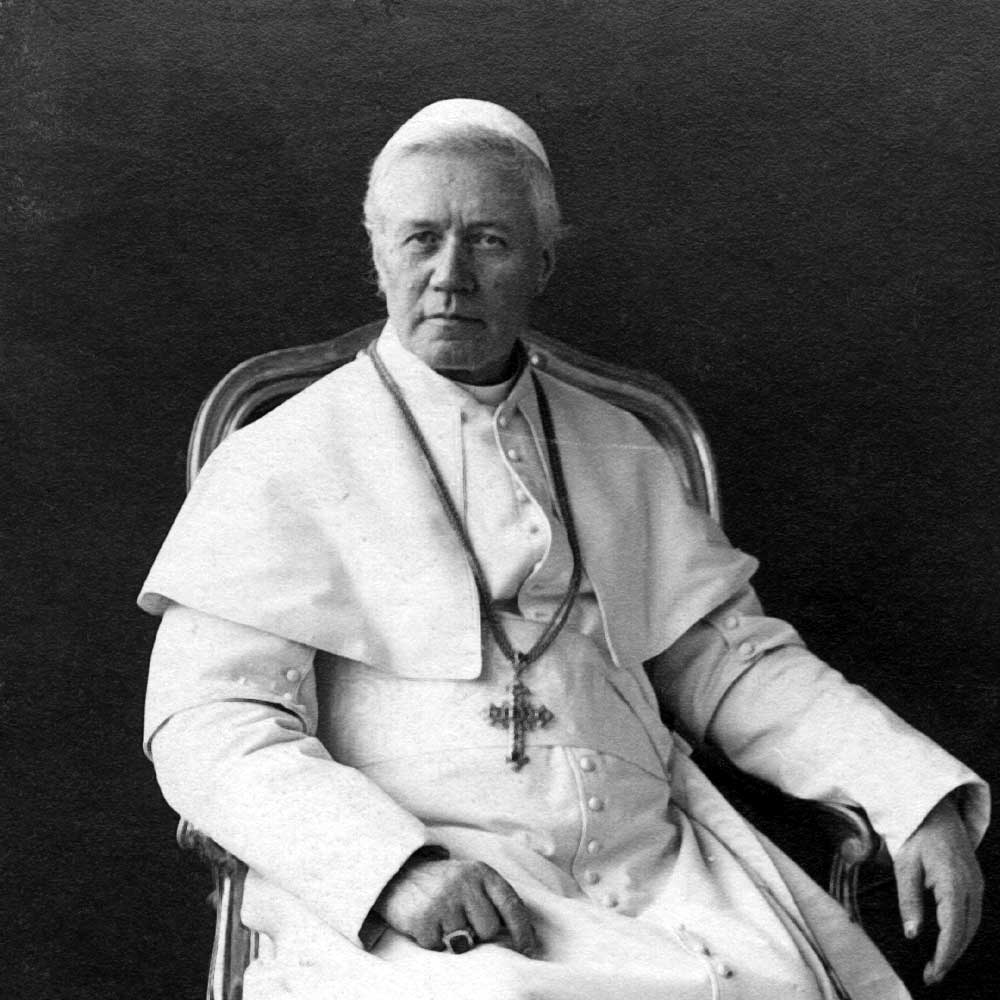
Pope Saint Pius X

“Once back in the time of the judges there was a famine in the land; so a man from Bethlehem of Judah left home with his wife and two sons to reside on the plateau of Moab.” (Ruth 1:1.)

Saint Jerome offers the following insight on this verses from today’s First Reading:

“The Hebrews’ tradition is that this is he in whose time the sun stood still, on account of those who did not keep the law, so that, when they had seen such a miracle, they should turn to the Lord God. And because they scorned to do such a thing, therefore the famine grew worse, and he who seemed foremost in the tribe of Judah not only was expelled from his native land with his wife and sons, made helpless by famine, but even continued in that same exile with his sons.” (Hebrew Questions on Chronicles)


Collect
O God,
Who to safeguard the Catholic faith
and to restore all things in Christ,
filled Pope Saint Pius the Tenth
with heavenly wisdom and apostolic fortitude,
graciously grant
that, following his teaching and example,
we may gain an eternal prize.
Through our Lord Jesus Christ, Your Son,
who lives and reigns with You
in the unity of the Holy Spirit,
one God, for ever and ever.


Glory to the Father
and to the Son
and to the Holy Spirit:
as it was in the beginning,
is now, and will be forever. Amen


The song of the Church

Today’s Second Reading from the
Office of Readings (Liturgy of the Hours)

Memorial
Saint Pius X

An excerpt from
Divino afflatu

Saint Piux X
(Bishop of Rome)


The collection of psalms found in Scripture, composed as it was under divine inspiration, has, from the very beginnings of the Church, shown a wonderful power of fostering devotion among Christians as they offer to God a continuous sacrifice of praise, the harvest of lips blessing his name. Following a custom already established in the Old Law, the psalms have played a conspicuous part in the sacred liturgy itself, and in the divine office. Thus was born what Basil calls the voice of the Church, that singing of psalms, which is the daughter of that hymn of praise (to use the words of our predecessor, Urban VIII) which goes up unceasingly before the throne of God and of the Lamb, and which teaches those especially charged with the duty of divine worship, as Athanasius says, the way to praise God, and the fitting words in which to bless him. Augustine expresses this well when he says: God praised himself so that man might give him fitting praise; because God chose to praise himself man found the way in which to bless God.

The psalms have also a wonderful power to awaken in our hearts the desire for every virtue. Athanasius says: Though all Scripture, both old and new, is divinely inspired and has its use in teaching, as we read in Scripture itself, yet the Book of Psalms, like a garden enclosing the fruits of all the other books, produces its fruits in song, and in the process of singing brings forth its own special fruits to take their place beside them. In the same place Athanasius rightly adds: The psalms seem to me to be like a mirror, in which the person using them can see himself, and the stirrings of his own heart; he can recite them against the background of his own emotions. Augustine says in his Confessions: How I wept when I heard your hymns and canticles, being deeply moved by the sweet singing of your Church. Those voices flowed into my ears, truth filtered into my heart, and from my heart surged waves of devotion. Tears ran down, and I was happy in my tears.

Indeed, who could fail to be moved by those many passages in the psalms which set forth so profoundly the infinite majesty of God, his omnipotence, his justice and goodness and clemency, too deep for words, and all the other infinite qualities of his that deserve our praise? Who could fail to be roused to the same emotions by the prayers of thanksgiving to God for blessings received, by the petitions, so humble and confident, for blessings still awaited, by the cries of a soul in sorrow for sin committed? Who would not be fired with love as he looks on the likeness of Christ, the redeemer, here so lovingly foretold? His was the voice Augustine heard in every psalm, the voice of praise, of suffering, of joyful expectation, of present distress.

Glory to the Father
and to the Son
and to the Holy Spirit:
as it was in the beginning,
is now, and will be forever. Amen


Memorial

Saint Bernard of Clairvaux
Abbot and Doctor of the Church

“Jephthah made a vow to the LORD. “If you deliver the Ammonites into my power,” he said, “whoever comes out of the doors of my house to meet me when I return from the Ammonites in peace shall belong to the LORD. I shall offer him up as a burnt offering.” (Judges 11:30-31.)

Saint Jerome offers the following insight on this verses from today’s First Reading:

“And whereas he [Jovin ianus] prefers the fidelity of the father Jephthah to the tears of the virgin daughter, that corroborates our point. For we are not commending virgins of the world so much as those who are virgins for Christ’s sake. Most Hebrews blame the father for the rash vow he made, “If you will indeed deliver the children of Ammon into my hand, then it shall be that whatsoever comes out of the doors of my house to meet me, when I return in peace from the children of Ammon, it shall be for the Lord’s, and I will offer it up for a burnt offering.” Supposing (the Hebrews say) a dog or an ass had met him, what would he have done? Their meaning is that God so ordered events that he who had improvidently made a vow should learn his error by the death of his daughter.” (Against Jovinianus, 1.)


Collect
O God,
Who made of the Abbot Saint Bernard
a man consumed with zeal for your house
and a light shining and burning in your Church,
grant, through his intercession,
that we may be on fire with the same spirit
and walk always as children of light.
Through our Lord Jesus Christ, Your Son,
who lives and reigns with You
in the unity of the Holy Spirit,
one God, for ever and ever.


Glory to the Father
and to the Son
and to the Holy Spirit:
as it was in the beginning,
is now, and will be forever. Amen


Ordinary Time
Wednesday of the Twentieth Week

“One day the trees went out to anoint a king over themselves. So they said to the olive tree, ‘Reign over us...” (Judges 9:8.)

Saint Augustine of Hippo comments on this verse from the First Reading proclaimed at Mass today:

“And no one has been so illiterate as to think that similar Fables of Aesop, related for the same purpose, ought to be called lies. But also in the sacred writings such passages are found, as in the Book of Judges the trees look for a king to rule over them and speak to the olive and the fig and the vine and the bramble. Surely, all this is invented in order that we may reach the matter intended by means of a narrative [that is] fictitious, to be sure, but bearing a true and not a false signification.” (Against Lying, 13.)


Collect
O God,
Who have prepared for those who love you
good things which no eye can see,
fill our hearts, we pray, with the warmth of your love,
so that, loving you in all things and above all things,
we may attain your promises,
which surpass every human desire.
Through our Lord Jesus Christ, your Son,
Who lives and reigns with You
in the unity of the Holy Spirit,
one God, for ever and ever. Amen.


Glory to the Father
and to the Son
and to the Holy Spirit:
as it was in the beginning,
is now, and will be forever. Amen


Ordinary Time
Tuesday of the Twentieth Week

“... the messenger of the LORD stretched out the tip of the staff he held. When he touched the meat and unleavened cakes, a fire came up from the rock and consumed the meat and unleavened cakes. Then the messenger of the LORD disappeared from sight.” (Judges 6:21.)

Saint Ambrose of Milan offers the following insight on this verse from today’s First Reading:

“Gideon, moved by that message, when he heard that though thousands of the people failed, God would deliver his own from their enemies by means of one man, offered a kid, and according to the word of the angel, laid its flesh and the unleavened cakes upon the rock and poured the broth upon them. And as soon as the angel touched them with the end of the staff which he bore, fire burst forth out of the rock, and so the sacrifice which he was offering was consumed. By which it seems clear that that rock was a figure of the body of Christ, for it is written: “They drank of that rock that followed them, and that rock was Christ.” This certainly refers not to his Godhead but to his flesh, which watered the hearts of the thirsting people with the perpetual stream of his blood.

Even at that time was it declared in a mystery that the Lord Jesus in his flesh would, when crucified, do away the sins of the whole world, and not only the deeds of the body but the desires of the soul. For the flesh of the kid refers to sins of deed, the broth to the enticements of desire, as it is written: “For the people greedily lusted, and said, ‘Who shall give us flesh to eat?’” That the angel then stretched forth his staff and touched the rock, from which fire went out, shows that the flesh of the Lord, being filled with the divine Spirit, would burn away all the sins of human frailty. Wherefore, also, the Lord says, “I have come to send fire upon the earth.” (On the Holy Spirit, 1.)


Collect
O God,
Who have prepared for those who love you
good things which no eye can see,
fill our hearts, we pray, with the warmth of your love,
so that, loving you in all things and above all things,
we may attain your promises,
which surpass every human desire.
Through our Lord Jesus Christ, your Son,
Who lives and reigns with You
in the unity of the Holy Spirit,
one God, for ever and ever. Amen.


Glory to the Father
and to the Son
and to the Holy Spirit:
as it was in the beginning,
is now, and will be forever. Amen


Struggles without, fears within

Today’s Second Reading from the
Office of Readings (Liturgy of the Hours)

Ordinary Time
Monday of the Twentieth Week

An excerpt from
Moral Reflections on Job
Saint Gregory the Great
(pope and Father of the Church)

Holy men beset by tribulation must endure the assaults of those who use violence and verbal attacks. The former they resist with the shield of patience, but against the latter they launch the sharp arrows of true doctrine. In both types of fighting they win the day through the wonderful arts that virtue bestows, for within wisdom they teach the wayward while showing a courageous contempt for outward hostility; the straying sheep they set on the right path by their teaching; the attacker they suffer and overcome. For they have nothing but patient scorn for the enemy who moves against them, but they sympathize with their weaker fellows and bring them back to the safe way, opposing the former lest they lead others astray and fearing for the latter lest they completely lose sight of the truly upright life.

Let us see how a soldier in God’s camp fights against both types of enemy. Paul says: Struggles without, fears within. He lists the attacks he must endure from without: Dangers from floods, dangers from robbers, dangers from my own people, dangers from the pagans, dangers in the city, dangers in the desert, dangers on the seas, dangers from false brothers. He also tells us what weapons he uses against his enemies in this war: Toil and hardship, many sleepless nights, hunger and thirst, frequent fasts, cold and nakedness.

When beset by so many struggles, he guards the camp, he tells us, with great watchfulness. Immediately he adds: Besides these outward difficulties there is that daily weight upon me: my anxiety for all the churches. Thus he himself fights courageously and devotes himself compassionately to protecting his neighbors. He tells us of the evils he endures but also of the blessings he brings to others.

Let us reflect, then, on how difficult it is simultaneously to endure attacks from without and to protect the weak from within. He endures the attacks without, inasmuch as he suffers flogging and chains; inwardly he experiences fear, since he is afraid that his sufferings may be a stumbling-block not to himself but to his disciples. For this reason he writes to them: Let no one be shaken by these trials, for you know that they are our lot. Amid his own sufferings it was the fall of others he feared, lest the disciples, seeing him flogged for the faith, might refuse to acknowledge their own faith.

What an immensely loving heart! He thinks nothing of what he himself suffers and is concerned only that the disciples may be led astray interiorly. He scorns his own bodily wounds and brings healing to the inner wounds of others. It is characteristic of holy men that their own painful trials do not make them lose their concern for the well-being of others. They are grieved by the adversity they must endure, yet they look out for others and teach them needed lessons; they are like gifted physicians who are themselves stricken and lie ill. They suffer wounds themselves but bring others the medicine that restores health.

Glory to the Father
and to the Son
and to the Holy Spirit:
as it was in the beginning,
is now, and will be forever. Amen


— The Lord’s Day —

Ordinary Time
Sunday of the Twentieth Week

“Wisdom has built her house, she has set up her seven columns.” (Proverbs 9:1.)

Saint Augustine of Hippo comments on this verse from the First Reading proclaimed at Mass today:

“Wisdom said] to the unwise, “Come, eat my bread, and drink the wine which I have mingled for you.” In these words, surely, we recognize that the wisdom of God, the Father’s coeternal Word, has built a house for himself, namely, a body in the virgin’s womb. And to this body, as to the head, he has united the church as his members, has “slain” his martyrs as “victims,” set his “table” with bread and wine in allusion to the priesthood according to Melchizedek, and called the weak and unwise.” (City of God, 17.)


A reflection and study of this Sunday’s Gospel is found at Words of THE WORD.


Collect
O God,
Who have prepared for those who love you
good things which no eye can see,
fill our hearts, we pray, with the warmth of your love,
so that, loving you in all things and above all things,
we may attain your promises,
which surpass every human desire.
Through our Lord Jesus Christ, your Son,
Who lives and reigns with You
in the unity of the Holy Spirit,
one God, for ever and ever. Amen.


Glory to the Father
and to the Son
and to the Holy Spirit:
as it was in the beginning,
is now, and will be forever. Amen


SOLEMNITY


Assumption of the
Blessed Virgin Mary


Saint Ephrem the Syrian
“And Mary said: “My soul proclaims the greatness of the Lord; my spirit rejoices in God my savior. For he has looked upon his handmaid’s lowliness; behold, from now on will all ages call me blessed. The Mighty One has done great things for me, and holy is his name.” (Luke 1:46-49)

Saint Ephrem the Syrian offers the following insight on these verses from today’s Gospel:

“[Mary] revealed to Elizabeth what the angel spoke to her in secret, and that he called her blessed because she believed in the realization of the prophecy and the teaching that she heard. Then Mary gently brought forth the fruit of what she heard from the angel and Elizabeth: “My soul bless the Lord.” Elizabeth had said, “Blessed is she who has believed,” and Mary replied, “From henceforth all generations will call me blessed.” It was then that Mary began to preach the new kingdom. “She returned home after three months,” so that the Lord whom she was carrying would not begin service before his servant. She returned to her husband to clarify the matter, for if she had become pregnant through human fruit, it would have been appropriate for her to flee from her husband.” (Commentary on Tatian’s Diatessaron, 1)


Pondering today’s Patristic passage...
As she always does, Mary teaches would be followers of her Son how to be a disciple. She herself speaks to others only what she has heard. In so doing, Mary erupts in praise that celebrates God the Father’s plan and work for our salvation and all of creation. Mary’s Spirit-inspired words of praise, thanksgiving and her reflective silence provide vital lessons for our schooling and forming as Jesus’ disciples. Be conscious today of speaking words of praise and words of thanksgiving. Call ‘time-outs’ throughout the day to sit quietly allowing the same Holy Spirit to mold, shape and form you as a disciple - not to mention that these activities consume time and energy that keeps us from sin!


Collect
Almighty ever-living God,
Who assumed the Immaculate Virgin Mary,
the Mother of Your Son,
body and soul into heavenly glory,
grant, we pray,
that, always attentive to the things that are above,
we may merit to be sharers of her glory.
Through our Lord Jesus Christ, Your Son,
Who lives and reigns with You
in the unity of the Holy Spirit,
one God, for ever and ever.


Glory to the Father
and to the Son
and to the Holy Spirit:
as it was in the beginning,
is now, and will be forever. Amen


ORDINARY TIME


— The Lord’s Day —


Sunday Week XX


Pondering Jesus’ victorious Word


εὐαγγελίζω (euaggelizo)
“to announce the Good News of victory in battle”

Jesus said to the crowds:
“I am the living bread that came down from heaven;
whoever eats (φάγῃ, phage) this bread will live forever;
and the bread that I will give
is my flesh for the life of the world.”
The Jews quarreled among themselves, saying,
“How can this man give us his flesh to eat (φαγεῖν, phagein)?”
Jesus said to them,
“Amen, amen, I say to you,
unless you eat (φάγητε, phagete) the flesh of the Son of Man and drink his blood,
you do not have life within you.
Whoever eats (τρώγων, trogon) my flesh and drinks my blood
has eternal life,
and I will raise him on the last day.
For my flesh is true food,
and my blood is true drink.
Whoever eats (τρώγων, trogon) my flesh and drinks my blood
remains in me and I in him.
Just as the living Father sent me
and I have life because of the Father,
so also the one who feeds on (τρώγων, trogon) me
will have life because of me.
This is the bread that came down from heaven.
Unlike your ancestors who ate and still died,
whoever eats (τρώγων, trogon) this bread will live forever.”


θεωρέω (theoreo)
(“to perceive, discover, ponder a deeper meaning”)

Do not eat or eat? The question is simple and the response is a common sense, emphatic declaration: “Yes (otherwise, we - as humans - die)!” But to gain a bit more insight on this question, we must turn our attention to Genesis 3. Why ... given that Proverbs, not Genesis is the First Reading this Sunday? Part of the answer lies with the Evangelist, Saint John himself. The Gospel that bears his name opens, “In the beginning,” a clear signal that as far as he is concerned, the saving, sacred record of Jesus that is about to unfold in the Sacred Text is a New Creation. Much in the Gospel according to Saint John presents a New Creation and this is important for us this Sunday because in the Creation account, eating plays a significant (surely an understatement) role in humanity’s relationship with God and the world.

In keeping the question, ‘Do not eat or eat?,’ before us this Sunday, it is clear in the Creation Account that humanity is not given carte blanche to eat anything. Boundaries are placed on what humanity can and can not consume in the Garden. The question of what to eat becomes important because we learn through Eve’s dialogue with the Snake that the Creator has imposed at least 1 restriction on food and Eve (along with Adam for that matter), while she may not know the exact reason why the food is prohibited, she knows that it is forbidden to eat.

(This food prohibition is not whimsical nor capricious on the part of God nor are any of the episodes of this Sacred Account of the Beginnings to be casually declared ‘just a story’ that can be dismissed because ‘we know better.’ We don’t. There is much bound with the fruit and the entire Garden experience that is crucial for grasping what it means to be created in the “image and likeness of God.” Being created “in the image and likeness of God” has implications not only for the rest of Creation, but for the relationship of God of humanity.)

Hence we were told not to eat of a particular food in the Garden. So long as humanity did the work entrusted to us by the Creator and did not eat of a particular fruit, Genesis contends that Divine Harmony - Original Justice - flourished. But when humanity choose to grasp (as opposed to receiving graciously) for that which Divinity forbade, life took a noticeable turn, to say the least and the relationship that humanity enjoyed with God changed utterly. That which was forbidden (for our own good) was grasped, taken and consumed. Adam, Eve and the whole of humanity were filled with shame and alienated from the Loving God because the command “Do not eat!” was ignored.

Out of love, the Creator sounded the ‘first Gospel (known by the Fathers of the Church as the Protoevangelium, [Genesis 3:15])’ and promised healing. Since the wound and the rupture were so grave, healing would take time because the human heart, caught in the addiction of selfishness and doing things ‘my way,’ takes (and continues to take) a long time to heal and to be re-fashioned. It is interesting to note that as Salvation History unfolds, food plays a significant role in God healing humanity’s relationship with Him - the covenant meals, the hospitality meals, the Passover, the Messianic Banquet envisioned by Isaiah, the meal prepared by Wisdom as we hear in the First Reading and ultimately the Last Supper: food plays a role in the healing and transforming humanity’s self-inflicted separation and alienation.

This brings us to the Person, Jesus. In the Garden, humanity was instructed ‘not to eat of a particular food.’ Now, Jesus commands the consumption of a particular food: HIMSELF! Because humanity ingested that which was not of the Creator’s Will, humanity is now commanded to consume the Body and Blood of Christ that He - JESUS! - says is true food and true drink. The path from the rupture of the Garden to new life as children of God requires the consumption of His Body and His Blood. Hence it is no longer “Do not eat” but “Eat!”

But this raises another question, “What kind of eating does Jesus mean?” It is an important question because the Evangelist John employs two distinct Greek verbs in this Sunday’s proclamation - and both of them are translated into English as “to eat.” In the first part of this Sunday’s pericope, the Greek verb ἐσθίω (esthio) is used. This verb has been used in proclamations of the “Bread of Life” discourse on previous Sundays. ἐσθίω (esthio) refers to a physical act of eating and it is the verb used to translate the Hebrew אָכַל (ʾakal) that appears in Genesis 3. אָכַל (ʾakal), while its primary meaning and principle usage is the physical act of ‘food into mouth,’ it can refer – on occasion – to a metaphoric or poetic ‘eating’ that is akin to ‘taking in a lesson or a message.’ The Greek ἐσθίω (esthio) functions in a similar way. Most of the time, ἐσθίω (esthio) refers to the physical act of eating but on occasion can refer to a metaphoric or poetic ‘eating.’

But then there is matter of the other verb in Greek that is translated into English “to eat,” the Greek verb τρώγω (trogo). Interestingly, in antiquity this verb did not specifically refer to the action of eating but rather how one ate: gnawing and chewing … and the gnawing and chewing were often accompanied by guttural sounds and monosyllabic grunts and groans. In other words, τρώγω (trogo) describes an exceptionally graphic action, often used to depict how animals and barbarians ate, not the way our moms and dads taught us to eat and behave at the supper table! τρώγω (trogo) functions here TO REMOVE any hint or suggestion that Jesus is speaking about a metaphoric, poetic or solely spiritual eating. The action is quite physical. The action is quite messy – AND – it points directly to the Cross. The only way that anyone can consume the flesh and blood of a living being is for that living being to be dead. Jesus’ command “to eat” and “to eat” in a specific way: τρώγω (trogo) is a declaration of giving Himself completely in fidelity to the Father’s Will that results in His Sacrifice on the Cross that we may live fully.

Thus the “do not eat” of Genesis is replaced by Jesus’ command “to eat” and “to eat” in a very particular way: τρώγω (trogo). Biblically, this is a significant Sacred Text in the Church’s teaching of Jesus’ Real Presence. At the Easter Vigil in the Diocese of Hippo some 1600 years ago, Saint Augustine addressed the newly Baptized and Confirmed prior to the reception of Holy Communion for the first time, “Become Who you consume.” In the Garden, our nature ingested a poison; our nature welcomed sin into our very being – not just into our spiritual nature, our physical nature as well. We are in need of an antidote for the ingested poison: spiritually and physically (sacramentally). No wonder that Saint Ignatius of Antioch and Saint Gregory of Nyssa referred to the Holy Eucharist as a Sacred Drug! Saint Ignatius wrote of the Eucharist as the “medicine of immortality” and Saint Gregory wrote of the Eucharist as the antidote for poison of sin swirling around in our souls and bodies. Graciously coming before our Lord, receiving (not taking) with hearts open to His Real Presence is our healing and our strength for the journey - a healing that we can receive no where else and from no one else.



Memorial
Saint Maximilian Kolbe
(priest and martyr)

“But I brought your father Abraham from the region beyond the River and led him through the entire land of Canaan. I made his descendants numerous, and gave him Isaac.” (Joshua 24:3.)

Saint Augustine of Hippo comments on this verse from the First Reading proclaimed at Mass today:

“The Septuagint has translated “And I took your father Abraham from across the river and led him into all the earth.” A literal reading of the Hebrew would be “And I led him into the land of Canaan.” It is astonishing, therefore, that the translators of the Septuagint would have wished to insert “the whole earth” instead of “land of Canaan,” unless they were considering the prophecy so much that they accepted as already done what was still at the time a promise from God. For it was announced beforehand in very clear terms what would take place concerning Christ and the church and that the true seed of Abraham would not be among the children of the flesh but among the children of the promise.” (Questions on Joshua, 25.)


Collect
O God,
Who filled the Priest and Martyr
Saint Maximilian Kolbe
with a burning love for the Immaculate Virgin Mary
and with zeal for souls and love of neighbor,
graciously grant, through his intercession,
that, striving for your glory by eagerly serving others,
we may be conformed, even until death, to your Son.
Who lives and reigns with You
in the unity of the Holy Spirit,
one God, for ever and ever. Amen.


Glory to the Father
and to the Son
and to the Holy Spirit:
as it was in the beginning,
is now, and will be forever. Amen