Light, radiance and grace are
in the Trinity and from the Trinity

Today’s Second Reading from the
Office of Readings (Liturgy of the Hours)
Solemnity of the
Most Holy Trinity

Saint Athanasius of Alexandria
(bishop and Father of the Church)

An excerpt from:
The First letter to Serapion
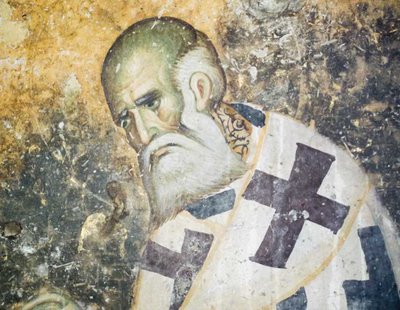

It will not be out of place to consider the ancient tradition, teaching and faith of the Catholic Church, which was revealed by the Lord, proclaimed by the apostles and guarded by the fathers. For upon this faith the Church is built, and if anyone were to lapse from it, he would no longer be a Christian either in fact or in name.

We acknowledge the Trinity, holy and perfect, to consist of the Father, the Son and the Holy Spirit. In this Trinity there is no intrusion of any alien element or of anything from outside, nor is the Trinity a blend of creative and created being. It is a wholly creative and energizing reality, self-consistent and undivided in its active power, for the Father makes all things through the Word and in the Holy Spirit, and in this way the unity of the holy Trinity is preserved. Accordingly, in the Church, one God is preached, one God who is above all things and through all things and in all things. God is above all things as Father, for he is principle and source; he is through all things through the Word; and he is in all things in the Holy Spirit.

Writing to the Corinthians about spiritual matters, Paul traces all reality back to one God, the Father, saying: Now there are varieties of gifts, but the same Spirit; and varieties of service, but the same Lord; and there are varieties of working, but it is the same God who inspires them all in everyone.

Even the gifts that the Spirit dispenses to individuals are given by the Father through the Word. For all that belongs to the Father belongs also to the Son, and so the graces given by the Son in the Spirit are true gifts of the Father. Similarly, when the Spirit dwells in us, the Word who bestows the Spirit is in us too, and the Father is present in the Word. This is the meaning of the text: My Father and I will come to him and make our home with him. For where the light is, there also is the radiance; and where the radiance is, there too are its power and its resplendent grace.

This is also Paul’s teaching in his second letter to the Corinthians: The grace of our Lord Jesus Christ and the love of God and the fellowship of the Holy Spirit be with you all. For grace and the gift of the Trinity are given by the Father through the Son in the Holy Spirit. Just as grace is given from the Father through the Son, so there could be no communication of the gift to us except in the Holy Spirit. But when we share in the Spirit, we possess the love of the Father, the grace of the Son and the fellowship of the Spirit himself.

Glory to the Father
and to the Son
and to the Holy Spirit:
as it was in the beginning,
is now, and will be forever. Amen


Ordinary Time
Saturday of the Eighth Week

“More desirable than gold, than a hoard of purest gold, Sweeter also than honey or drippings from the comb.” (Psalm 19, 11.)

Saint Basil the Great offers the following insight on this verse from today's Responsorial Psalm:

“Renunciation [is] the severance of the bonds of this material and transient life and freedom from human concerns, whereby we render ourselves more fit to set out on the road leading to God. It is the unhindered impulse toward the possession and enjoyment of inestimable goods, “more to be desired than gold and many precious stones.” In short, it is the transference of the human heart to a heavenly mode of life, so that we can say, “But our conversation is in heaven.” Also — and this is the chief point — it is the first step toward the likeness to Christ, who, being rich, became poor for our sake. Unless we attain to this likeness, it is impossible for us to achieve a way of life in accord with the gospel of Christ.” (The Long Rules, Q. 8)


Collect
Grant us, O Lord, we pray,
that the course of our world
may be directed by your peaceful rule
and that your Church may rejoice,
untroubled in her devotion.
Through our Lord Jesus Christ, Your Son,
Who lives and reigns with You
in the unity of the Holy Spirit,
one God, for ever and ever. Amen.


Glory to the Father
and to the Son
and to the Holy Spirit:
as it was in the beginning,
is now, and will be forever. Amen


Job was a type of Christ

Today’s Second Reading from the
Office of Readings (Liturgy of the Hours)
Ordinary Time: Saturday of the Eighth Week

An excerpt from:
Sermon (Tractate 15)
Saint Zeno of Verona
(bishop)

Is Job a type of Christ? If I am right, he is, and the comparison will reveal the truth of my claim. But while Job was called a just man by God, God himself is the fountain of justice from whom all the saints drink. See what Scripture says: The sun of justice will arise for you. Job was called truthful, but the Lord is, as he says in the Gospel, the way, the truth and the life. And while Job was rich, the Lord is far richer, for the earth is the Lord’s and everything in it; the world and all who dwell in it. All rich men are his servants, and the whole world and all of nature as well.

But we may compare Job and Christ in many ways. As Job was tempted by the devil three times, so too Christ was tempted three times. The Lord set aside his riches out of love for us and chose poverty so that we might become rich, while Job lost all that he possessed. A violent wind killed Job’s sons, while the sons of God, the prophets, were killed by the fury of the Pharisees. Job became ulcerated and disfigured, while the Lord, by becoming man, took on the defilement of the sins committed by all mankind. The wife of Job tempted him to sin, much as the synagogue tried to force the Lord to yield to corrupt leadership. Thus he was insulted by the priests, the servants of his altar, as Job was insulted by his friends. And as Job sat on a dunghill of worms, so all the evil of the world is really a dunghill which became the Lord’s dwelling place, while men that abound in every sort of crime and base desire are really worms.

The restoration of health and riches to Job prefigures the resurrection, which gives health and eternal life to those who believe in Christ. Regaining lordship over all the world, Christ says: All things have been given to me by my Father. And just as Job fathered other sons, so too did Christ, for the apostles, the sons of the Lord, succeeded the prophets.

Job died happily and in peace, but there is no death for the Lord. He is praised for ever, just as he was before time began, and as he always will be as time continues and moves into eternity.

Glory to the Father
and to the Son
and to the Holy Spirit:
as it was in the beginning,
is now, and will be forever. Amen


Ordinary Time
Friday of the Eighth Week

“Sing to the LORD a new song, his praise in the assembly of the faithful.” (Psalm 149, 1.)

Saint Augustine of Hippo comments on this verse from the Responsorial Psalm proclaimed at Mass today:

“My brothers and sisters, my children, O seedlings of the catholic church, O holy and heavenly seed, O you that have been born again in Christ and been born from above, listen to me — or rather, listen to God through me: “Sing to the Lord a new song.” “Well, I am singing,” you say. Yes, you are singing, of course you are singing, I can hear you. But do not let your life give evidence against your tongue. Sing with your voices, sing also with your hearts; sing with your mouths, sing also with your conduct. “Sing to the Lord a new song.” You ask what you should sing about the one you love? For of course you do want to sing about the one you love. You are asking for praises of his to sing. You have been told, “Sing to the Lord a new song.” You are looking for songs of praise, are you? “His praise is in the church of the saints.” The praise of the one to be sung about is the singer himself. Do you want to sing God his praises? Be yourselves what you sing. You are his praise if you lead good lives. His praise, you see, is not to be found in the synagogues of the Jews, or in the madness of the pagans, or in the errors of the heretics or in the applause of the theaters. You ask, “Where it is to be found?” Look at yourselves: you are it. “His praise is in the church of the saints.” You ask what to rejoice about when you are singing? “Let Israel rejoice in the one who made him,” and all he can find to rejoice about is God.” (Sermon 34, 6.)


Collect
Grant us, O Lord, we pray,
that the course of our world
may be directed by your peaceful rule
and that your Church may rejoice,
untroubled in her devotion.
Through our Lord Jesus Christ, Your Son,
Who lives and reigns with You
in the unity of the Holy Spirit,
one God, for ever and ever. Amen.


Glory to the Father
and to the Son
and to the Holy Spirit:
as it was in the beginning,
is now, and will be forever. Amen


The interior witness

Today’s Second Reading from the
Office of Readings (Liturgy of the Hours)
Ordinary Time: Friday of the Eighth Week

An excerpt from:
Moral Reflections on Job, (Book 10)
Saint Gregory the Great
(pope and Father of the Church)

Whoever is mocked by his friend, as I am, shall call upon God, and he shall hear him. A weak-minded person is frequently diverted toward pursuing exterior happiness when the breath of popular favor accompanies his good actions. So he gives up his own personal choices, preferring to remain at the mercy of whatever he hears from others. Thus, he rejoices not so much to become but to be called blessed. Eager for praise, he gives up what he had begun to be; and so he is severed from God by the very means by which he appeared to be commendable in God.

But sometimes a soul firmly strives for righteousness and yet is beset by men’s ridicule. He does what is admirable but he gets only mockery. He might have gone out of himself because of man’s praise; he returns to himself when repelled buy their abuse. Finding no resting-place without, he cleaves more intensely to God within. All his hope is fixed on his Creator, and amid all the ridicule and abuse he invokes his interior witness alone. One who is afflicted in this way grows closer to God the more he turns away from human popularity. He straightway pours himself out in prayer, and, pressured from without, he is refined with a more perfect purity to penetrate what is within.

In this context, the words apply: Whoever is mocked by his friend, as I am, shall call upon God, and he shall hear him. For while the wicked reproach the just, they show them whom they should look to as the witness of their actions. Thus afflicted, the soul strengthens itself by prayer; it is united within to one who listens from on high precisely because it is cut off externally from the praise of men. Again, we should note how appropriately the words, are inserted, as I am. There are some people who are both oppressed by human mockery and are yet deprived of God's favorable hearing. For when the mockery is done to a man’s own sin, it obviously does not produce the merit that is due to virtue.

The simplicity of the just man is laughed to scorn. It is the wisdom of this world to conceal the heart with stratagems, to veil one’s thoughts with words to make what is false appear true and what is true appear false. On the other hand it is the wisdom of the just never to pretend anything for show, always to use words to express one’s thoughts, to love the truth as it is and to avoid what is false, to do what is right without reward and to be more willing to put up with evil than to perpetrate it, not to seek revenge for wrong, and to consider as gain any insult for truth’s sake. But this guilelessness is laughed to scorn, for the virtue of innocence is held as foolishness by the wise of this world. Anything that is done out of innocence, they doubtless consider to be stupidity, and whatever truth approves of, in practice is called folly by their worldly wisdom.

Glory to the Father
and to the Son
and to the Holy Spirit:
as it was in the beginning,
is now, and will be forever. Amen


Ordinary Time
Thursday of the Eighth Week

“By the LORD’S word the heavens were made; by the breath of his mouth all their host.” (Psalm 33, 6.)

Saint Basil the Great offers the following insight on this verse from today's Responsorial Psalm:

“Where are those who set at naught the Spirit? Where are those who separate it from the creative power? Where are those who dissever it from union with the Father and Son? Let them hear the psalm that says, “By the word of the Lord the heavens were established; and all the power of them by the spirit of his mouth.” The term “Word” will not be considered as this common form of diction that consists of names and expressions; nor will the Spirit be considered as vapor poured out in the air but as the Word, which was in the beginning with God, and as the Holy Spirit, which has obtained appellation as its own. As, then, the Creator, the Word, firmly established the heavens, so the Spirit, which is from God, which proceeds from the Father, that is, which is from his mouth (that you may not judge that it is some external object or some creature but may glorify it as having its substance from God) brings with it all the powers in him. Since, then, the Savior is the Word of the Lord and the Holy Spirit is the Spirit from his mouth, both joined with him in the creation of the heavens and the powers in them, and for this reason the statement was made: “By the word of the Lord the heavens were established; and all the power of them by the spirit of his mouth.” For nothing is made holy except by the presence of the Spirit.” (Homilies on the Psalms, 15)


Collect
Grant us, O Lord, we pray,
that the course of our world
may be directed by your peaceful rule
and that your Church may rejoice,
untroubled in her devotion.
Through our Lord Jesus Christ, Your Son,
Who lives and reigns with You
in the unity of the Holy Spirit,
one God, for ever and ever. Amen.


Glory to the Father
and to the Son
and to the Holy Spirit:
as it was in the beginning,
is now, and will be forever. Amen


The law of the Lord is manifold

Today’s Second Reading from the
Office of Readings (Liturgy of the Hours)
Ordinary Time: Thursday of the Eighth Week

An excerpt from:
Moral Reflections on Job, (Book 10)
Saint Gregory the Great
(pope and Father of the Church)

How must we interpret this law of God? How, if not by love? The love that stamps the precepts of right-living on the mind and bids us put them into practice. Listen to Truth speaking of this law: This is my commandment, that you love one another. Listen to Paul: The whole law, he declares, is summed up in love; and again: Help one another in your troubles, and you will fulfill the law of Christ. The law of Christ—does anything other than love more fittingly describe it? Truly we are keeping this law when, out of love, we go to the help of a brother in trouble.

But we are told that this law is manifold. Why? Because love’s lively concern for others is reflected in all the virtues. It begins with two commands, but it soon embraces many more. Paul gives a good summary of its various aspects. Love is patient, he says, and kind; it is never jealous or conceited; its conduct is blameless; it is not ambitious, not selfish, not quick to take offense; it harbors no evil thoughts, does not gloat over other people’s sins, but is gladdened by an upright life.

The man ruled by this love shows his patience by bearing wrongs with equanimity; his kindness by generously repaying good for evil. Jealousy is foreign to him. It is impossible to envy worldly success when he has no worldly desires. He is not conceited. The prizes he covets lie within; outward blessings do not elate him. His conduct is blameless, for he cannot do wrong in devoting himself entirely to love of God and his neighbor. He is not ambitious. The welfare of his own soul is what he cares about. Apart from that he seeks nothing. He is not selfish. Unable to keep anything he has in this world, he is as indifferent to it as if it were another’s. Indeed, in his eyes nothing is his own but what will be so always. He is not quick to take offense. Even under provocation, thought of revenge never crosses his mind. The reward he seeks hereafter will be greater in proportion to his endurance. He harbors no evil thoughts. Hatred is utterly rooted out of a heart whose only love is goodness. Thoughts that defile a man can find no entry. He does not gloat over other people’s sins. No; an enemy’s fall affords him no delight, for loving all men, he longs for their salvation.

On the other hand, he is gladdened by an upright life. Since he loves others as himself, he takes as much pleasure in whatever good he sees in them as if the progress were his own. That is why this law of God is manifold.

Glory to the Father
and to the Son
and to the Holy Spirit:
as it was in the beginning,
is now, and will be forever. Amen


Ordinary Time
Wednesday of the Eighth Week

“Help us, God our savior, on account of the glory of your name. Deliver us, pardon our sins for your name’s sake.” (Psalm 79, 9.)

Saint Augustine of Hippo comments on this verse from the Responsorial Psalm proclaimed at Mass today:

“As for those who insult over them in their trials, and when ills befall them say, “Where is thy God?” we may ask them where their gods are when they suffer the very calamities for the sake of avoiding which they worship their gods, or maintain they ought to be worshipped; for the family of Christ is furnished with its reply: our God is everywhere present, wholly everywhere; not confined to any place. He can be present unperceived, and be absent without moving; when he exposes us to adversities, it is either to prove our perfections or correct our imperfections; and in return for our patient endurance of the sufferings of time, he reserves for us an everlasting reward. But who are you, that we should deign to speak with you even about your own gods, much less about our God, who is “to be feared above all gods? For all the gods of the nations are idols; but the Lord made the heavens.” (City of God, 1.)


Collect
Grant us, O Lord, we pray,
that the course of our world
may be directed by your peaceful rule
and that your Church may rejoice,
untroubled in her devotion.
Through our Lord Jesus Christ, Your Son,
Who lives and reigns with You
in the unity of the Holy Spirit,
one God, for ever and ever. Amen.


Glory to the Father
and to the Son
and to the Holy Spirit:
as it was in the beginning,
is now, and will be forever. Amen


All my hope lies in your great mercy

Today’s Second Reading from the
Office of Readings (Liturgy of the Hours)
Ordinary Time: Wednesday of the Eighth Week


An excerpt from: The Confessions (Book 10)
Saint Augustine
(bishop and Father of the Church)

Where did I find you, that I came to know you? You were not within my memory before I learned of you. Where, then, did I find you before I came to know you, if not within yourself, far above me? We come to you and go from you, but no place is involved in this process. In every place, O Truth, you are present to those who seek your help, and at one and the same time you answer all, though they seek your counsel on different matters.

You respond clearly, but not everyone hears clearly. All ask what they wish, but do not always hear the answer they wish. Your best servant is he who is intent not so much on hearing his petition answered, as rather on willing whatever he hears from you.

Late have I loved you, O beauty ever ancient, ever new, late have I loved you! You were within me, but I was outside, and it was there that I searched for you. In my unloveliness I plunged into the lovely things which you created. You were with me, but I was not with you. Created things kept me from you; yet if they had not been in you they would not have been at all. You called, you shouted, and you broke through my deafness. You flashed, you shone, and you dispelled my blindness. You breathed your fragrance on me; I drew in breath and now I pant for you. I have tasted you; now I hunger and thirst for more. You touched me, and I burned for your peace.

When once I shall be united to you with my whole being, I shall at last be free of sorrow and toil. Then my life will be alive, filled entirely with you. When you fill someone, you relieve him of his burden, but because I am not yet filled with you, I am a burden to myself. My joy when I should be weeping struggles with my sorrows when I should be rejoicing. I know not where victory lies. Woe is me! Lord, have mercy on me! My evil sorrows and good joys are at war with one another. I know not where victory lies. Woe is me! Lord, have mercy! Woe is me! I make no effort to conceal my wounds. You are my physician, I your patient. You are merciful; I stand in need of mercy.

Is not the life of man upon earth a trial? Who would want troubles and difficulties? You command us to endure them, not to love them. No person loves what he endures, though he may love the act of enduring. For even if he is happy to endure his own burden, he would still prefer that the burden not exist. I long for prosperity in times of adversity, and I fear adversity when times are good. Yet what middle ground is there between these two extremes where the life of man would be other than trial? Pity the prosperity of this world, pity it once and again, for it corrupts joy and brings the fear of adversity. Pity the adversity of this world, pity it again, then a third time; for it fills men with a longing for prosperity, and because adversity itself is hard for them to bear and can even break their endurance. Is not the life of man upon earth a trial, a continuous trial?

Glory to the Father
and to the Son
and to the Holy Spirit:
as it was in the beginning,
is now, and will be forever. Amen


Rejoice in the Lord always

Today’s Second Reading from the
Office of Readings (Liturgy of the Hours)
Ordinary Time: Tuesday of the Eighth Week

Saint Philip Neri

An excerpt from: Sermon 171
Saint Augustine
(bishop and Father of the Church)

The Apostle tells us to rejoice, but in the Lord, not in the world. Whoever wishes to be a friend of this world, says Scripture, will be reckoned an enemy of God. As a man cannot serve two masters, so one cannot rejoice both in the world and in the Lord.

Let joy in the Lord prevail, then, until joy in the world is no more. Let joy in the Lord go on increasing; let joy in the world go on decreasing until it is no more. This is said, not because we are not to rejoice while we are in this world, but in order that, even while we are still in this world, we may already rejoice in the Lord.

You may object: I am in the world; if I rejoice I certainly rejoice where I am. What is this? Do you mean that because you are in the world you are not in the Lord? Listen again to the Apostle, speaking now to the Athenians: in the Acts of the Apostles he says this is of God and the Lord our creator: In him we live and move and have our being. If he is everywhere, where is he not? Surely this was what he was exhorting us to realize. The Lord is near, do not be anxious about anything.

This is a great truth, that he ascended above all the heavens, yet is near to those on earth. Who is this stranger and neighbor if not the one who became our neighbor out of compassion? The man lying on the road, left half-dead by robbers, the man treated with contempt by the priest and the levite who passed by, the man approached by the passing Samaritan to take care of him and help him, that man is the whole human race. When the immortal one, the holy one, was far removed from us because we were mortal and sinners, he came down to us, so that he, the stranger, might become our neighbor.

He did not treat us as our sins deserved. For we are now sons of God. How do we show this? The only Son of God died for us, so that he might not remain alone. He who died as the only Son did not want to remain as the only Son. For the only Son of God made many sons of God. he bought brothers for himself by his blood; he made them welcome by being rejected; he ransomed them by being sold; he honored them by being dishonored; he gave them life by being put to death.

So, brethren, rejoice in the Lord, not in the world. That is, rejoice in the truth, not in wickedness; rejoice in the hope of eternity, not in the fading flower of vanity. That is the way to rejoice. Wherever you are on earth, however long you remain on earth, the Lord is near, do not be anxious about anything.

Glory to the Father
and to the Son
and to the Holy Spirit:
as it was in the beginning,
is now, and will be forever. Amen