You shall be my witnesses

Today’s Second Reading from the
Office of Readings (Liturgy of the Hours)
Ordinary Time Week 4: Friday

Memorial of Saint Paul Miki and Companions

From an account of the martyrdom of Saint Paul Miki and his companions
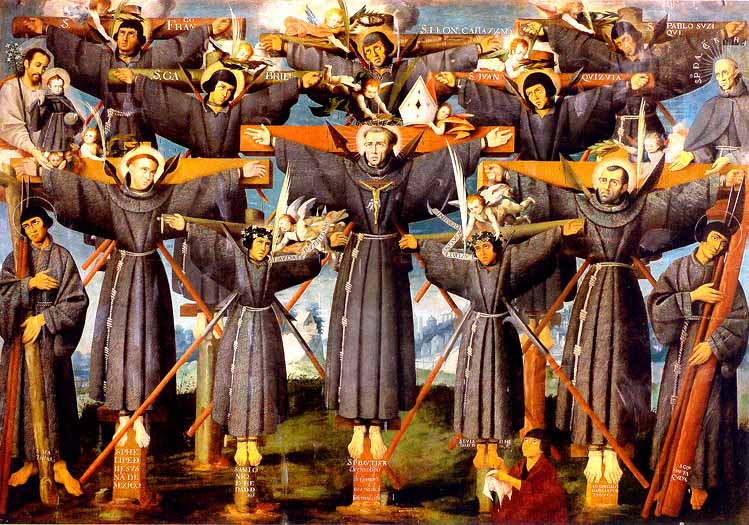

The crosses were set in place. Father Pasio and Father Rodriguez took turns encouraging the victims. Their steadfast behavior was wonderful to see. The Father Bursar stood motionless, his eyes turned heavenward. Brother Martin gave thanks to God’s goodness by singing psalms. Again and again he repeated: “Into your hands, Lord, I entrust my life.” Brother Francis Branco also thanked God in a loud voice. Brother Gonsalvo in a very loud voice kept saying the Our Father and Hail Mary.

Our brother, Paul Miki, saw himself standing now in the noblest pulpit he had ever filled. To his “congregation” he began by proclaiming himself a Japanese and a Jesuit. He was dying for the Gospel he preached. He gave thanks to God for this wonderful blessing and he ended his “sermon” with these words: “As I come to this supreme moment of my life, I am sure none of you would suppose I want to deceive you. And so I tell you plainly: there is no way to be saved except the Christian way. My religion teaches me to pardon my enemies and all who have offended me. I do gladly pardon the Emperor and all who have sought my death. I beg them to seek baptism and be Christians themselves.”

Then he looked at his comrades and began to encourage them in their final struggle. Joy glowed in all their faces, and in Louis’ most of all. When a Christian in the crowd cried out to him that he would soon be in heaven, his hands, his whole body strained upward with such joy that every eye was fixed on him.

Anthony, hanging at Louis’ side, looked toward heaven and called upon the holy names—“Jesus, Mary!” He began to sing a psalm: “Praise the Lord, you children!” (He learned it in catechism class in Nagasaki. They take care there to teach the children some psalms to help them learn their catechism.)

Others kept repeating “Jesus, Mary!” Their faces were serene. Some of them even took to urging the people standing by to live worthy Christian lives. In these and other ways they showed their readiness to die.

Then, according to Japanese custom, the four executioners began to unsheathe their spears. At this dreadful sight, all the Christians cried out, “Jesus, Mary!” And the storm of anguished weeping then rose to batter the very skies. The executioners killed them one by one. One thrust of the spear, then a second blow. It was over in a very short time.


Glory to the Father
and to the Son
and to the Holy Spirit:
as it was in the beginning,
is now, and will be forever. Amen


— Saint Paul Miki and Companions —
Ordinary Time Week 4: Friday
 

“Let mutual love continue. Do not neglect hospitality, for through it some have unknowingly entertained angels.” (Hebrews 13:1-2)

In commenting on these verses from today’s First Reading, Saint John Chrysostom writes:

“See how he enjoins them to preserve what they had; he does not add other things. He did not say, “Be loving as brothers,” but “Let brotherly love continue.” And again, he did not say, “Be hospitable,” as if they were not, but “Do not neglect to show hospitality,” for this neglect was likely to happen, due to their afflictions.

Therefore, he says, “Some have entertained angels unawares.” Do you see how great was the honor, how great the gain! What is “unawares”? They entertained them without knowing it. Therefore, the reward also was great, because he entertained them, not knowing that they were angels. If he had known it, it would have been nothing wonderful. Some say that he here alludes to Lot also.” (On the Epistle to the Hebrews, 33)


Collect
O God, strength of all the Saints,
who through the Cross were pleased to call
the Martyrs Saint Paul Miki and companions to life,
grant, we pray, that by their intercession
we may hold with courage even until death
to the faith that we profess.
Through our Lord Jesus Christ, your Son,
Who lives and reigns with You
in the unity of the Holy Spirit,
one God, for ever and ever. Amen.


Glory to the Father
and to the Son
and to the Holy Spirit:
as it was in the beginning,
is now, and will be forever. Amen


The gift of God, the source of all goodness

Today’s Second Reading from the
Office of Readings (Liturgy of the Hours)
Ordinary Time Week 4: Thursday

Memorial of Saint Agatha

From a homily on Saint Agatha
Saint Methodius of Sicily (also, Constantinople)
(bishop)

My fellow Christians, our annual celebration of a martyr’s feast has brought us together. She achieved renown in the early Church for her noble victory; she is well known now as well, for she continues to triumph through her divine miracles, which occur daily and continue to bring glory to her name.

She is indeed a virgin, for she was born of the divine Word, God’s only Son, who also experienced death for our sake. John, a master of God’s word, speaks of this: He gave the power to become children of God to everyone who received him.

The woman who invites us to this banquet is both a wife and virgin. To use the analogy of Paul, she is the bride who has been betrothed to one husband, Christ. A true virgin, she wore the glow of pure conscience and the crimson of the Lamb’s blood for her cosmetics. Again and again she meditated on the death of her eager lover. For her, Christ’s death was recent, his blood was still moist. Her robe is the mark of her faithful witness to Christ. It bears the indelible marks of his crimson blood and the shining threads of her eloquence. She offers to all who come after her these treasures of her eloquent confession.

Agatha, the name of our saint, means “good.” She was truly good, for she lived as a child of God. She was also given as the gift of God, the source of all goodness to her bridegroom, Christ, and to us. For she grants us a share in her goodness.

What can give greater good than the Sovereign Good? Whom could anyone find more worthy of celebration with hymns of praise than Agatha?

Agatha, her goodness coincides with her name and way of life. She won a good name by her noble deeds, and by her name she points to the nobility of those deeds. Agatha, her mere name wins all men over to her company. She teaches them by her example to hasten with her to the true Good. God alone.


Glory to the Father
and to the Son
and to the Holy Spirit:
as it was in the beginning,
is now, and will be forever. Amen


— Saint Agatha —
Ordinary Time Week 4: Thursday
 

“No, you have approached Mount Zion and the city of the living God, the heavenly Jerusalem, and countless angels in festal gathering and the assembly of the firstborn enrolled in heaven, and God the judge of all, and the spirits of the just made perfect and Jesus, the mediator of a new covenant, and the sprinkled blood that speaks more eloquently than that of Abel.” (Hebrews 12:22-24)

In commenting on these verses from today’s First Reading, Saint John Chrysostom writes:

“From the first, therefore, the Israelites were themselves the cause of God’s being manifested through the flesh. Let Moses speak with us, and “Let not God speak with us.” They who make comparisons elevate the one side more that they may show the other to be far greater. In this respect also our privileges are more gentle and more admirable. For they are great in a twofold respect, because, while they are glorious and greater, they are more accessible. This he says also in the epistle to the Corinthians, “with unveiled face,” and “not as Moses put a veil over his face.” They, he means, were not counted worthy as we are. For of what were they thought worthy? They saw “darkness, gloom”; they heard “a voice.” But you also have heard a voice, not through darkness but through flesh. You have not been disturbed, neither troubled, but you have stood and held discourse with the Mediator.

And in another way, by the “darkness” he shows the invisibleness. “And darkness,” it says, “was under his feet.” Then even Moses feared, but now no one. The Son is near to God, but not as Moses. There was a wilderness, here a city. “And to innumerable angels.” Here he shows the joy, the delight, in place of the “darkness” and “gloom” and “tempest.” “And to the assembly and church of the firstborn who are enrolled in heaven, and to a judge who is God of all.” They did not draw near but stood afar off, even Moses, but “you have come near.” Here he makes them stand in awe by saying, “And to a judge who is God of all,” not of the Jews alone and the faithful, but even of the whole world. “And to the spirits of just men made perfect.” He means the souls of those who are approved.” (On the Epistle to the Hebrews, 32)


Collect
May the Virgin Martyr Saint Agatha
implore your compassion for us,
O Lord, we pray,
for she found favor with you
by the courage of her martyrdom
and the merit of her chastity.
Through our Lord Jesus Christ, your Son,
Who lives and reigns with You
in the unity of the Holy Spirit,
one God, for ever and ever. Amen.


Glory to the Father
and to the Son
and to the Holy Spirit:
as it was in the beginning,
is now, and will be forever. Amen


Ordinary Time Week 4: Wednesday
 

“So strengthen your drooping hands and your weak knees. Make straight paths for your feet, that what is lame may not be dislocated but healed.” (1 Hebrews 12:12-13)

In commenting on these verses from today’s First Reading, Saint John Chrysostom writes:

“Do not wonder if discipline, being itself hard, has sweet fruits; since in trees also the bark is almost destitute of all quality and rough, but the fruits are sweet. Why, after you have endured the painful, are you despondent as to the good? The distasteful things that you had to endure you endured. Do not then become despondent when you are rewarded. He speaks as to runners and boxers and warriors. Do you see how he arms them, how he encourages them? “Walk straight,” he says. Here he speaks with reference to their thoughts; that is to say, not doubting. For if the discipline be of love, if it begin from loving care, if it end with a good result (and this he proves both by facts and by words, and by all considerations), why are you dispirited? For such are they who despair, who are not strengthened by the hope of the future. “Walk straight,” he says, that your lameness may not be increased but brought back to its former condition. For he that runs when he is lame galls the sore place. Do you see that it is in our power to be thoroughly healed?” (On the Epistle to the Hebrews, 30)


Collect
Grant us, Lord our God,
that we may honor you with all our mind,
and love everyone in truth of heart.
Through our Lord Jesus Christ, your Son,
Who lives and reigns with You
in the unity of the Holy Spirit,
one God, for ever and ever. Amen.


Glory to the Father
and to the Son
and to the Holy Spirit:
as it was in the beginning,
is now, and will be forever. Amen


In Christ are the firstfruits of the Resurrection

Today’s Second Reading from the
Office of Readings (Liturgy of the Hours)
Ordinary Time Week 4: Tuesday

An excerpt from:
Against Heresies
Saint Irenaeus of Lyons
(bishop, martyr and Father of the Church)

The Word of God became man, the Son of God became the Son of Man, in order to unite man with himself and make him, by adoption, a son of God. Only by being united to one who is himself immune could we be preserved from corruption and death, and how else could this union have been achieved if he had not first become what we are? How else could what is corruptible and mortal in us have been swallowed up in his incorruptibility and immortality, to enable us to receive adoptive sonship? Therefore, the Son of God, our Lord, the Word of the Father, is also the son of man; he became the son of a man by a human birth from Mary, a member of the human race.

The Lord himself has given us a sign here below and in the heights of heaven, a sign that man did not ask for because he never dreamt that such a thing would be possible. A virgin was with a child and she bore a son who is called Emmanuel, which means “God with us.” He came down to the earth here below in search of the sheep that was lost, the sheep that was in fact his own creature, and then ascended into the heights of heaven to offer to the Father and entrust to his care the human race that he had found again. The Lord himself became the firstfruits of the resurrection of mankind, and when its time of punishment for disobedience is over, the rest of the body, to which the whole human race belongs, will rise from the grave as the head has done. By God’s aid it will grow and be strengthened in all its joints and ligaments, each member having its own proper place in the body. There are many rooms in the Father’s house because the body has many members.

God bore with man patiently when he fell because he foresaw the victory that would be his through the Word. Weakness allowed strength its full play, and so revealed God’s kindness and great power.


Glory to the Father
and to the Son
and to the Holy Spirit:
as it was in the beginning,
is now, and will be forever. Amen


Ordinary Time Week 4: Tuesday
 

“... while keeping our eyes fixed on Jesus, the leader and perfecter of faith. For the sake of the joy that lay before him he endured the cross, despising its shame, and has taken his seat at the right of the throne of God.” (Hebrews 12:2)

Saint Gregory of Nyssa (part 2 of the background of Saint Gregory of Nyssa is found here) offers the following insight on this verse from today’s First Reading:

“A fire that lies in wood hidden below the surface is often unobserved by the senses of those who see or even touch it but is manifest when it blazes up. So too, at his death (which he brought about at his will, who separated his soul from his body; who said to his own Father, “Into your hands I commit my spirit” who, as he says, “had power to lay it down and had power to take it again”) he — who, because he is the lord of glory, despised that which is shame among men — having concealed, as it were, the flame of his life in his bodily nature, by the dispensation of his death, kindled and inflamed it once more by the power of his own Godhead, fostering into life that which had been brought to death. Having infused with the infinity of his divine power that humble firstfruits of our nature, he made it also to be that which he himself was — making the servile form to be Lord, and the human born of Mary to be Christ, and him who was crucified through weakness to be life and power, and making all that is piously conceived to be in God the Word to be also in that which the Word assumed. Thus these attributes no longer seem to be in either nature by way of division, but the perishable nature, being, by its commixture with the divine, made anew in conformity with the nature that overwhelms it, participates in the power of the Godhead, as if one were to say that mixture makes a drop of vinegar mingled in the deep to be sea, by reason that the natural quality of this liquid does not continue in the infinity of that which overwhelms it. This is our doctrine.” (Against Eunomius, 5)


Collect
Grant us, Lord our God,
that we may honor you with all our mind,
and love everyone in truth of heart.
Through our Lord Jesus Christ, your Son,
Who lives and reigns with You
in the unity of the Holy Spirit,
one God, for ever and ever. Amen.


Glory to the Father
and to the Son
and to the Holy Spirit:
as it was in the beginning,
is now, and will be forever. Amen


Feast of the
— Presentation of the Lord —
 

“Now I am sending my messenger — he will prepare the way before me; And the lord whom you seek will come suddenly to his temple; The messenger of the covenant whom you desire — see, he is coming! says the LORD of hosts.” (Malachi 3:1)

Saint Augustine of Hippo comments on this verse from the Second Reading proclaimed at Mass today:

“Speaking further of Christ in the same vein, Malachi says, “Behold, I send my angel, and he shall prepare the way before my face. And presently the Lord, whom you seek, and the angel of the testament whom you desire, shall come into the temple. Behold, he comes, says the Lord of hosts. And who shall be able to think of the day of his coming? And who shall stand to see him?” In this text he foretells both comings of Christ, the first and the second — the first where he says, “And presently the Lord shall come into his temple.” This refers to Christ’s body, of which he himself said in the Gospel, “Destroy this temple, and in three days I will raise it up.”1 His second coming is foretold in these words: “‘Behold, he comes,’ says the Lord of hosts. ‘And who shall be able to think of the day of his coming? And who shall stand to see him?’” (City of God, 18)


Collect
Almighty ever-living God,
we humbly implore your majesty
that, just as your Only Begotten Son
was presented on this day in the Temple
in the substance of our flesh,
so, by your grace,
we may be presented to you with minds made pure.
Through our Lord Jesus Christ, your Son,
Who lives and reigns with You
in the unity of the Holy Spirit,
one God, for ever and ever. Amen.


Glory to the Father
and to the Son
and to the Holy Spirit:
as it was in the beginning,
is now, and will be forever. Amen


—The Lord’s Day—
Ordinary Time Week 4: Sunday
 

“What have you to do with us, Jesus of Nazareth? Have you come to destroy us? I know who you are—the Holy One of God!” (Mark 1:24)

Saint Augustine of Hippo comments on this verse from the Second Reading proclaimed at Mass today:

“Call to mind with me the time when Peter was praised and called blessed. Was it because he merely said, “You are the Christ, the Son of the living God”? No, he who pronounced him blessed regarded not merely the sound of his words, but the affections of his heart. Compare that with the words of the demons who said almost the same thing: “We know who you are, the Son of God,” just as Peter had confessed him as “Son of God.” So what is the difference? Peter spoke in love, but the demons in fear. So tell us how faith is to be defined, if even the devils can believe and tremble? Only the faith that works by love is faith.” (Sermons on New Testament Lessons, 40)


Collect
Grant us, Lord our God,
that we may honor you with all our mind,
and love everyone in truth of heart.
Through our Lord Jesus Christ, your Son,
Who lives and reigns with You
in the unity of the Holy Spirit,
one God, for ever and ever. Amen.


Glory to the Father
and to the Son
and to the Holy Spirit:
as it was in the beginning,
is now, and will be forever. Amen


— Saint John Bosco —
Ordinary Time Week 3: Saturday
 

“So it was that there came forth from one man, himself as good as dead, descendants as numerous as the stars in the sky and as countless as the sands on the seashore.” (Hebrews 11:12)

Saint Gregory of Nyssa (part 2 of the background of Saint Gregory of Nyssa is found here) offers the following insight on this verse from today’s First Reading:

“Let [the one who is waiting for the Lord’s second coming] therefore wait for that time then which is, necessarily, in the same time frame as the development of humanity. For even while Abraham and the patriarchs desired to see the promised better things, they did not stop seeking the heavenly country. This is what the apostle says when he declares that even now they are in a condition of hoping for that grace: “God having provided some better thing for us,” according to the words of Paul, “that they without us should not be made perfect.” If those then, who by faith alone and by hope saw the good things “afar off ” and “embraced them”—if they bear the delay as the apostle bears witness, and if they place the certainty that they will enjoy the things for which they hoped in the fact that they “judged him faithful who has promised,” what should the rest of us do who perhaps do not have a grasp of that better hope from the character of our own lives?

Even the prophet’s soul fainted with desire, and in his psalm he confesses this passionate love, saying that his “soul has a desire and longing to be in the courts of the Lord.” [He still has this desire] even if he has to be demoted to a place amongst the lowest, since it is a greater and more desirable thing to be last there than to be first among the ungodly tents of this life. Nevertheless he was patient during the delay, considering, indeed, the life there blessed, and accounting a brief participation in it more desirable than “thousands”[of days] of time. For, he says, “one day in your courts is better than thousands.” And yet, he did not become dejected at the necessary dispensation concerning existing things. He thought it was sufficient bliss for a person to have those good things even by way of hope. This is why he says at the end of the psalm, “O Lord of hosts, blessed is the man that hopes in you.” (On the Making of Man, 22)


Collect
O God,
who raised up the Priest Saint John Bosco
as a father and teacher of the young,
grant, we pray,
that, aflame with the same fire of love,
we may seek out souls and serve you alone.
Through our Lord Jesus Christ, Your Son,
Who lives and reigns with You
in the unity of the Holy Spirit,
one God, for ever and ever. Amen.


Glory to the Father
and to the Son
and to the Holy Spirit:
as it was in the beginning,
is now, and will be forever. Amen